Toxoplasmosis spread by cats poses growing threat to endangered nēnē, public health

Nēnē, Hawaiʻi’s state bird, face a growing threat not just from predators—but from disease. Feral and free-roaming cats are transmitting toxoplasmosis, a parasitic disease that is increasingly killing these endangered geese, according to conservationists at Pacific Birds Habitat Joint Venture.
Despite appearing common in places like Kaua‘i’s North Shore, there are fewer than 4,000 wild individual wild birds remaining in the world. They are listed as an Endangered Species by the Hawaiʻi Department of Land and Natural Resources.
The nēnē is the last surviving member of at least seven species of geese that evolved in Hawaiʻi. Most of these species were large and flightless; one was blind and burrowed underground like a mole; yet all of them went extinct except the nēnē.
The nēnē retained its ability to fly and developed a “sassy” personality to go with it. Their unusual neck patterning makes them stand out, and they have become an iconic symbol of Hawaiʻi as the State bird.
Despite their resilience, nēnē are still vulnerable, especially the young. Feral cats prey on goslings and spread toxoplasmosis through feces. As outdoor cat feeding stations have increased across the islands, so too have toxoplasmosis cases. The US Geological Survey’s National Wildlife Health Center has already reported a record number of cases in nēnē this year.

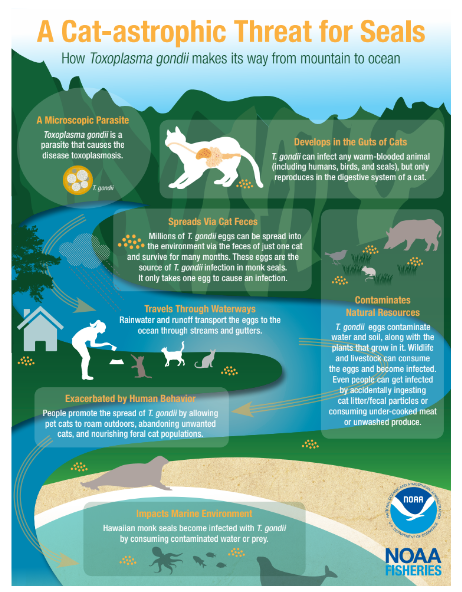
Nēnē and other animals become infected through contact with contaminated soil or water. Feline feces can enter wetlands, rivers and oceans, exposing not just birds but also marine mammals such as Hawaiian monk seals (ʻilio holo i ka uaua) and spinner dolphins (naiʻa), which are also affected by the disease.
Pacific Birds Habitat says that should worry everyone. Toxoplasmosis can be deadly to humans, causing miscarriage and birth defects in pregnant women and sickness in people with compromised immune systems. Recent research also suggests that it affects male fertility, with a 2025 study showing that human sperm are decapitated when they come into contact with the parasite.
“The nēnē are our canary in the coal mine – they tell us that levels of toxoplasmosis in the environment are too high,” the group articulated.
Cats are the primary host of the parasite Toxoplasma gondii which is responsible for the
toxoplasmosis infection, and the only source of oocysts (parasite eggs) which they pass
on in their feces. A single cat can excrete hundreds of millions of infectious oocysts and
just one oocyst is sufficient to infect people and other animals.
Pacific Birds Habitat says the occurrence of toxoplasmosis is directly linked to the high numbers of outdoor cats in Hawaiʻi.
To reduce the spread, conservation groups are urging communities to stop outdoor cat feeding stations across the islands and to encourage responsible pet ownership by keeping cats indoors.
Such actions, they say, will help protect Hawaiʻi’s endangered wildlife and safeguard public health.
The US Fish & Wildlife Service Migratory Bird Program and other federal and state agencies provide core funds for Pacific Birds Habitat Joint Venture operations in areas of the Pacific and Alaska.
Q&A with Pacific Birds Habitat Joint Venture
Q: Will stopping outdoor cat feeding cruelly starve cats?
A: Providing food for outdoor cats and cat colonies allows more cats to live on the landscape, resulting in even more cats in a given area. These food sources also increase other species, such as rats, which are also a human health hazard.
Q: Doesn’t feeding cats mean that they don’t need to hunt birds?
A: Cats are instinctive predators that hunt and kill birds regardless of whether they’re hungry. Feeding cats may result in more birds killed over a longer period by increasing their fitness and numbers.
Q: Does eliminating cats result in more rats?
A: No. Scientific studies (e.g., Glass et al. 2009, Parsons et al. 2018) have shown that cats are not effective at controlling rat populations.
Q: Do feral cats spread disease to people?
A: Yes – The Centers for Disease Control and Prevention states that “cats play an important role in the spread of toxoplasmosis” and recognizes the risks of exposure to humans.
Q: Isn’t it rare for someone to catch toxoplasmosis from a cat? And if a cat is infected with Toxoplasma, it typically only sheds the disease-spreading oocysts for a few weeks.
A: Toxoplasmosis is an infection caused by the parasite Toxoplasma gondii, which is common worldwide. In the US, over 40 million people may be infected, though most show no symptoms a healthy person’s immune system can cope with the infection. However, it can cause serious health issues in pregnant women and those with weakened immune systems. However, for pregnant women and individuals who have compromised immune systems, a Toxoplasma infection could be serious (CDC, 2022,
https://www.cdc.gov/parasites/toxoplasmosis/gen_info/faqs.html)
Q: Are adult cats immune – so they can’t spread the disease?
A: Cats, regardless of their age, can excrete Toxoplasma gondii oocysts in their feces multiple times throughout their lives. A single oocyst is sufficient to cause infection. Tenter et al. (2000) stated, “It has previously been believed that shedding of oocysts…is rare. However, recent studies showed that this immunity does not persist for the life of the cat.” Zulpo et al. (2018) further found that re-shedding of T. gondii oocysts by re-infected adult cats was only 30% lower than that from kittens.
Q: Isn’t the leading cause of human toxoplasmosis the ingestion of undercooked meat?
A: The Centers for Disease Control and Prevention acknowledges the serious risks of environmental oocyst exposure, as well as exposure from consuming contaminated meats. It is important to remember, however, that cats are the only definitive host of Toxoplasma gondii and the only source of oocysts. Thus, all roads lead back to cats when it comes to infection; contaminated meats are the result, ultimately, of feline- excreted oocyst exposure. Furthermore, Aguirre et al. (2019) stated, “Recent studies have demonstrated that undetected environmental oocyst transmission is the major route of T. gondii transmission presenting a direct public and animal health problem.” Among congenital toxoplasmosis cases from four outbreaks in North America, 78% were caused by oocyst exposure (Boyer et al. 2011).
Source: Pacific Birds Habitat Joint Venture, US Geological Survey, CDC and peer-reviewed studies.
Sponsored Content