Update: Council committee votes 6-3 to approve vacation rental phase-out bill
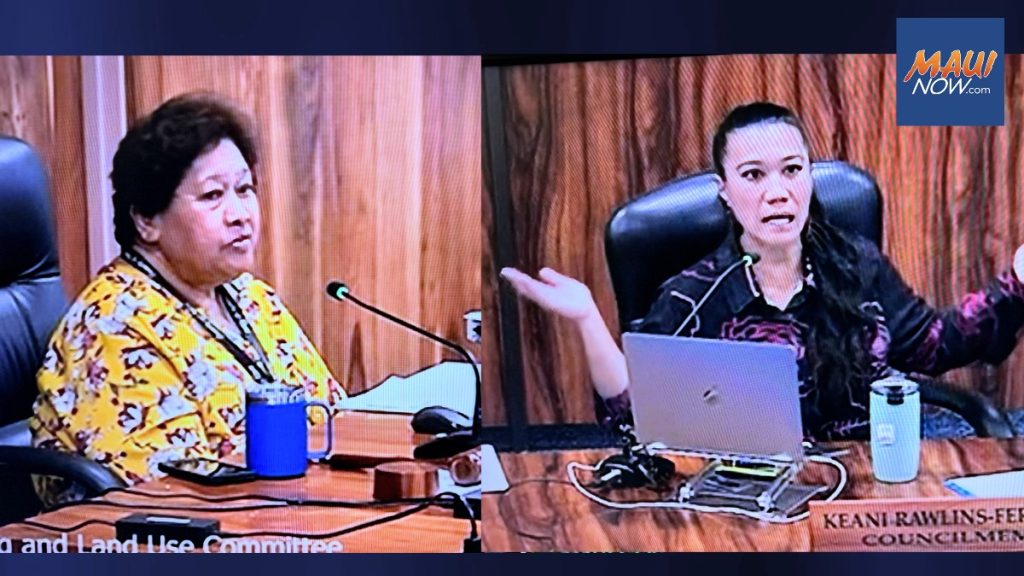
Members of the Maui County Council’s Housing and Land Use Committee voted 6-3 on Thursday to recommend passage of Bill 9 on first reading, reaching a milestone in a review process that saw more than 300 people testify for and against the bill over the course of five days this summer.
The measure would phase-out more than 7,000 transient vacation rentals over three to five years in apartment-zoned districts, first in West Maui, then in the rest of Maui County. As amended by the committee, the phase-out would start in 2028 in West Maui, which lost thousands of homes in the August 2023 wildfires, and begin in 2030 in the rest of Maui County.
The bill predominantly affects vacation rentals in West and South Maui, where the highest concentrations of those units are in apartment-zoned areas. The bills advances to first reading before the full Council.
Two members of the Council’s majority — Chair Alice Lee (with reservations) and Council Member Nohelani Uʻu-Hodgins — voted “aye” along with minority members Keani Rawlins-Fernandez, Tamara Paltin, Shane Sinenci and Gabe Johnson. Committee Chair Tasha Kama and Council Members Yuki Lei Sugimura and Tom Cook voted “no.”
The committee’s final vote received cheers and applause from those assembled in the Council Chamber gallery.
Fueled by Maui’s ongoing housing crisis, the bill introduced by Mayor Richard Bissen in May 2024 is aimed at converting short-term vacation rentals to long-term residential units, which is the purpose of apartment-zoned districts.
The mayor released a statement late Thursday afternoon, saying: “Mahalo to Committee Chair Kama and the members of the Housing and Land Use Committee for their thoughtful deliberation and work in advancing Bill 9. I also extend my deep appreciation to every community member and organization who took the time to speak, write, or show up throughout this process. While we still await final readings before the full Council, today’s vote marks a monumental step forward. We’re especially grateful for the Council’s willingness to collaborate with the administration to help pave the way for successful implementation. Bill 9 is a critical first step in restoring our commitment to prioritize housing for local residents — and securing a future where our keiki can live, grow, and thrive in the place they call home.”
The mayor and members of his administration made their case for passage of Bill 9 on June 9, the first day of committee hearings on the measure.
Before the committee’s final vote, committee members each took a couple of minutes to explain their votes for or against passage of Bill 9, as amended. The bill anticipates the creation of a temporary investigative group to address problems with the measure as they arise.
Cook did not support the bill, saying he supports housing for residents, but expressing concern for those whose livelihoods are tied to vacation rentals.
In its final committee version, the bill “didn’t end up with enough tools” to provide a clear path forward for property owners to seek a change of zoning, Cook said. The measure doesn’t have “actionable” procedures for rezoning or obtaining conditional use permits.
“Right now, today, a lot of people, this bill has lit the fuse for the next five years,” he said. “They can keep doing what they’re doing and then they’re going to lose the right to use a property like that.”
Sugimura expressed disappointment that the majority of council members did not support amendments, proposed and then withdrawn by Cook. One of his proposed amendments would have excluded properties in resort and shoreline areas and those that received County approvals for transient vacation rental use.
She encouraged affected property owners to contact her office for assistance with zoning changes, expressing hope that the administration would collaborate to expedite the process. “I’m voting no for today, but I look forward to the future to making it stronger so that truly our local people can afford and want to rent and buy these parcels,” Sugimura said.
Lee, who voted “aye” with reservations, called the bill “half-baked,” and said it was “hastily put together by a lot of inexperienced people.” She raised concerns about unaddressed impacts and the unlikelihood of a quick zoning change process.
“There’s no clear path forward, and we know that it would take a miracle to expedite the change in zoning process,” she said. “We have projects that we’re dealing with that have been in the process for over 15, 16 years for a change in zoning. So let’s not fool the people out there. We have to come up with something substantive and concrete.”
Rawlins-Fernandez, who stood with Bissen in May 2024 when he introduced the bill and participated in its drafting, thanked the Lahaina Strong group and Bissen administration for their work.
She said the bill aims to correct the long-standing problem of the tourism industry absorbing housing for residents.
“This is reclaiming housing for our residents,” she said, dismissing Lee’s comment about it being a “half-baked” bill. She noted that the idea for a temporary investigative group came from the County Council.
Johnson also expressed strong support, advocating for “people over profits” and the diversification of Maui’s economy. He expressed willingness to work with the administration on new policies, including a potential tax on vacant housing units.
“For too long, our municipal, our state, our federal governments have always put profits before people. Well, the times are changing, brothers and sisters. I’m telling you, it’s now time for people over profits,” Johnson said.
Paltin acknowledged the negative impact on a segment of the community that relies on income from vacation rentals, but she stressed the importance of the bill in addressing the “speculation and commodification of our housing.” She argued that relying on real estate as a primary wealth builder detracts from community well-being and the ability of essential workers, like teachers, to afford to live in Maui County.
Sinenci said Bill 9 is a crucial step to ensure local residents have a “fighting chance” for affordable housing. He framed the bill as a broader picture of economic hardship for local families.
“We see how short-term rentals have displaced local families, including teachers, nurses, emergency personnel,” he said. “We’re also well above the preferential ratio of one visitor to every three residents.”
Converting short-term rentals to local housing is “definitely a faster and more cost-effective way to increase local housing than trying to build our way out of this crisis,” Sinenci said. “As public servants, our job is to protect the health, safety and general well-being of our communities. And we have that purview to regulate our own zoning laws . . . I want to stop the exodus of our young families to the Mainland, and I want to support our community in achieving affordable housing over investment profits.”
Uʻu-Hodgins acknowledged the likelihood of legal challenges: “I do know and understand that we’re probably gonna get sued, so best of luck to you folks and best of luck to all of us.”
Earlier, she expressed frustration with trying to make sense of Bill 9.
“That is, how it’s going to be actually applied and not just in theory, which is what I think we got,” she said..”We got a bill that’s gonna operate in theory. In theory, this is gonna provide housing. And in theory, this is gonna work. And I’m supportive of that concept and I’m supportive of that theory. But what I wanted to see from you folks was all the other tools that you said belong in the toolbox, that this is just one tool.”
Uʻu-Hodgins said she hoped the creation of the temporary investigative group would “figure out all the nitty gritty and how this is really going to help our people. I feel like we’re doing it backwards, so that part makes me slightly uncomfortable.”
Summing up, committee Chair Kama reflected on the difficulty of the decision, noting the conflicting opinions even within her own family. She urged members to “do what you all know is the right thing to do.” She emphasized the importance of continued care, love, and dialogue within the community.
On Wednesday, committee members asked numerous questions about the bill and its implications for Maui County’s housing shortage, economy, jobs and tax revenue. The panel came of short of completing its work Wednesday. On Thursday, the committee also spent time consulting with county attorneys in a closed executive session.
With the numerous questions asked Wednesday, it wasn’t clear which way the full committee would vote ultimately.
“There’s a lot of questions that are being asked,” Rawlins-Fernandez said Wednesday afternoon, with the Council Chambers gallery dotted with an audience wearing red “Lahaina Strong” T-shirts. “Really, a lot of people took off from work to be here, and I feel like it’s disrespecting everyone’s time to be going down all these different rabbit holes that aren’t really relevant to Bill 9.”
Later, she said: “At this point, it feels really like just stalling, and I really want us to just get on with it.”
Kama indicated that she had wanted to give council members the opportunity to “exhaust” all their questions from administration and other resources before beginning deliberations on the bill itself.
“This is the council’s baby,” she said. “It’s in our hands, and now we have to deal with it the best way we believe that we can deal with it. And we just got to take the time we need to do it.”
She apologized to those in the gallery who may have expected committee action Wednesday. “But I’m not going to apologize for the work of this entire committee,” Kama said. “That takes time for us to delve into this deeply.”
In a statement released Friday morning, Jordan Ruidas of Lahaina Strong said: “This is a huge win for the community! This isn’t the end, this is just the beginning. From occupying Ka’anapali beach to the halls of county and state government, we’ve fought with everything we have to bring our people home. We look forward to the work ahead in collaboration between the community, the council and the administration to make sure that Bill 9 returns the apartment zone back to its intended purpose of residential multi-family housing.”
On Wednesday, Bissen administration officials defended Bill 9 as part of a wider effort to address Maui’s housing shortage, exacerbated by the loss of thousands of homes in the August 2023 wildfires.
“This bill cannot be seen in isolation,” Department of Housing Director Richard Mitchell said. “We’re seeing they’re all part of the actions we have to continue focusing on in order to fix the housing crisis.”
The measure specifically targets more than 7,000 units currently operating as legal TVRs under the “Minatoya list,” properties built before 1989 that were previously allowed to operate as short-term rentals and have been grandfathered to continue operations ever since.
Concerns regarding potential tax revenue losses, estimated at $40 million to $75 million annually, were addressed by Finance Director Marcy Martin. “This revenue change isn’t in a silo,” she said. “It’s in exchange for something that’s been very costly to the county in terms of housing insecurity. So, the expectation is to provide more housing units and then in the long run, that should offset the expenses of the (loss of) tax revenue.”
Council members questioned the affordability of these units for local residents should they become available.
Sugimura asked mortgage banker Kara Beltran how many people are financially prepared to buy housing.
“In the 40 years I’ve originated loans, I can honestly tell you that when I talk to like 100 people, only about 15 of them will be ready,” she said. “That’s the way the numbers roll. So, if you’re looking at say 2,000 families in Lahaina that are going to be in need of a house, the real question is whether or not the families in Lahaina have begun to go through their preapproval process.”
Beltran said it takes an “incubation period” to prepare to purchase a home, and that process can take, on average, about six to 12 months. “And if you’re absolutely not ready and if you’re starting from ground zero, it takes us on minimum 24 months to nurture and incubate you and get you ready.”
Chair Lee asked how much a monthly mortgage payment would be for a $445,000 home. Beltran said it would cost $4,127, with a 3% downpayment.
The committee explored various amendments, including proposals for differing phase-out periods across regions, with West Maui potentially facing a faster transition due to urgent housing needs exacerbated by the 2023 wildfires.
Paltin said properties on the so-called Minatoya List have evolved over time.
“When we talk about units built before 1989, it’s a totally different landscape because of not only the codification of the Minatoya List, but the social media platforms, the internet. . . Like the internet wasn’t around prior to 1989. Rental platforms weren’t around prior to February 2007. I don’t believe they were widely used in Hawaii prior to 2014.”
Before then, people were able to live in areas of West Maui that were “livable, walkable” communities, Paltin said.
She warned against “fear-mongering,” saying that “there is a fear of not doing stuff too because the trajectory that we’re on right now is not a good trajectory. . . . We’re not acting unified with a single-mind focus on the goal of housing our people.”
Lee said the effort behind Bill 9 “represents kicking the can down the road because what we really need is new housing. So, I’m hoping that if we do pass a bill in some form as you’re proposing, that we do not wait to build what we actually need and that is new, decent, safe, permanent housing for West Maui.”
Laksmi Abraham, the county’s director of communications and government affairs, agreed with Lee, saying “that’s why we are currently in the process of not only building temporary housing but also permanent housing.”
“Bill 9 is just one piece of a broader housing strategy in unity with many other strategies that we’re utilizing to increase housing capacity across the board,” she said.
Editor’s note: The original version of this story has been updated to report the Housing and Land Use Committee’s vote; council members’ comments for and against Bill 9; and a statement from Mayor Richard Bissen.
Sponsored Content