Hawaiʻi downgraded to Tsunami ADVISORY following 8.8 Russia quake; 15 foot drop in water levels reported at Kahului Harbor
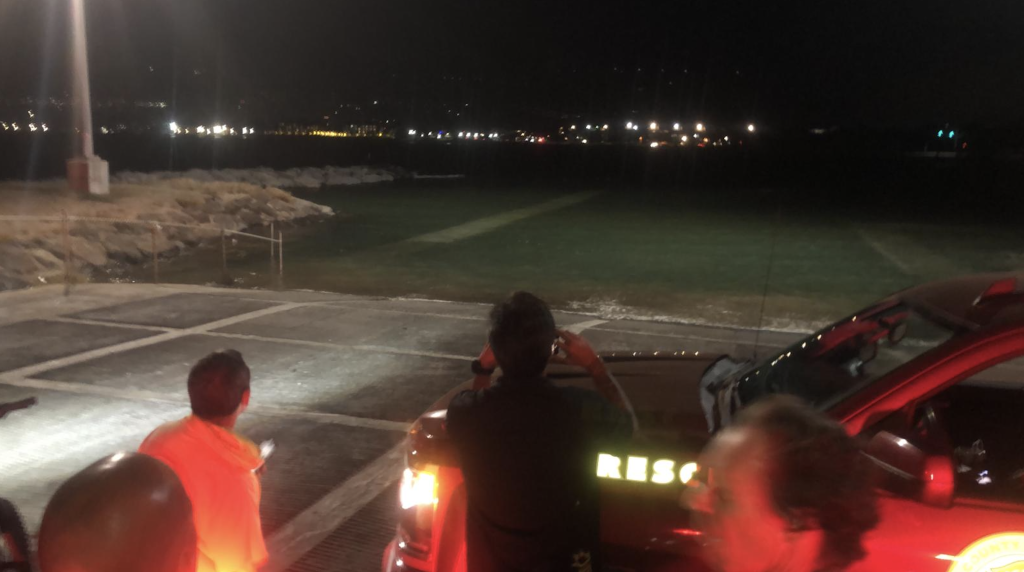
Tsunami Advisory continues for Hawaiʻi
(Update: 5:22 a.m., 4:24 a.m., 3:18 a.m., 2:10 a.m., 1:06 a.m., July 30, 2025)
A Tsunami Advisory remains in effect for Hawaiʻi. This comes following a large 8.8 earthquake off the east coast of Kamachatka Russia at 1:25 p.m. HST on Tuesday, July 29, 2025. The state was downgraded from a warning to an advisory late last night at around 10:30 p.m.
Based on all available data, a major tsunami is not expected to strike the state of Hawaiʻi. A Tsunami Advisory means that the potential for strong currents or dangerous waves are expected to occur for those in or near the water. Those who have evacuated may now safely return home based on county assessments and directives. The Maui Emergency Management Agency (MEMA) lifted evacuations at 11:05 p.m., allowing residents to return home in Maui County.
Shelters in Maui County have since closed.
Once the warning was downgraded to an advisory, County of Maui Department of Water Supply began reopening valves that were closed to prevent potential damage; and the Department of Environmental Management began restoring wastewater pump stations and facilities in Lahaina, Kihei and Central Maui.
Department of Parks and Recreation parks and facilities in shoreline areas will remain closed until staff can conduct condition assessments and confirm safety.
The Maui Bus fixed route services will start at least an hour later than normal operations on Wednesday, July 30, 2025 to allow additional time required to refuel vehicles and ensure roads are safe to travel.
There have been no major reports of damage in the Hawaiian Islands at this point. There was a 15-foot water drop reported at Kahului Harbor as water receded and exposed the pier on Tuesday evening. Kahului also had the highest amplitude wave values in Hawaiʻi of 5.7 feet, which is the height of the wave, relative to normal sea level. That was followed by Hilo at 4.9 feet, Haleiwa at 4 feet, Hanalei at 3 feet and Makapuʻu at 2.3 feet, There were also videos that surfaced of flooding in the vicinity of the Hilo Seaside Hotel on Hawai’i Island on Tuesday night.
Authorities say the advisory will end when the hazard has passed.
Hawaiʻi downgraded to Tsunami ADVISORY; MEMA lifts evacuation orders at 11:05 p.m.
(Update: 11:15 p.m., 10:44 p.m., July 29, 2025)
The Tsunami Warning has been downgraded to a Tsunami Advisory by the Pacific Tsunami Warning Center as of 10:38 p.m. on Tuesday, July 29, 2025. Based on all available data, a major tsunami is not expected to strike the state of Hawaiʻi. Sea level changes and strong currents may still be occurring along all coasts, posing a hazard to swimmers and boaters. The public is still advised to stay away from coastal areas and out of nearshore waters.
Earlier this evening, there was a 15-foot water drop reported at Kahului Harbor as water receded and exposed the pier.
A Tsunami Advisory means that the potential for strong currents or dangerous waves are expected to occur for those in or near the water. Those who have evacuated may now safely return home based on county assessments and directives, according to HIEMA officials.
Maui Emergency Management Agency (MEMA) lifted evacuations at 11:05 p.m. today, July 29, 2025, allowing residents to return home in Maui County.
The coast guard will start working with partners to ensure commercial harbors are safe for navigation. When that has occurred, ports will reopen accordingly.
Authorities say there is no immediate signs of major damage in the islands, however there were videos that surfaced of flooding in the vicinity of the Hilo Seaside Hotel on Hawai’i Island.
Shelters have since closed at Moloka’i High School, Kihei Community Center, Velma McWayne Santos Center, Lahainaluna High School, Hana High School, Hannibal Tavares Pukalani Community Center and the Social Hall at Lahaina Civic Center.
Once the tsunami was downgraded, County of Maui Department of Water Supply began reopening valves that were closed to prevent potential damage. The County of Maui Department of Environmental Management also began restoring several wastewater pump stations and facilities in Lahaina, Kihei and Central Maui.
Department of Parks and Recreation parks and facilities in shoreline areas will remain closed tomorrow, 7/30, until staff can conduct condition assessments and confirm safety.
The County of Maui Department of Transportation announced that Maui Bus fixed route services will start at least an hour later than normal operations on Wednesday, July 30, 2025. This is due to additional time required to refuel vehicles and ensure roads are safe to travel.
15 foot drop in water levels at Kahului Harbor; rural residents airlifted to safety
(Update: 9:59 p.m., July 29, 2025)
We received reports of a 15 foot water drop reported at Kahului Harbor this evening with water receding and exposing the pier, according to County officials.
Today MFD staffed two helicopters to evacuate rural areas, including two fisherman in Kahikinui/Kaupo, 10 to 15 people at Nu’u landing and one in Nahiku; three people in Halawa, one in Wailau. People on Lana’i and four people at Nakalele were also warned.
The largest wave activity in Hawaiʻi so far was recorded at 11 feet (crest to trough) at Kahului Harbor, followed by 9 feet in Hilo, according to authorities. Officials believe this data marks the height of the event in the islands, but impacts are still being observed and a tsunami warning remains in effect for Hawaiʻi.
Authorities continue to ask the public to refrain from using the roadways and stay at least 100 feet above sea level and 2 miles inland from coastal areas. In the meantime, officials with the Pacific Tsunami Warning Center urge those who have evacuated to continue to stay away from coastal areas until an all clear is given.
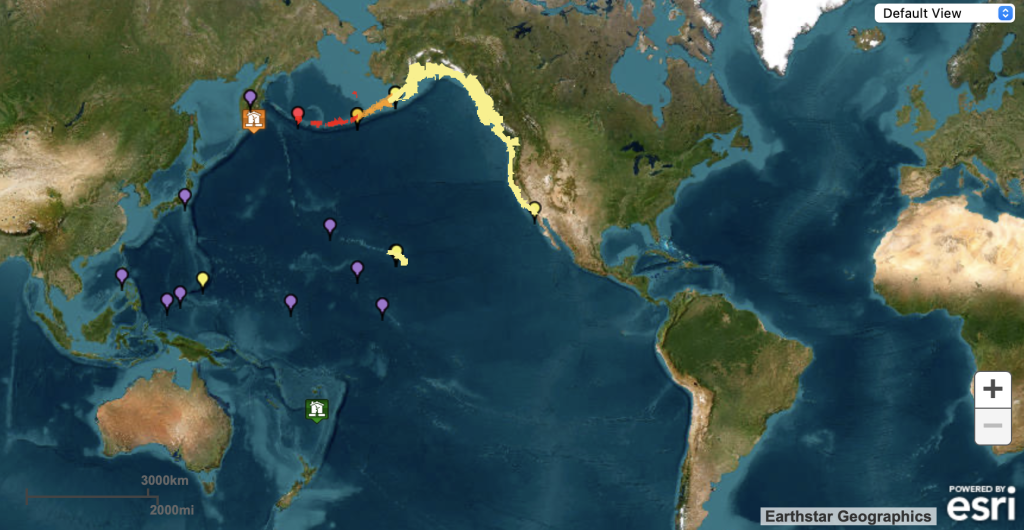
Energy observed in the ocean; window is still 2-3 hours of observation
( 9:13 p.m., 9:06 p.m., 8:20 p.m., July 29, 2025)
While energy changes have been observed with “significant” water receding at several locations including Haleiwa on Oʻahu, the window of observation is still 2-3 hours before any further action can be taken.
“We haven’t seen a big wave, but when that water receded in Haleiwa and we saw some boats laying on the dry rock and sand, that gave us pause. That doesn’t happen for no reason,” said Gov. Josh Green.
“Right now we still have not seen any wave activity come past the Big Island. That’s important,” said Green. “Until we see what happens on the Big Island and the full wrap around of the islands, we don’t feel that we’re in a position to start saying that we’re in the clear. We expect to be about 2-3 hours at least until we can call an all-clear. So far though, at the moment, so good.”
The governor said there are about 200 people sheltering at the Kahului Airport terminal due to canceled flights in and out of Maui. The state Department of Transportation shut down the airport lobby and there are no flights out just yet. In the morning, those sheltering will be re-screened prior to departure.
The Tsunami Warning continues in effect for Hawaiʻi following a large 8.8 earthquake off the east coast of Russia.
There has been no power outages reported in association with the event, and no plans to shut off power at this time. The public is reminded not to call 911 unless they have an actual emergency.
Authorities continue to ask the public to refrain from using the roadways and stay at least 100 feet above sea level and 2 miles inland from coastal areas.
“Just be a little safe for a little longer,” said Green.
In the meantime, officials with the Pacific Tsunami Warning Center urge those who have evacuated to continue to stay away from coastal areas until an all clear is given.
Overall, there have been no major coastal flooding reports; however, as of 9:28 p.m., Hawaii News Now showed video from @HHHNews of high water just offshore of the Hilo “Ice Pond,” and Haleiwa Harbor parking lot flooding footage on Oʻahu.
First wave expected imminently at Hanalei on Kaua’i
As of 8:04 p.m., the Tsunami Warning continues in effect for the state of Hawaiʻi following a large 8.8 earthquake off the east coast of Russia. A NOAA bouy at Nawiliwili on Kauaʻi showed a shift in water levels. NWS officials say the latest bulletin shows a 4 foot amplitude reading at Haleiwa on the north shore of Oʻahu.
All eyes were on Kauaʻi as the first wave impacts from a tsunami were due to arrive at around 7:10 p.m. on Tuesday, July 29, 2025. Webcams are also being monitored across the state. As of 7:22 p.m. no significant waves were observed on Oʻahu at Honolulu Harbor. Although the initial wave impact time has passed, we are not out of the clear since a tsunami is a series of waves with the time between wave crests varying from 5 minutes to an hour. The hazard may persist for many hours or longer after an initial wave.
The Pacific Tsunami Warning Center held a news conference at 7:37 p.m., saying a 1.5 foot above normal sea level rise was reported at Hanalei on Kauaʻi. This was just the first tsunami impacts observed in the islands.
PTWC officials say based on forecast models, there could be impacts of up to 10 feet according to forecast models. Areas that are being watched for potential impacts include Haleiwa, Kahului and Hilo based on historic data.
Over at Midway, the 3rd wave was the largest there. That doesn’t necessarily mean Hawaiʻiʻs 3rd wave will be the largest, according to the PTWC. That’s because of the way the waves get focused and defocused when passing different coasts and geography. This event involves waves moving down the island chain. It may be several hours before the PTWC considers lowering the warning. PTWC says the threat will likely continue for several hours.
Another update is expected at 8:20 p.m. with a press conference from the governor with information containing the latest data.
Tsunami Warning issued for Hawaiʻi following 8.8 Russia Quake
(Update: 6:15 p.m. 6:04 p.m., 5:26 p.m., 5:04 p.m., 4:10 p.m., 3:28 p.m., 2:45 p.m., July 29, 2025)
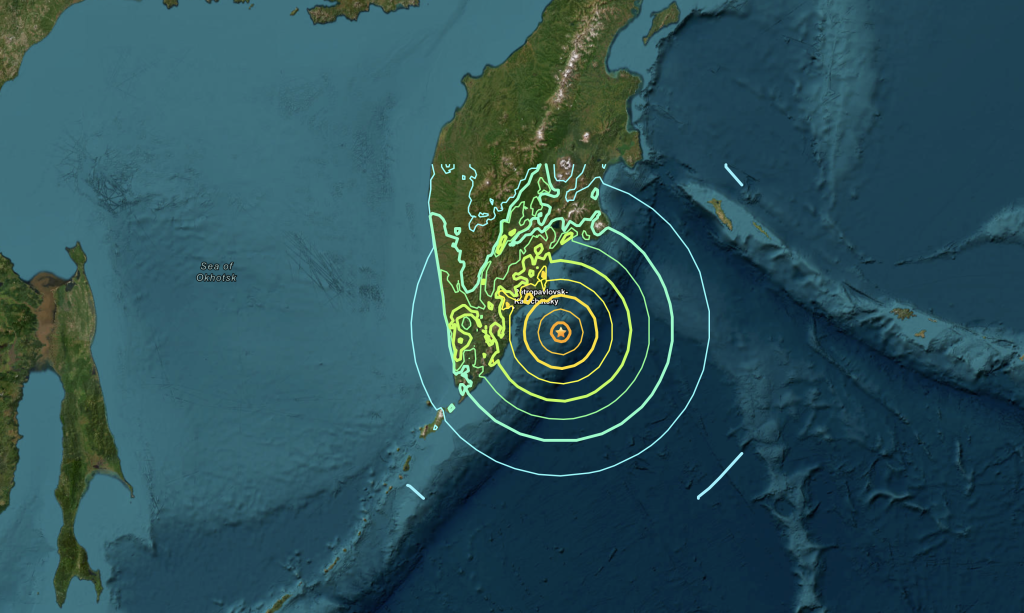
A tsunami warning has been issued for the state of Hawaiʻi effective at 2:43 p.m. HST following a large 8.8 earthquake off the east coast of Kamachatka Russia at 1:25 p.m. HST on Tuesday, July 29, 2025.
A tsunami has been generated that could cause damage along coastlines of all islands in the state of Hawaiʻi. Urgent action should be taken to protect lives and property. All individuals in coastal areas should move inland and to high ground immediately. Maui officials are urging all residents and visitors in coastal areas to evacuate immediately.
The Pacific Tsunami Warning Center reports that tsunami wave reaching 1 to 3 meters above the tide level are possible along some coasts of Hawaii and the Northwestern Hawaiian Islands.
Maui Emergency Management Agency around 3:22 p.m. today, for residents and visitors in Maui County tsunami evacuation zones after the National Weather Service (NWS) sent a statewide tsunami warning this afternoon.
The estimated arrival time in Maui County of the first tsunami wave is 7:17 p.m. HST on Tuesday, July 29, 2025. For Kauaʻi, the time estimate is 7:10 p.m. A warning means that a tsunami has been generated that could cause damage along coastlines of all islands in the state and urgent actions should be taken to protect lives and property.
Wave data:
Gov. Josh Green spoke at 6:20 p.m. news conference saying the wave from peak to trough at Midway was 6 feet—meaning 3 feet of wave riding on the top of the ocean. At 6:40 p.m., will a last and final alarm sounded (30 minutes out from the estimated time of the initial wave). The next wave data is expected from Guam at a 6:57 p.m.
Airport Update:
Kahului Airport operations will be suspended prior to the first wave arrival. On Molokaʻi, personnel at the Kalaupapa Airport are ready to evacuate to the lighthouse. On all islands, commercial ports are secured.
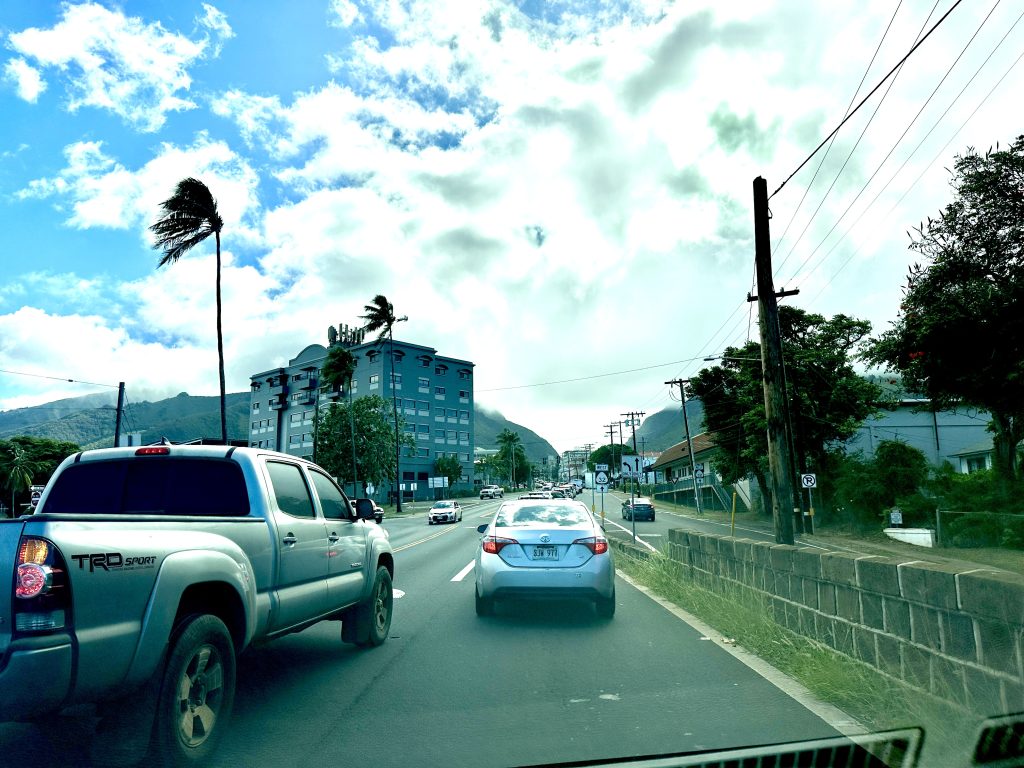
Traffic updates:
If you are on a coastal road stuck in gridlock, go by foot at least 100 feet above seal level or 2 miles inland. You can also evacuate vertically to the 4th floor or higher of a tall building.
As of 7 p.m., Maui Veterans Highway is congested; use Cane Haul Road toward Hansen and Pulehu roads to get to Kula. The road above Makena Golf Course provides access to Ulupalakua. Also, Oprah’s road is open to get Upcountry, according to Maui Police Department.
“As soon as we heard the tsunami warnings, we contacted local law enforcement and FEMA to ensure the road was opened. Any reports otherwise are false. Local law enforcement are currently on site helping residents through 50 cars at a time to ensure everyone’s safety. The road will remain open as long as necessary,” a spokesperson for Oprah Winfrey told Maui Now.
As of 6:45 p.m, officers are closing all access points to Kahului Beach Road. This includes closures at Wahine Pio, Kaʻahumanu Avenue and Kanaloa Avenue.
Motorists are reporting traffic backups in various areas around Central Maui including Main Street in Wailuku and roads leading away from Kahului Harbor, as well as South Kihei Road and the Piʻilani Highway in South Maui.
As of 6:15 p.m., motorists report that traffic was moving steadily on North Kihei Road. Mokulele is backed up from Kahului to the Kihei junction. Traffic is backed up at Kuihelani to Waikapu, and possibly further. Motorists in Central Maui on the Hana Highway near the airport say traffic is backed up in the area as well. Maui police are directing traffic at Hoʻokele and Hana Highway.
Pacific Tsunami Warning Center calls the wave approaching Hawaiʻi as “flooding threat”
Pacific Tsunami Warning Center Director Dr. Charles (Chip) McCreery told KITV Island News in an interview that ocean buoys show that the wave approaching Hawaiʻi is big.
“It’s a flooding threat to Hawaiʻi, which means it’s not just some small thing right at the coast,” McCreery said. “In certain places, the model says that the ocean could rise up as much as 10 feet or more and flood the land. And it’s not like a surf wave where the water comes in and goes out very quickly. Tsunami waves has a time period from one crest to the next of maybe 20 to 30 minutes. And, so then it’s like the ocean rises up by 10 feet and floods (the shoreline).”
“And that’s, of course, very dangerous,” he said. “We want everyone to take this warning seriously, evacuate, follow the instructions from Hawaii and county emergency management agencies, and be safe.”
The monitoring buoys are all around the Pacific Rim, McCreery said, “so it’s pretty much hit all the buoys that we’re interested in. But out next reading should come from Midway Island, and it should actually start coming in right about now (5:30 p.m. Hawaiʻi time), but it’ll take roughly a half an hour before we see the full cycle of the wave.”
That data will be used to update forecast models, he said.
Crews preparing for tsunami:
The sate Highwayʻs division is staging vehicles and equipment on Maui. On Molokaʻi, personnel at Kalaupapa Airport are ready to evacuate to the lighthouse. On all islands, the Coast Guard Captain of the Port has ordered all vessels to follow their procedures to leave port. On Hawaiʻi Island, Hilo Airport commercial operations have been suspended to facilitate evacuations from Keaukaha. As of 5 p.m, Civil Air Patrol has flown over Ha’ena to Kekaha on Kauaʻi to assist DLNR in evacuating the coastline.
Maui water advisory – Valves to close in coastal areas:
Out of an abundance of caution, the County of Maui Department of Water Supply will be closing off valves along coastal areas due to the tsunami warning. The department will begin closing vales at 5 p.m. in the following areas: Waiheʻe, Waiehu, Wailuku, Kahului, Maʻalaea, Kihei, Wailea, Makena, Lahaina, Napili, Hana and Molokaʻi. Residents and visitors in the above mentioned areas will experience low/no pressure until an all clear is signaled and valves are reopened. Customers are encouraged to store water prior to the upcoming valve closures.
Wastewater update:
The County of Maui will be shutting down several wastewater pump stations and facilities in Lahaina, Kihei and Central Maui to prevent damage amid the tsunami warning. All residents connected to the County’s wastewater system in these areas are requested to limit toilet flushing and bathing until further notice. Cooperation will prevent or greatly reduce the amount of raw wastewater discharged to the County wastewater collection system during this emergency. If you have any questions, call the Wastewater Division at 270-7417.
Shelters on Maui:
7 p.m. update: The Social Hall at Lahaina Civic Center and the parking lot at Lahaina Intermediate School recently opened. Motorists are asked to avoid coastal roads when accessing shelters. Moloka’i High School, Kihei Community Center, Velma McWayne Santos Center, Lahainaluna High School, Hana High School, Hannibal Tavares Pukalani Community Center opened by 5:30 p.m. Animals on a leash or on crates will be accepted at all shelters. All County parks not in the tsunami zone are open to shelter. Ulupalakua Ranch road off Moana Drive in Maui Meadows is open to park. Visitors should follow their hotel or lodging directives for tsunami evacuation plans.
Parks and facilities closures:
Department of Parks and Recreation parks and facilities in tsunami evacuation zones around the county have been closed, including Kepaniwai Park.
Bus/Transportation:
All Maui Bus services will cease operations by 6:30 p.m. or earlier based on the route, according to the County Department of Transportation. Check mauibus.org or call Roberts Hawaii dispatch for information at 808-871-4838.
Evacuation Guidance and Safety Tips
Around 3:22 p.m. Tuesday, the Maui Emergency Management Agency (MEMA) activated its emergency sirens across the island, signaling residents in tsunami evacuation zones to move to higher ground.
- If you are in a coastal zone, do not wait for further instructions. Move inland and seek higher elevation immediately.
- Do NOT call 911 unless you are experiencing a life-threatening emergency. Officials say emergency lines are being overwhelmed with non-urgent calls.
- If you are unsure whether your location is in a tsunami evacuation zone, refer to the official NOAA tsunami inundation map: https://tsunami.coast.noaa.gov/
Stay Informed and Connected
- MEMA’s call center has been activated for non-emergency questions. Call 808-270-7285.
- Residents can receive real-time evacuation alerts and updates by downloading the Genasys Protect App or signing up for MEMA Alerts at www.mauicounty.gov/MEMA.
- Road closure information is being updated by Maui Police. Sign up at bit.ly/MauiRoadClosure.
The first wave arrival is estimated at 7:10 p.m. HST, according to the Hawai’i Emergency Management Agency. A tsunami is a series of long ocean waves. Each individual wave crest can last 5-15 minutes or more and extensively flood coastal areas. The danger can continue for many hours after the initial wave as subsequent waves arrive. Tsunami wave heights cannot be predicted and the first may not be the largest.
As of now, Maui County has not announced specific shelter locations for this event. Residents are encouraged to evacuate to high ground outside the tsunami evacuation zones and shelter with family or friends inland if possible. Monitor MEMA Alerts and the MEMA website for updates. You may also call MEMA’s call center at 808-270-7285 for current evacuation or shelter guidance.
Hawaiian Electric: (4:30 p.m. update)
Facilities are being secured to make sure employees and equipment remain safe. For example, preparations are being made to ensure emergency vehicles are properly fueled and moved to higher ground. In addition, system operators are managing the output of generating units at power plants and have brought in additional crews to respond as necessary.
Other islands:
On the Island of Kauaʻi, police have shut down traffic going westbound across the Hanalei Bridge as of 3:50 p.m. Officials advise the public to stay off the road if at all possible. Do not call 911 unless you have an emergency. Officials on Kauaʻi are advising the public to prepare and complete their evacuations by 5 p.m. at the latest.
On Hawaiʻi Island, county officials are hoping to complete evacuations by 6:15 p.m. Hawaiʻi County has opened the following locations as Public Evacuation Shelters; Puʻueo Community Center, Panaewa Park, Keaʻau Armory, Pahoa Community Center, Kaʻu District Gym, Naʻalehu Community Center, Yano Hall, Kealakehe H.S. Gym, Waimea Community Center, Hisaoka Gym, and Honokaʻa Gym.
What is a Tsunami:
A tsunami is a series of long ocean waves. Each individual wave crest can last 5-15 minutes or more and extensively flood coastal areas. The danger can continue for many hours after the initial wave as subsequent waves arrive. Tsunami wave heights cannot be predicted and the first may not be the largest.
Tsunami waves efficiently wrap around islands. All shores are at risk no matter which direction they face. The trough of a tsunami wave may temporarily expose the seafloor, but the area will quickly flood again.
Extremely strong and unusual nearshore currents can accompany a tsunami. Debris picked up and carried by a tsunami amplifies its destructive power. Simultaneous high tides or high surf can significantly increase the tsunami hazard.
Further messages will be issued hourly or sooner as conditions warrant until the threat to Hawaiʻi has passed.
Magnitude of Russia quake upgraded to 8.7; Hawaiʻi remains under Tsunami Watch
(Update: 2:17 p.m., July 29, 2025)
A tsunami watch remains in effect for Hawaiʻi following a large earthquake off the east coast of Kamchatka Russia. Officials with the USGS have since upgraded the magnitude to 8.7 from an earlier report of 8.0.
If tsunami waves impact Hawaiʻi, the estimated earliest arrival of the first tsunami wave is 7:17 p.m. HST on Tuesday, July 29, 2025. Further messages will be issued hourly or sooner as conditions warrant until the threat to Hawaiʻi has passed.
An investigation is underway to determine if there is a tsunami threat to Hawaiʻi.
Hawaiʻi under Tsunami Watch following large Russia quake
Update: 1:33 p.m., July 29, 2025
A tsunami watch has been issued for Hawaiʻi. An investigation is underway to determine if there is a tsunami threat to Hawaiʻi following a 8.0 earthquake reported at 1:25 p.m. HST on Tuesday, July 29, 2025 off the east coast of Kamchatka Russia.
If tsunami waves impact Hawaiʻi, the estimated earliest arrival of the first tsunami wave is 7:17 p.m. HST on Tuesday, July 29, 2025. Further messages will be issued hourly or sooner as conditions warrant until the threat to Hawaiʻi has passed.
The Pacific Tsunami Warning Center reports that based on all available data, a tsunami may have been generated by this earthquake that could be destructive on coastal areas even far form the epicenter.
Again, an investigation is underway to determine if there is a tsunami threat to Hawaiʻi. The tsunami watch was posted for Hawaiʻi at 1:34 p.m.
What is a Tsunami?
A tsunami is a series of waves. The time between wave crests can vary from 5 minutes to an hour. The hazard may persist for many hours or longer after an initial wave.
Impacts can vary significantly from one section of coast to the next due to local bathymetry and the same and elevation of the shoreline. Impacts can also vary depending upon the state of the tide at the time of the maximum tsunami waves.
Individuals caught in the water of a tsunami may drown, be crushed by debris in the water, or be swept out to sea.
*We will continue to update this post with information as it becomes available
Sponsored Content