Work concludes on Maui project to restore 11 acres damaged by axis deer, protect water quality
A pilot project to protect against soil erosion, reduce flood risk, restore damaged landscapes, and improve coastal water quality has been successfully completed.
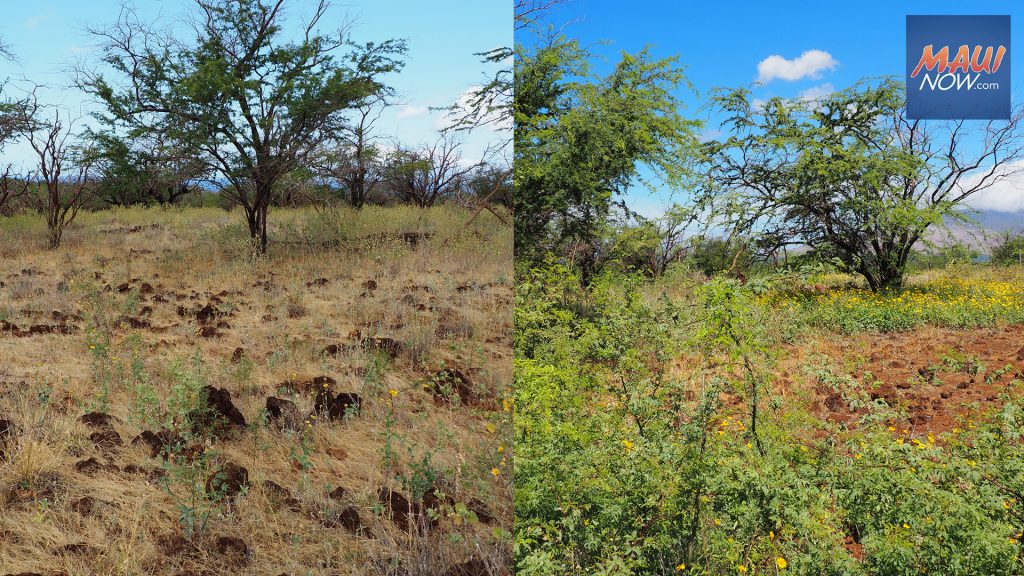
The Hapapa Watershed project was designed to revegetate an area in South Maui that had been denuded by feral axis deer. Without adequate groundcover, exposed landscapes are highly susceptible to soil erosion, and during rain events, sediment can be swept away in storm waters and deposited on streets, homes, and in critical habitats such as wetlands and coral reefs.
The Hapapa Watershed Axis Deer Damage Mitigation project is a joint effort managed by the Central Maui Soil and Water Conservation District (CMSWCD) with support from the Hawaiʻi Department of Health, Clean Water Branch, Polluted Runoff Control Program. Project partners included Haleakalā Ranch, Maui Environmental Consulting, F.A.R.E. (Feral Animal Removal Experts), and Pride Landworks.
The collaborative, 19-month project resulted in revegetation and stabilization of an 11-acre area that had been heavily damaged by feral ungulates; lower risk of soil erosion from the project landscape; removal of more than 1,300 pounds of nitrogen and 480 pounds of phosphorous from Maui’s injection wells; and strategic management of the restored landscape using cows to reduce fuel loads and fire risk.
“We are very pleased by the outcomes of this pilot project, not only for the project landscape that is in a much healthier state today, but for the coastal areas and communities located downslope that can be at risk for flooding and sediment damage,” said Mike Silva, CMSWCD chair. “This project would not have been successful without the collaboration of its many partners. The Central Maui SWCD is grateful for the continued partnerships that help us carry out our mission to protect our island’s natural resources.”
The project additionally sought to improve water quality by utilizing R-1 recycled water from the Kīhei Wastewater Treatment Facility to irrigate the new vegetation. Currently, approximately 2.1 million gallons of R-1 water are injected into underground wells daily. The nutrient-rich water percolates through the ground and drains into the ocean, negatively impacting nearshore water quality and degrading important marine habitats.
Over the course of the project, nearly 21 million gallons of R-1 water were diverted from the underground injection wells to support revegetation of the landscape and contribute toward aquifer recharge and improved water quality. Based on known pollutant concentrations of R-1 water, the project helped remove significant quantities of nitrogen and phosphorous from the injection wells and coastal waters.
Funding for the project totaled $221,235, including $119,900 from the US Environmental Protection Agency and $101,335 in matching contributions from Maui Environmental Consulting and Haleakalā Ranch.
The Central Maui Soil and Water Conservation District works to protect and conserve soil and water resources via watershed planning, improving water quality, flood prevention, restoration, runoff control, wildlife habitat restoration and environmental education. For more information, visit www.mauicountysoilandwater.org.
This project has been funded wholly or in part by the United States Environmental Protection Agency (“EPA”) under assistance agreement C9-96978722-0 to the Hawaiʻi State Department of Health, Clean Water Branch.
The contents of this document do not necessarily reflect the views and policies of the EPA, nor does the EPA endorse trade names or recommend the use of commercial projects mentioned in this document.
Sponsored Content