

Rare native Hawaiian land snails rediscovered after nearly a century
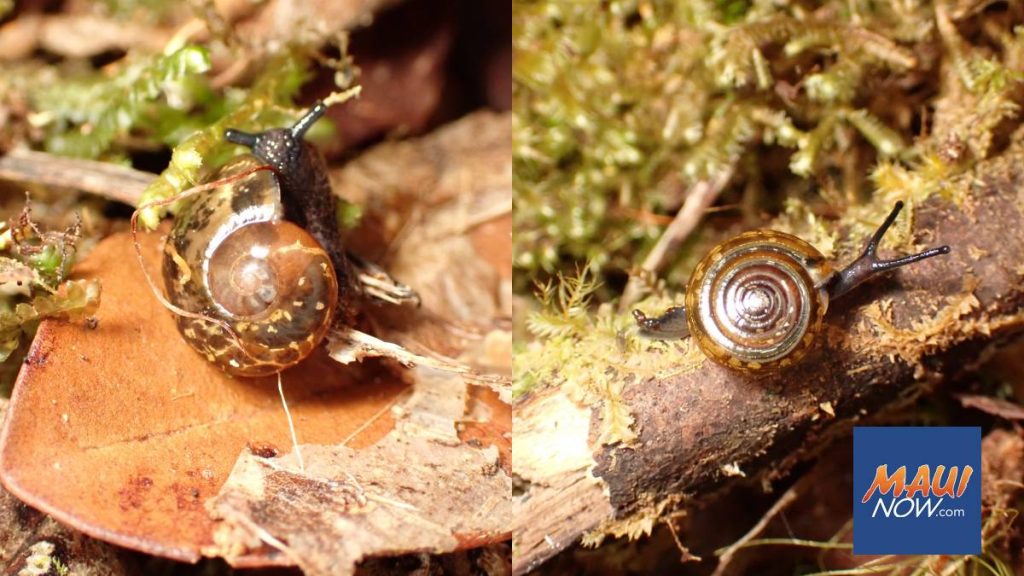
Bishop Museum, the State of Hawai‘i Museum of Natural and Cultural History, has announced the rediscovery of two native Hawaiian land snails not seen in nearly a century.
Museum researchers, along with partners from the Kauaʻi Forest Bird Recovery Project, found live specimens of Godwinia caperata (first described in 1852) and Hiona exaequata (described in 1846) during recent biodiversity surveys on Kauaʻi.
Hawaiʻi’s land snails are among the most threatened animals on Earth, with hundreds of species already extinct. In Hawaiian tradition, kāhuli (land snails) are honored in song and stories as voices of the forest. Each surviving species represents millions of years of evolution as well as deep cultural connections.
“This is a rare spark of hope in the fight against extinction,” said Norine Yeung, Ph.D., Bishop Museum curator of malacology. “These tiny snails remind us that Hawaiʻi’s forests still hold hidden treasures.”
A handful of the newly rediscovered snails are now being carefully reared at Bishop Museum’s Pūpū Ola: Kāhuli Protective Rearing Research Center, which houses 42 other species. Researchers are studying their habitat, ecology and behavior to guide conservation.
“Understanding why these species survived while so many others did not may offer vital lessons for safeguarding Hawaiʻi’s biodiversity,” Yeung said.
The rediscovery was made possible through years of collaboration between Bishop Museum, conservation partners, agencies, teachers and local students. Two conservationists, Graham Talaber and Brendan Wang, who attended a snail workshop led by Dr. Yeung, first alerted researchers to the possible sightings.
“Finding them again after nearly a century underscores the importance of continued surveys, outreach, partnerships and training,” said Kenneth Hayes, Ph.D., Bishop Museum curator of malacology and director of the museum’s Pacific Center for Molecular Biodiversity.
“These snails show us that the story of Hawaiʻi’s biodiversity is not finished,” Yeung said. “But to write the next chapter, we must continue to search, to teach, and to care.”
More information about Bishop Museum’s malacology collection and biodiversity research can be found at BishopMuseum.org/Explore.
Sponsored Content