

Hawaiian Moment: The Big Island – Hawaiʻi Island or Maui Nui?
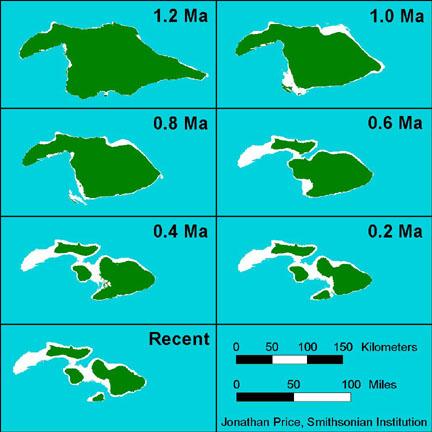
Maui Nui or Greater Maui, is a modern geologists’ name given to a prehistoric Hawaiian Island built from seven shield volcanoes. Nui means “great/large” in the Hawaiian language. This concept was first proposed 60 years ago by geologist Harold Stearns, who “recognized the geologic evidence for repeated episodes of island submergence and reemergence,” according to the Hawaiian Volcano Observatory.
“Jonathan Price of the Smithsonian Institution modeled the area’s submergence history using a computer-based geographic information system (GIS). The model examines the effects of global sea-level change, age of volcanism, and likely rates of volcano subsidence,” according to the HVO.
“Maui Nui in its heyday, about 1.2 million years ago, encompassed about 5,640 square miles, larger by 50% than today’s Big Island of Hawaiʻi. Included in this landmass was Penguin Bank, a broad shoal west of Molokaʻi,” according to the HVO.
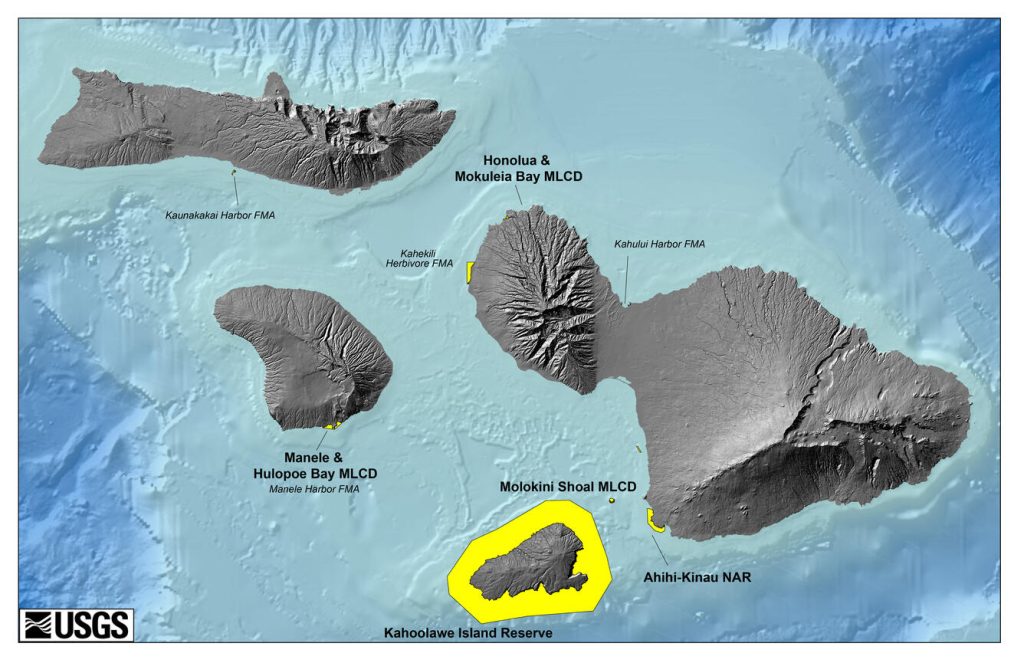
“Enter the agent of subsidence. Hawaiʻi’s volcanoes build by a vast outpouring of lava from the Earth’s upper mantle. The oceanic crust bows under the added weight, subsiding at rates exceeding 3 mm per year (0.1 inch per year). As Maui Nui’s up building volcanoes waned, the saddles between them were submerged, isolating the different volcanoes as distinct islands,” according to the HVO.
According to the HVO: “Another factor that isolates islands is sea level change resulting from the growth and wasting of continental glaciers. Unlike subsidence, which works to diminish an island’s extent, sea-level changes may either diminish or enlarge an island. Glacial expansion, for example, leads to falling sea level, which enlarges an island. Today our world has a greatly reduced ice volume. As a consequence, sea level stands higher now than almost any other time in the past 200,000 years,” forming four islands: Maui, Molokaʻi, Lānaʻi, and Kahoʻolawe.
“The sea floor between these four islands is relatively shallow, about 1,600 feet deep. But at the outer edges of former Maui Nui, as with the edges of all Hawaiian Islands, the floor plummets to the abyssal ocean floor of the Pacific Ocean,” Kiddle reports, about 28,000 feet deep
Administratively, the current islands remaining from Maui Nui comprise Maui County.
Note: Much of the information contained in this post was sourced from: “Volcano Watch — Once a big island, Maui County now four small islands,” originally published by the Hawaiian Volcano Observatory in April 10, 2003
Sponsored Content