

Hawaiian Moment: Hawaiian currency – Akahi Dala – One Dollar
Communities in ancient Hawaiʻi were generally interdependent, with gifting and informal trade governing commerce; there was no formal currency. We learned this in hoʻokipa class in the topic of ahupuaʻa and living in a community stretching from the mountain to the sea.
As foreign ships began arriving in the late 1700’s, Hawaiians traded for metal, cloth and other items. Livestock was a common currency exchanged both with foreigners and among those living in the Islands. Along the way, standards of equivalency and commerce developed. When trade in ʻiliahi (Hawaiian sandalwood) exploded, the fragrant timber became a prominent unit of currency throughout the kingdom.
As more foreigners arrived, their currencies arrived with them. An official Hawaiian Kingdom government publication of 1848 lists over 150 different currencies being exchanged in Hawaiʻi. US gold and silver coins served as the official standard currency as Hawaiʻi became an internationally recognized nation-state in the 1840’s.
An 1846 Hawaiian Kingdom law declared US coins the national standard but also gave legal tender status to coins “I kau ia ka hōʻailona o kekahi aupuni kūʻokoʻa” (bearing the impression of any sovereign state).
Commerce between Hawaiʻi and the US increased the influence of US currency in Hawaiʻi. As these connections developed some began calling for the annexation of the Islands. This sparked King Kalākaua to issue paper currency fully backed by deposits of gold and silver – making Hawaiʻi one of the few nations in the world to do so.
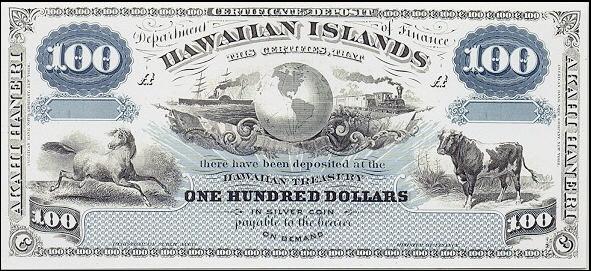
Denominations of $10, $20, $50, $100, and $500 were produced by the American Bank Note Company. The Hawaiian paper currencies of 1879 and 1880 were beautifully drawn notes printed in vivid yellow, green and red, they featured images that portrayed the Hawaiian Kingdom as a vibrant modern member of the family of nations: island trains, ships, scenes of agricultural commerce, a Hawaiian paniolo, a globe. The kingdom notes never really took hold as both local and international banks and businesses preferred US bank notes for any significant amount of money.
Upon his return from his around-the-world tour in 1881, Kalākaua’s experiences abroad had reinforced his understanding of the power of national symbols and redoubled his commitment to supplant American currency in the Islands with his nation’s own. Hawaiian Kingdom’s Minister of Finance, Walter Murray Gibson was insistent that the country should develop its own currency to “inspire the confidence of the people, and add to the prestige of the Kingdom.”
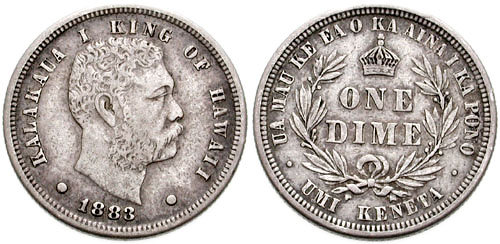
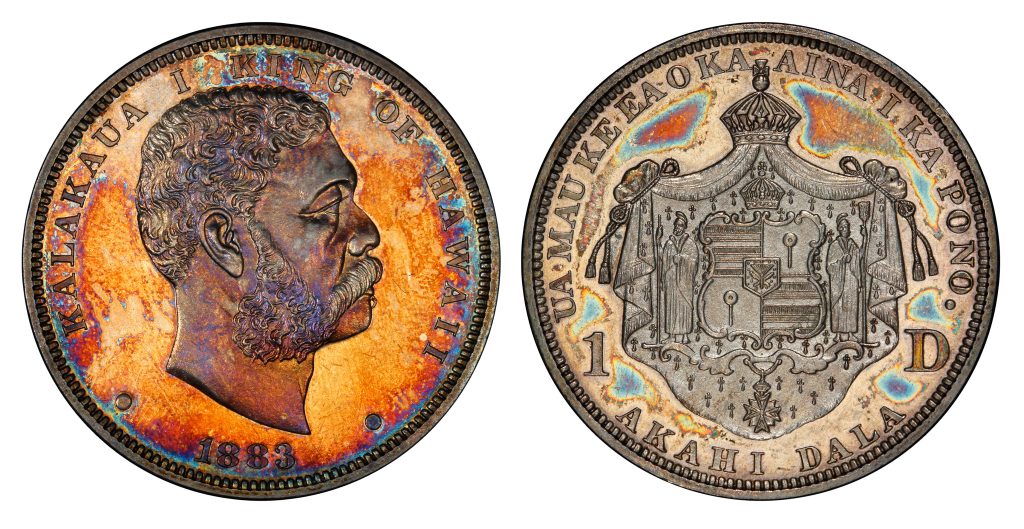
A deal was made to strike $1 million dollars worth of coins at the US Mint in San Francisco. All made out of silver were – akahi dala (dollar), hapalua dala (half dollar), hapaha dala (quarter dollar), and umi keneta (ten cents).
On Dec. 9, 1883, the steamship Mariposa arrived in Honolulu Harbor from San Francisco loaded with $130,000 in currency (the first delivery of Kalākaua coins) bound for the Hawaiian Kingdom’s treasury. The business class sought to resist currency distribution by filing multiple lawsuits, however Kalākaua coins began to make their way into the hands and pockets of the community.
In 1902, four years after the US took possession of the Hawaiian Islands, around 90% of the original million dollars was still in circulation. The Kalākaua coins were legal tender under US law, but banks and business interests were wary about keeping large reserves of them and concerned about possible refusals by US businesses to accept them.
Representatives urged Congress to pass a bill that would end the Hawaiian currency. In January 1903, President McKinley signed the bill declaring Hawaiian coins valueless after Dec. 30, 1903. On March 11 of 1903, the first sacks of silver Kalākaua coins were being shipped back to the US Mint in San Francisco.
By the end of 1903, just 20 years after being minted, the crafted images of Hawaiʻi’s king and its royal standard, and the words of its motto – “Ua mau ke ea o ka aina i ka pono” all of which once graced Hawaiʻi’s own silver currency, disappeared, melted in the furnace of a California mint and transformed into American dimes.
Sponsored Content