Maui residents file Sunshine Law complaint against County Council over Waiʻehu housing vote
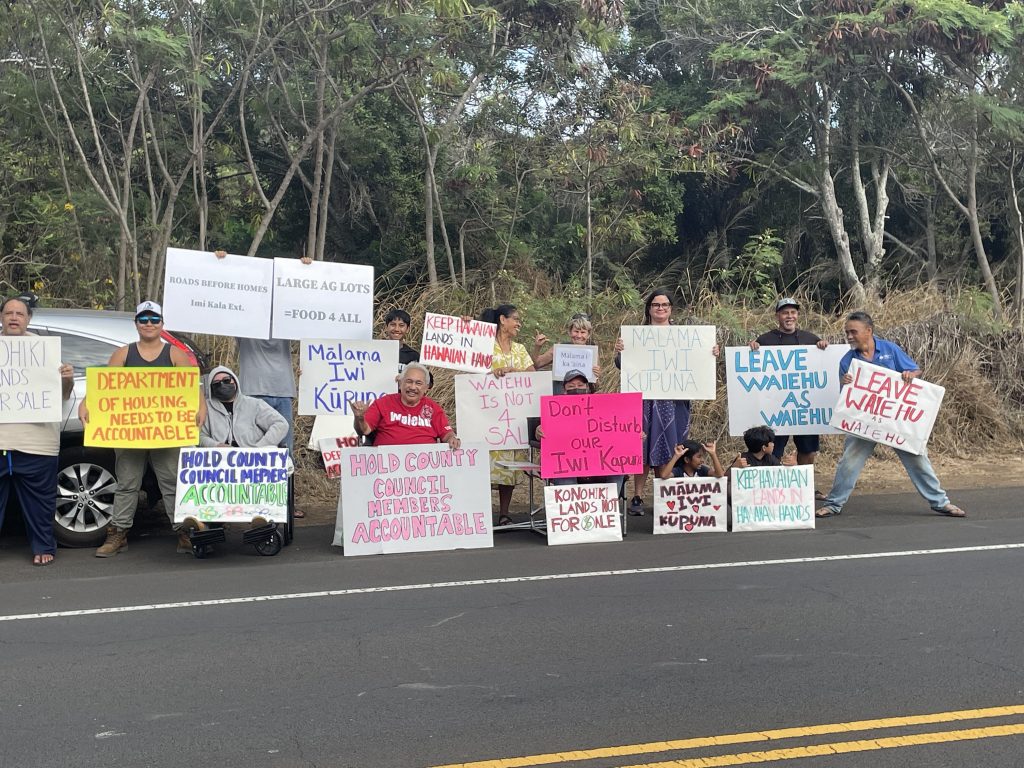
Waiʻehu community members who oppose the 119-unit Hale Mahaolu Ke Kahua affordable housing project have escalated their fight, filing a formal Sunshine Law complaint against the Maui County Council.
Filed earlier this month with the Department of the Corporation Counsel, the complaint alleges the County Council violated Hawaiʻi Revised Statutes Chapter 92 by failing to provide proper public notice related to a substantive amendment made during a meeting on Sept. 8. At that meeting, the Council narrowly adopted Resolution 25-167. It grants exemptions for the housing project.
During the Sept. 8 discussion on a specific exemption concerning the property being “sold, exchanged or divested,” Council Member Tamara Paltin moved to amend the language.
A brief recess was taken to allow Corporation Counsel attorneys, the director of Housing, and the developer to confer on the new language. Upon return, an updated exemption was presented and subsequently passed.
Opponents argue that the change, made after public testimony was largely closed, deprived the public of fair notice and an opportunity to testify on the actual version being voted upon — a violation of Hawaii Revised Statutes Section 92-7(a), according to the complaint.
The Maui County Council has already defended its actions to the state Office of Information Practices in response to an earlier appeal filed by Laura “Lala” Johnson regarding the same meeting.
In an Oct. 6 letter, the Office of Council Services, through Chair Alice Lee, argued that the amendment did not constitute a Sunshine Law violation because the final change was not “so fundamentally different” from the original proposal as to render the public hearing meaningless.
The Council’s position is that the amendment, which added the phrase “provided that Maui Economic Opportunity, Inc., remains the land lessor” to a specific exemption, merely clarified ambiguous language already under discussion and was not a new legislative proposal. The Council’s letter requested that the Office of Information Practices director dismiss the appeal.
Rather than immediately filing a lawsuit, the community group, including members of Hui Pono Ike Kānāwai, has offered an avenue for resolution rooted in Hawaiian tradition, extending a good-faith invitation for voluntary mediation or corrective action — a practice often referred to as hoʻoponopono.
“Our intent has always been to approach this with aloha and pono,” said Joyclynn Costa of Hui Pono Ike Kānāwai. “We believe in accountability through transparency — not just for us, but for our keiki and future generations.”
The formal notification was delivered Oct. 13 to the Maui County Department of the Corporation Counsel. The complaint gave the County three business days to respond, or until Oct. 16.
“Government transparency is not a favor to the people — it’s pono… and it’s the law,” added Johanna Kamaunu, also of Hui Pono Ike Kānāwai.
Regarding the Oct. 16 deadline for a response from Maui County, Johnson said the community group has not, as of Monday morning, “received any engagement or corrective action from Maui County in response to our Sunshine Law complaint.”
“On Oct. 16, Corporation Counsel sent a brief reply essentially directing us to file a formal complaint with the Office of Information Practices rather than engaging in any voluntary resolution or mediation with the County,” she said. “Our initial outreach on Oct. 13 was made in good faith to allow the County an opportunity to address the matter collaboratively and avoid formal legal proceedings. Unfortunately, their response indicates no willingness to mediate at this time.”
The Sunshine Law complaint and offer of hoʻoponopono is the latest action in an ongoing effort to halt the Waiʻehu development, which has faced opposition over cultural and historical concerns.
During the Sept. 8 meeting, testifier Harry Brown opposed the resolution, citing concerns over the land title’s clarity and the presence of iwi kūpuna (ancestral remains) in the area.
“The title is not clear,” Brown testified. “I stand in opposition to this resolution because iwi kūpuna is there.”
Community members, including Johnson, an interest holder to the land, emphasize their commitment to mālama (care for) the kūpuna and ʻāina, calling the area the “resting places of our ancestors and the foundation of our identity.”
Sponsored Content