


Kīhei Charter School embraces AI as essential educational tool
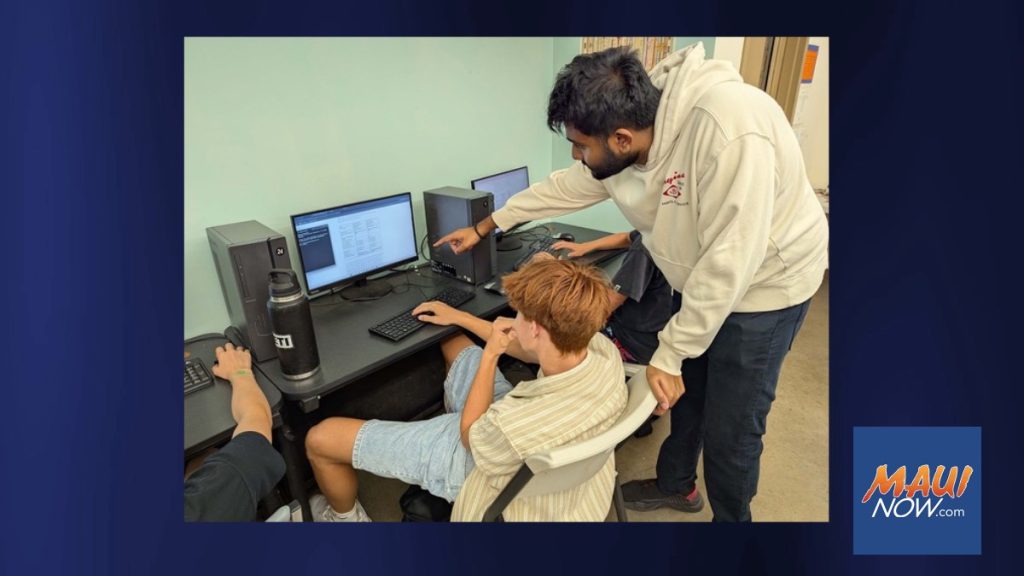
While educators nationwide grapple with the integration of artificial intelligence into the classroom, Kīhei Charter School is forging a path forward, viewing AI not as a threat, but as a tool to prepare students for the 21st-century workforce.
Instead of attempts to ban the technology, the school administration has chosen to integrate AI into its self-directed learning programs, positioning itself at the forefront of this educational shift.
“The mission of the Kīhei Charter School is to create innovative educational environments that prepare students for fulfilling and successful lives in the 21st century,” said Michael Stubbs, Kīhei Charter’s Head of School. “Therefore, we strive to incorporate artificial intelligence as a mechanism to enhance education, resulting in more engagement, more effective learning and greater overall student achievement.”
The move comes amid rapid technological advancement, with the field of AI tracing its formal beginnings back to the Dartmouth Conference in 1956. Now, the technology is reshaping industries, making an AI-educated workforce essential.
Tyler Robles, an assistant to IT Director Phill Schmidt, emphasized the urgency for students to master the technology. “As these students enter the real world there are going to be three types of people: those who don’t use AI, those who use AI, and those who use AI properly,” Robles said. “Only the latter of the three will get ahead in life, the rest might be left behind.”
Teachers are already finding ways to leverage the technology. Varun Vaidhyanathan, a computer science high school teacher, uses AI to assist with lesson planning and generating examples. He acknowledges that the biggest challenge is preventing plagiarism and misuse.
“Assignments incorporating AI are meant to be fun for students and require the human element of creativity,” he said. “This teaches them that AI is a complementary tool rather than a replacement.”
Vaidhyanathan stresses the “very thin line between AI being used as a tool and as a crutch,” aiming for his students to approach it as the former.
Students appear eager for the integration. Andrew Van Bueren, a 15-year-old, 9th-grade student, supports the policy.
“I think allowing us to have some freedom with AI in schoolwork can be very beneficial to our schooling,” he said. “I also think that AI can give us, as students, a different perspective on topics that we may not have thought of before.”
Sponsored Content



_1768613517521.webp)







