Maui Council celebrates Filipino American History Month
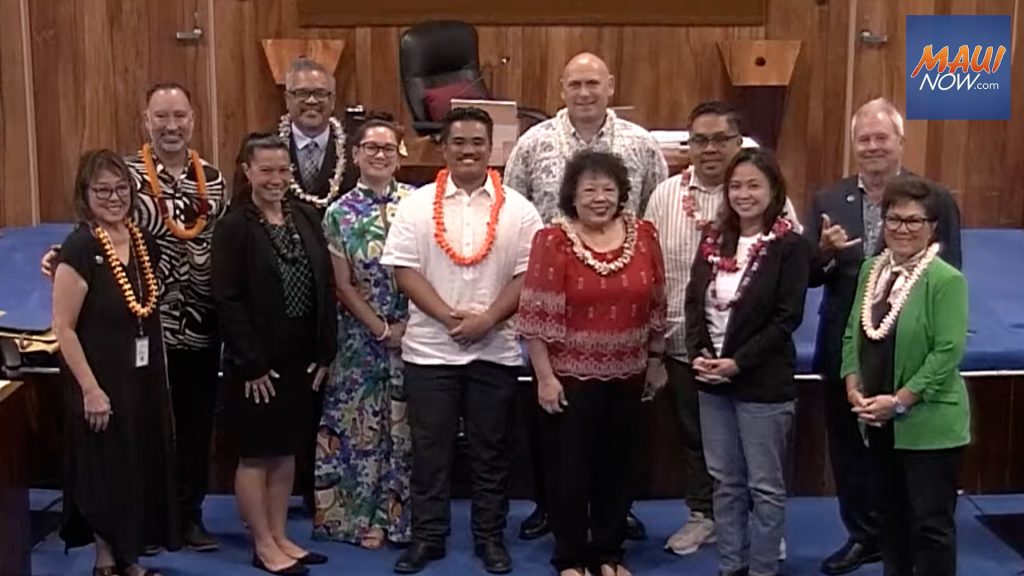
Maui County Council members recognized October as Filipino American History Month in a resolution on Friday morning and honored the Filipino community’s contributions in Maui County.
The ceremonial resolution drew heartfelt testimony emphasizing cultural pride, the legacy of labor struggles, and a call for greater civic engagement, especially following the devastating Lahaina wildfires in August 2023.
In testimony in favor of the resolution, Michelle Santos, representing the Maui Filipino Community Council, said she felt a deep connection to her roots despite being half-Filipino.
“It is a great feeling and honor to be Filipino, and it is so fulfilling to not only share our culture but to watch it flourish amongst our community.,” she said, adding that she was honored when she was publicly recognized in the Philippines as “while she is only 50% Filipino, she is 100% Filipino at heart. Those words resonate to me until this day.”
Sharon Zalsos Banaag, a director of the Maui Filipino Chamber of Commerce and a veteran, said she enjoys being recognized for her Filipino heritage.
“Whenever I see someone who looks like me or who looks Filipino, I do say ‘Filipino?’ to which almost always they will probably say, ‘No, Hawaiian or Mexican,” she said. “It’s only because we are so proud of our heritage.”
She also shared a humorous cultural note about language: “When a Filipino group of Filipinos are speaking in their native tongue, don’t take offense, because I guarantee you, even though they’re looking at you, they’re not talking about you, they’re most likely complaining about their husbands.”
Christian Galapon, also a board member of the Filipino Chamber of Commerce, reflected on a lesson from his great-grandmother: “No matter how beaten or dirty life makes you, you will never lose your value. That, to me, is what it means to be Filipino. No matter the trials, the tribulations, or even disasters that we face, we rise. We march forward with a smile, with laughter and with resiliency.”
In discussion of the resolution passed unanimously, council members noted their ethnic and personal ties to the Filipino community and their appreciation of their significant contributions to Maui County.
Introduced by Lānaʻi Council Member Gabe Johnson, the resolution noted that the first recorded presence of Filipinos in what’s now the United States was on Oct. 18, 1587, when Filipino sailors in a Spanish galleon arrived at Morro Bay, California.
Also, in 1906, the first group of migrant farm workers from the Philippines — known as sakadas — were recruited by the Hawaiian Sugar Planters’ Association to work on Hawaii’s sugar and pineapple plantations. In 1932, Filipinos made up 70% of Hawaii’s plantation workforce and endured racial discrimination, harsh conditions and hours of back-breaking labor. In 1946, Filipinos were on the front lines of the 79-day Hawai‘i Sugar Strike organized by the International Longshoremen’s and Warehousemen’s Union Local 142. That strike helped transform Hawaii’s economy, politics, and social structures, and pave the way for improved worker rights.
The resolution notes that, as the community continues to recover from the August 2023 Maui wildfires, where, in Lahaina, an estimated 40% of the pre-fire population was Filipino. The community has exhibited qualities “such as bayanihan and panagkaykaysa — the spirit of mutual aid and civic unity — and kapwa — a sense of identity emphasizing shared humanity and mutual obligation — are more important than ever.”
Filipinos make up 26% of Hawai‘i’s and 28% of Maui’s, 31% of Moloka‘i’s and 64% of Lānaʻi’s population.
Sponsored Content