

Kīlauea erupts again: Episode 37 begins with 400-foot lava fountains at Halemaʻumaʻu
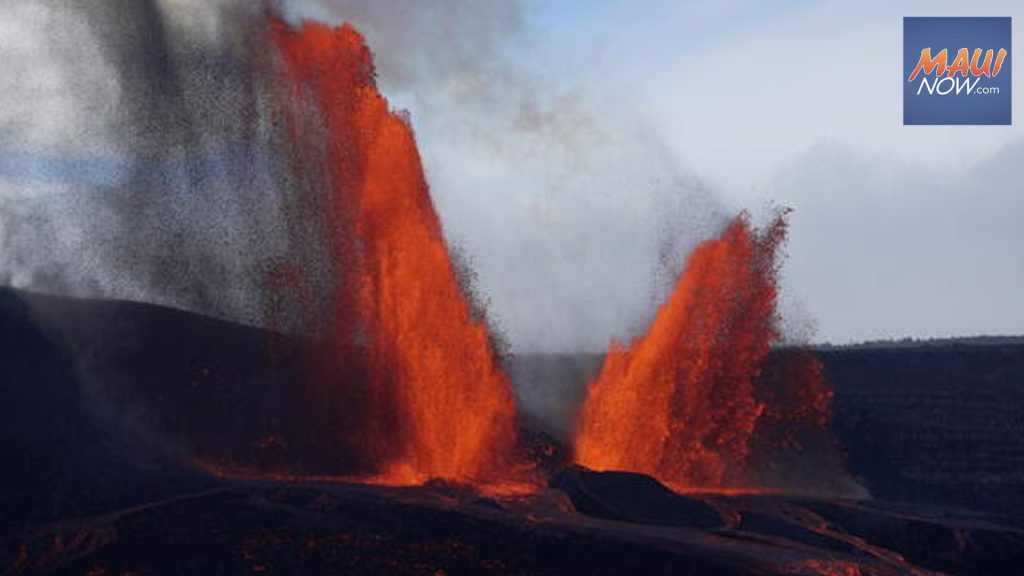
Episode 37 of the ongoing Halemaʻumaʻu eruption began at 2:30 p.m. HST on Nov. 25, according to the Hawaiian Volcano Observatory. Sustained lava fountains approximately 400 feet (120 meters) in height are currently erupting from the north vent. Fountain heights are increasing rapidly.
Past episodes have produced incandescent lava fountains over 1,000 feet (300 meters) high that produce eruptive plumes up to 20,000 feet (6,000 meters) above ground level. According to the National Weather Service, winds are light and blowing from the northeast direction, which suggests that volcanic gas emissions and volcanic material may be distributed towards the southwest, but could spread more widely.
All eruptive activity is confined to Halemaʻumaʻu crater within Hawaiʻi Volcanoes National Park; commercial airports in Hawaii County (KOA and ITO) will not be affected by this activity.
Three Kīlauea summit livestream videos that show eruptive lava fountains are available here: https://youtube.com/@usgs/streams.
KPcam and MKcam provide views of the plume height for aviation purposes
Previous post (updated Tuesday, Nov. 25 at 3:30 p.m.)
The Hawaiian Volcano Observatory reports that glow and intermittent splattering continued from both of Kīlauea’s summit vents overnight Monday, while no overflows were seen from either vent on Monday.
According to observatory scientists, models suggest Episode 37 may occur between Nov. 25-28, with Nov. 26-27 most likely. The volcano remains at Alert Level WATCH and Aviation Color Code ORANGE.
As mentioned, no lava overflows were observed Monday, but both summit vents continued to emit bright glow and periods of spatter, particularly from the south vent. Before activity paused, 73 overflows had been recorded since Friday morning.
Sustained seismic tremor has increased slightly at the summit, with minor tremor bursts suggestive of gas pistoning behavior at the vents, according to HVO.
Plumes of gas are visible from both the south and north vents. Sulfur dioxide (SO2) gas emissions remain at 3,000 to 4,000 tonnes per day, which is higher than typical eruption pause levels of 1,200 and 1,500 tonnes per day.
Previous Episode
Episode 36 began at approximately 11:15 a.m. HST on Nov. 9 and ended the same day at 4:16 p.m. HST, after erupting for five hours. The north vent stopped earlier, at 3:38 p.m. HST, and the south vent gradually decreased in height and volume until it stopped erupting at 4:16 p.m. HST.
South vent fountains reached heights of about 1,200 feet (360 meters) and north vent fountains reached heights of about 750 feet (230 meters). Episode 36 fountains produced just under 11 million cubic yards (about 8 million cubic meters) of lava. The combined average eruption rate was over 600 cubic yards per second (500 cubic meters per second) from the dual fountains.
Lava flows from the fountains covered about 80 percent of the floor of Halemaʻumaʻu crater. The Uēkahuna tiltmeter recorded 23.5 microradians of deflationary tilt during episode 36. The end of the episode was coincident with a rapid change from deflation to inflation at the summit and a decrease in seismic tremor intensity.
The following notices provide more information about Episode 36:
The following links provide more information about the current eruption that began Dec. 23, 2024:
- Eruption resources, including the most recent map and a timeline of eruption episodes since Dec. 23, 2024: https://www.usgs.gov/volcanoes/kilauea/science/eruption-information
- Three Kīlauea summit livestream videos that show eruptive lava fountains are available here: https://www.youtube.com/@usgs/streams
- Summit eruption webcams: https://www.usgs.gov/volcanoes/kilauea/summit-webcams
- Volcano Watch article on gas pistons: https://www.usgs.gov/observatories/hvo/news/volcano-watch-so-what-earth-or-least-kilauea-a-gas-piston
Rift Zone Observations
Rates of seismicity and ground deformation remain very low in the East Rift Zone and Southwest Rift Zone, with no significant earthquake activity in the past 24 hours. SO2 emissions from the East Rift Zone remain below the detection limit.
HVO continues to closely monitor Kīlauea and is in contact with Hawai‘i Volcanoes National Park and the Hawai‘i County Civil Defense Agency about eruptive hazards.
See the Hawaiʻi Volcanoes National Park website for visitor information: https://www.nps.gov/havo/index.htm
Hazards
This episodic eruption is occurring within a closed area of Hawai’i Volcanoes National Park. High levels of volcanic gas—primarily water vapor (H2O), carbon dioxide (CO2), and sulfur dioxide (SO2)—are one major hazard of concern, as this hazard can have far-reaching effects downwind. As SO2 is continuously released from the summit during an eruption, it will react in the atmosphere to create the visible haze known as vog (volcanic smog) downwind of Kīlauea. SO2 and vog may cause respiratory and other problems at high concentrations. Further information on vog can be found at https://vog.ivhhn.org/
Another major hazard is fallout of Pele’s hair and other volcanic fragments from lava fountains. Pele’s hair is strands of volcanic glass often produced by lava fountaining activity that can be carried well over 10 miles (15 kilometers) from the vent. Other hot glassy volcanic fragments (tephra) including volcanic ash, pumice, scoria, and reticulite can fall on the ground within 1–3 miles (1–5 kilometers) of the eruptive vent(s), with the highest concentrations immediately downwind of the vent(s). Various volcanic fragments have fallen on Highway 11 west of Hawai’i Volcanoes National Park at times, depending on wind and eruption conditions. Strong winds may waft light particles, including Pele’s hair, to greater distances downwind. Once on the ground, Pele’s hair can sometimes cluster and tangle together, giving it the appearance of a tumbleweed. The extent of Pele’s hair deposition is dependent on lava fountaining activity and wind conditions. Residents and visitors should minimize exposure to Pele’s hair and other glassy volcanic fragments, which can cause skin and eye irritation and can also contaminate catchment water supplies. More information about how Pele’s hair, its hazards, and what to do is available here: https://www.usgs.gov/observatories/hvo/news/volcano-watch-recent-lava-fountains-highlight-peles-hair-hazards. A recently updated Frequently Asked Questions document that includes information about potential health effects of Pele’s hair is available here: https://vog.ivhhn.org/sites/default/files/PelesHair_FAQs_v2.pdf
Hawaiian lava flows generally advance slowly downslope, and during this eruption flows have been confined to Halemaʻumaʻu crater and the southwest side of Kaluapele, Kīlauea’s summit caldera.
Other significant hazards also remain around Kīlauea caldera from Halemaʻumaʻu crater wall instability, ground cracking, and rockfalls that can be enhanced by earthquakes within the area closed to the public. This underscores the extremely hazardous nature of Kīlauea’s caldera rim surrounding Halemaʻumaʻu crater, an area that has been closed to the public since late 2007.
More Information:
- Kīlauea activity summary also available by phone: (808) 967-8862
- Kīlauea webcam images: https://www.usgs.gov/volcanoes/kilauea/webcams
- Kīlauea photos/video: https://www.usgs.gov/volcanoes/kilauea/photo-and-video-chronology
- Kīlauea lava-flow maps: https://www.usgs.gov/volcanoes/kilauea/maps
- Kīlauea FAQs: https://www.usgs.gov/volcanoes/kilauea/faqs
The Hawaiian Volcano Observatory is one of five volcano observatories within the US Geological Survey and is responsible for monitoring volcanoes and earthquakes in Hawaiʻi and American Samoa.
Sponsored Content