30 years and counting: Community science helps track humpback whales across Hawaiʻi
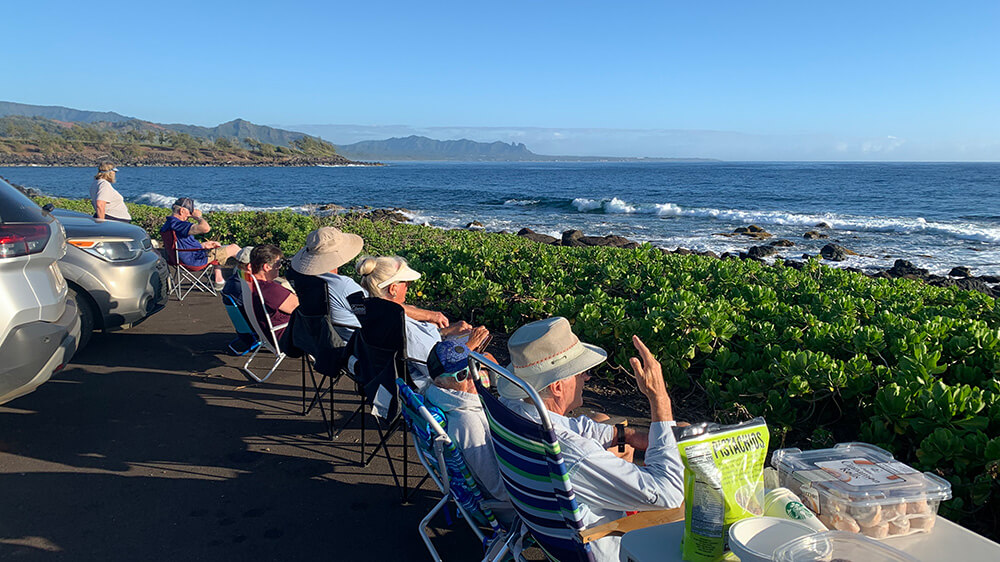
This January, ocean lovers and community scientists from across the islands and beyond are celebrating the 30th anniversary of Sanctuary Ocean Count—Hawaiian Islands Humpback Whale National Marine Sanctuary’s signature community science and ocean education program.
For three decades, Sanctuary Ocean Count has invited the public to monitor marine wildlife along the shallow coastal waters of Hawaiʻi, with a special focus on the thousands of humpback whales, or koholā, that return each winter. These waters serve as the primary breeding, calving, and nursing ground of the Hawai‘i distinct population segment of North Pacific humpback whales that spend their summers primarily in Alaska and higher latitude feeding grounds.
Each season, Hawaiʻi hosts one of the world’s largest seasonal gatherings of humpback whales, currently estimated at more than 12,000 whales. Sanctuary Ocean Count has helped foster deep community connections to these animals—building public awareness, supporting responsible whale watching, and inspiring generations of volunteer observers and naturalists who continue to share their knowledge of and passion for koholā.
Ocean Count’s Humble Beginnings
Sanctuary Ocean Count was one of the first programs of its kind for the newly designated Hawaiian Islands Humpback Whale National Marine Sanctuary in the early 1990s. At that time, there was limited observational knowledge regarding whale abundance and behavior in their nursing and breeding grounds. Most whale watching was—and still is—from boats. To enhance understanding of these remarkable creatures and provide viewing opportunities for more people, Sanctuary Ocean Count was created as a free program for shore-based observations at designated coastal sites led by trained community volunteers.
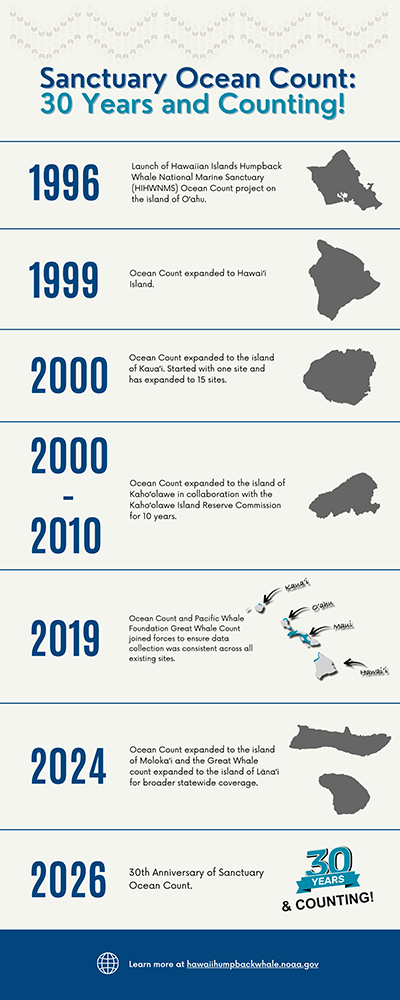
The first Sanctuary Ocean Count was conducted on Oʻahu in February 1996 with approximately 150 volunteers. Today, the community science program has over 60 sites on four islands, with more than 1,000 volunteers donating over 3,000 hours annually. Since 2019, Sanctuary Ocean Count has been collaborating with Pacific Whale Foundation’s Great Whale Count on Maui, sharing resources and combining data for a statewide view of changes in humpback whale populations over time.
Three Decades of Data, Discovery, and Awareness
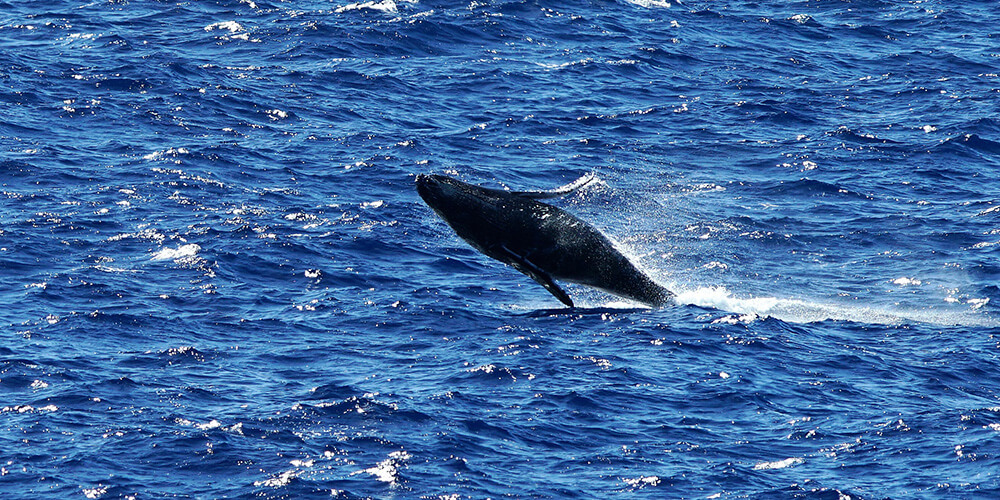
On the last Saturday of January, February, and March, volunteers gather at their designated coastal sites on the islands of Oʻahu, Molokaʻi, Hawaiʻi, and Kauaʻi to tally observed species and help scientists assess whale distribution and abundance in the sanctuary. Volunteers are trained to observe whale surface behaviors, including blows, slaps (by pectoral fins, head, or tail), breaches, and dives, as well as note other species observed throughout the day. Each site has different orientations, elevations, ocean depths, accessibility, visibility, and number of volunteers, providing a broad view of ocean habitat across the state.
Sanctuary Ocean Count expands the reach of sanctuary staff and researchers while providing an opportunity for the public to participate in research and learn more about their sanctuary, humpback whales, and the many other unique species that call our ocean home.
Community Science in Action
Across your national marine sanctuaries, volunteers play a vital role in helping researchers and scientists better understand the natural world. At NOAA, we use the terms “community science” or “citizen science” to describe projects in which volunteers partner with researchers to answer questions and address real-world challenges. Community scientists can help researchers identify questions, collect and interpret data, make innovative discoveries, and support the development of new technologies and applications.
Volunteers are an integral part of many programs, contributing invaluable time and energy across the National Marine Sanctuary System. The various skills, knowledge, and support they provide help expand the reach of national marine sanctuaries and build on the work of sanctuary staff.
Sanctuary Ocean Count is dependent on our enthusiastic and committed volunteers, and successful because of their decades-long dedication. In addition to counting whales, our volunteers reach over 1,000 members of the public each year, providing information on the sanctuary, humpback whales, community science, and much more.
Stay Tuned
You can join us in celebrating three decades of Sanctuary Ocean Count on the last Saturday of January, February, and March 2026. This is your chance to join our dedicated volunteers in a statewide effort to monitor humpback whales and other marine life from across our islands.
By Cindy Among-Serrao and Catherine Takata-Tonini. Cindy Among-Serrao is the Hawaiʻi Island program coordinator for Sanctuary Ocean Count. Catherine Takata-Tonini is a policy and planning specialist with the Office of National Marine Sanctuaries Pacific Islands Region
Sponsored Content