



 Hawai'i Journalism Initiative
Controversial $13M Nāpili home now offering partial ownership to buyers
An 8-bedroom, 12.5-bathroom house in Nāpili that sparked community backlash over its size is on the market again — this time with an opportunity for up to four owners to buy interests in the property.
Cohana Homes, which describes itself as a vacation home co-ownership company, is offering 25% ownership of the house for $3.55 million apiece. The entire 7,344-square-foot house at 5385 Lower Honoapi‘ilani Road is listed with a value of $12.9 million.
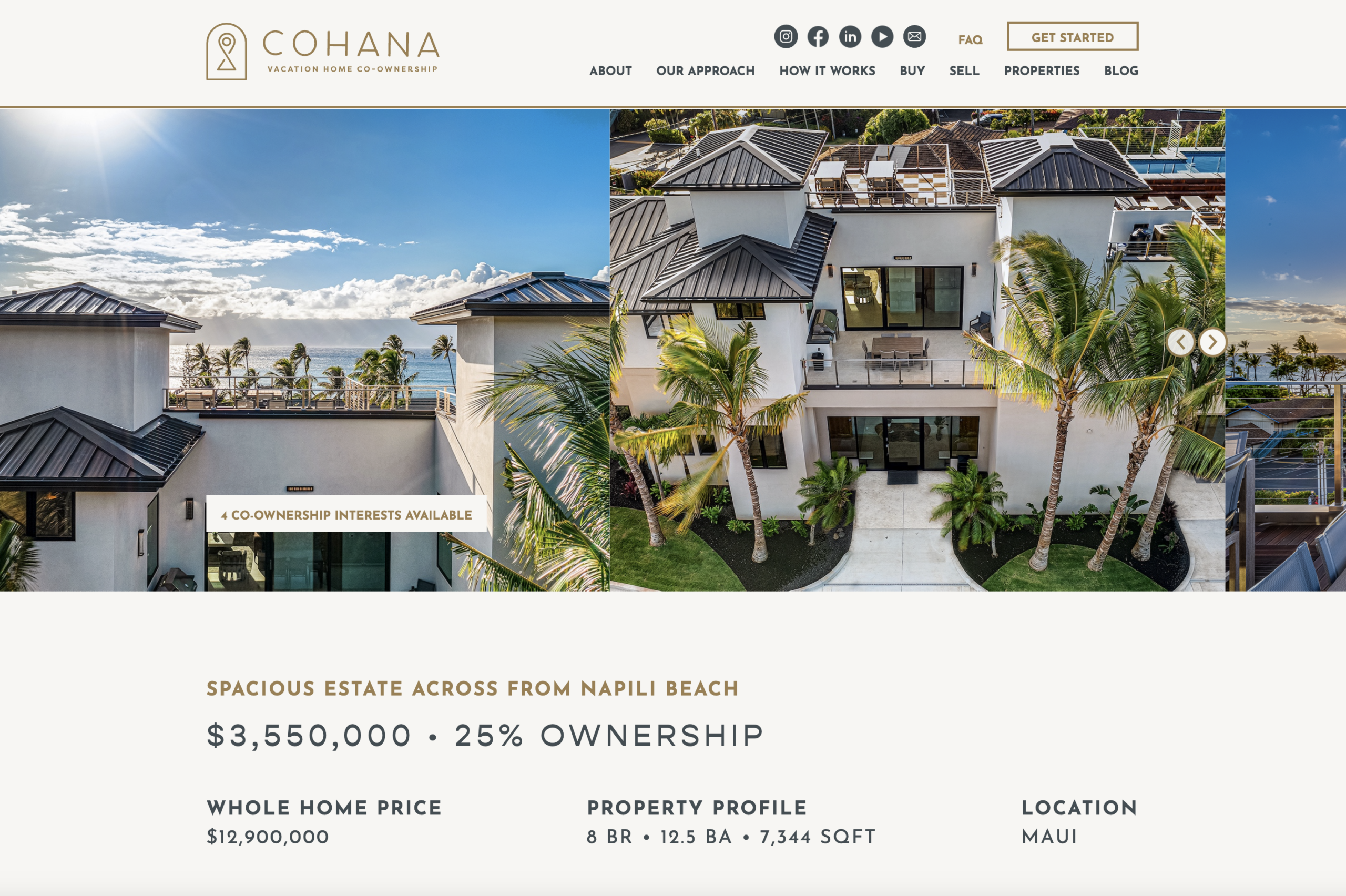
Dean Otto, co-founder of Cohana, said the intention is to have two to four co-owners join a limited liability company to purchase the property. The LLC would be able to buy and sell the property, “just like any other property on the market.”
HJI Weekly Newsletter
Get more stories like these delivered straight to your inbox. Sign up for the Hawai‘i Journalism Initiative's weekly newsletter:
“With so many restrictions on vacation-renting and sky-rocketing expenses, the concept of co-ownership is becoming very popular,” Otto told the Hawai‘i Journalism Initiative via email last week. “In comparison to vacation renters, co-owners are committed, long-term users who spend meaningful time on the island while respecting the cultural and environmental balance Maui is working to create. Co-owners fit this future.”
The property, which is classified as a non-owner-occupied home under Maui County property records, is owned by Napili House LLC, a company tied to developer Greg Brown. Brown did not respond directly to the Hawai‘i Journalism Initiative’s request for comment but allowed Cohana to make a statement about the property listing.
In 2022, the Maui County Council passed a law aimed at preventing businesses such as LLCs from buying properties that multiple owners could use for short-term periods. Spurred by the rise of companies like Pacaso that sold fractional ownership in luxury vacation homes on Maui, the law expanded the definition of a timeshare from any unit circulated among multiple people for a period of less than 60 days per occupant to a period of less than 180 days.
“We try to troubleshoot as much as we can and prevent things like this from happening, but we can’t speculate the lengths that people go to to exploit loopholes,” said Maui County Council Member Tamara Paltin, who lives in Nāpili and holds the West Maui residency seat.
When asked if selling the property to co-owners compiled with the home’s current permitting and zoning, Maui County Planning Director Jacky Takakura said simply: “The property owner can sell the property.”
However, the home’s uses must follow Maui County Code regulations for the Nāpili Bay Civic Improvement District, Takakura said. As for whether multiple owners using the home counted as a transient vacation rental, Takakura pointed to the County Code, which defines transient as “any person who owns, rents or uses a lodging or dwelling unit, or a portion of it, for less than 180 days and whose permanent address for legal purposes is not the lodging or dwelling unit occupied by the person.”
Cohana says on its website that it strives to offer “co-ownership solutions for luxury vacation homes” and wants to help owners “discover the smarter way to own second homes.” But Otto said Cohana’s model is different from fractional ownership or timeshares. He said that Cohana’s LLC agreements “contain a set ownership term so that the co-owners agree in advance to sell together in the future.” Generally that’s five years, but the time period can be extended if the parties agree.
“Because of the co-owner coordinated re-sale, Cohana does not re-sell partial interests,” Otto said. “Therefore, Cohana is not a fractional or a timeshare company. Nor does Cohana offer vacation renting or usage rights, which are regulated by county zoning, in the sale of 5385 Lower Honoapiilani Road.”
The entire home had previously been listed for sale at $12.9 million in 2024, and a previous advertisement stated it had 12 bedrooms. The current listing now notes eight bedrooms, with two offices and two private dens. Amenities also include a rooftop swimming pool with a spa, an outdoor rooftop kitchen, an elevator, two dining areas and two great rooms.
For years, the home has drawn criticism from community members who have raised concerns over its size and potential use as a vacation rental. In 2018 emails that came to light during Maui County Council committee meetings in 2022, Brown had described the property to the county as “a residential home that I have designed for my family that I can legally vacation rent on hotel property,” Maui Now reported at the time.
In a 2021 letter to the county, Brown’s attorney said that while they understood the community had concerns, “we feel that vacation rentals are prevalent throughout this area and the house of his home as a vacation rental would not affect the character of the neighborhood.” The home is surrounded by multiple resorts and hotels, and for years the Nāpili Bay Civic Improvement District’s permitted uses were the same as in the hotel district.
Brown’s project received a special management area permit exemption in 2019 because it was not on the shoreline and was less than 7,500 square feet, The Maui News reported in 2021. The exemption meant the project could bypass the lengthy approval process under special management area rules and avoid a public hearing, based on the written intention that it would be used as a single-family home. The project received its building permits in 2020, county records show.
As the 45-foot-tall building took shape, it caught the eye of residents who thought it resembled a small hotel more than a single-family home. In public testimony, they described it as a “monster house.” Then-Council Member Mike Molina called it a “neighborhood eyesore.” Then-Planning Director Michele McLean said it was “horribly out of place.”

In December 2021, the county issued stop-work orders for the home after building and zoning inspectors found it exceeded the two-story height limit allowed in the Nāpili Bay Civic Improvement District and the limit of 7,500 square feet required for special management area permit exemptions for a single-family home in the area.
The order was lifted in February 2022 after the county said the home had come into compliance by removing floor space and an equipment room.
Paltin said in 2022 that she thought the house should not have received an exemption because it was originally intended as a vacation rental. The council considered launching an investigation into how the home had been permitted and allowed to move forward, but a committee chaired by Paltin ultimately decided against it due to the costs of hiring outside counsel.
At one point, the council even considered taking it by eminent domain and turning it into a public facility.
Takakura told the Hawai‘i Journalism Initiative that the home is currently compliant with county regulations, according to the county’s automated planning and permitting system.
She said that the house “met requirements of the zoning code” in 2020, the year it received its building permits.
“From 1971 to 2021, the code did not have a height limit measured in feet but said building heights ‘shall not exceed two stories,’” Takakura said via email on Tuesday. “The project complied with the Special Management Area requirements and conditions imposed by County staff when it was built.”
The council changed that in 2021, passing a law to clarify height requirements in the district as two stories, or 30 feet. The new law also redefined permitted uses: any hotel or apartment-hotel use established by Aug. 6, 2021 could follow uses permitted in hotel districts, while any use established after Aug. 6, 2021 had to follow permitted uses in residential and apartment districts.
For Chris Salem, who has long opposed the project as the former head of the Nāpili Bay Community Association’s Board of Directors, the size of the building is at the heart of the issue. Even if the Nāpili district had only specified a two-story limit prior to 2021, he pointed out that the county code has long set general residential height limits at 30 feet. The home is even taller than the 35-foot limit set for buildings in hotel H-1 districts, which is why he sees it akin to a hotel.
The recent proposal to raise height regulations in the West Maui Community Plan from 30 feet to 35 feet to help streamline the rebuilding of homes in Lahaina’s historic district after the 2023 wildfires further confirms Salem’s view that 30 feet should have been the standard for what was billed as a “single-family home” at the time it was built.
Salem, a former county employee, filed a lawsuit against then-Mayor Michael Victorino’s administration in 2021, claiming wrongful termination after he raised issues over Brown’s development and the special management area permitting process and alleging county collusion with private developers, which the county has denied. The case was set to go to trial last year when the county sought to settle with Salem, who rejected their offer.
Still, Salem points out that the permitting process for Brown’s home started even before Victorino took office in 2019, and the size of the home surprised people when it “started coming out of the ground.” He says he feels “sadness” every time he passes it.
“There’s no such thing as a 45-foot-high single-family residence,” Salem said. “And if they’re using the law that allows a single-family residence to be bought into quarters, they’re doing their classic maneuver, which is grab one section of the law while disregarding another section of the law.”
He added: “This goes under the category of ‘buyer beware.'”