Waikapū sewer plant costs more than double as Maui Council considers 9% sewer fee hike

Department of Environmental Management officials now forecast the planned Central Maui Wastewater Reclamation Facility in Waikapū will cost from $298 million to $420 million, or two- to three-times higher than the $130.6 million project estimate published in the project’s final environmental impact statement in February.
The ballooning price tag for the Waikapū plant emerges as a sign of rapidly rising construction costs while the Maui County Council considers an overall $698.2 million capital improvement project budget and takes up a 9% sewer rate increase for the upcoming fiscal year. The increase in sewer user fees is estimated to generate an additional $2.2 million in revenue for Wastewater Division operations.
Overall, the department is seeking a 3.7% increase to $141.9 million for operations and $124 million for capital improvement projects. The department also is requesting two expansion positions, which would bring its full-time equivalent employee total to 264.
Mayor Richard Bissen has proposed a $1.61 billion budget for fiscal 2027.
Central Maui wastewater
Regarding the Central Maui sewage treatment plant, the department has budgeted spending $128 million in fiscal year 2027, tapping various funding sources.
When asked about the two- to three-times-higher overall project costs, Department of Environmental Management Director Shayne Agawa said the initial $130.6 million cost estimate came from “conceptual cost” prepared in 2022 during facility plan work. He put the final EIS cost estimate’s accuracy rate at less than 50% to 100%.

“The cost was prepared without geotechnical or survey information, without equipment quotes and before the August 2023 Maui wildfires,” he said.
Agawa added that: “At the time the EIS was being prepared, an updated cost estimate had not yet been finalized, and no revisions to the cost were incorporated during the EIS process.”
The county plans to build the facility to add capacity to the Central Maui wastewater collection and treatment system, making possible developments such as the Waikapu Country Town master-planned community.

Other factors pushing construction costs higher
According to a recent quarterly report of Rider Levitt Bucknall construction cost indicators, Hawaiʻi’s year-over-year construction costs rose by 5.89%, outpacing the national average of 4.41%. The report says that, despite ongoing labor and supply chain challenges, the construction market in the islands was “active,” in the first quarter of this year.
“Residential and mixed-use developments continue to lead construction activity, reflecting statewide demand for housing,” the report says. “The long-term pipeline for both residential and commercial projects remains heavily influenced by recovery efforts following the 2023 Maui wildfires.”

The report also notes that “geopolitical tensions” in the Middle East are likely to have global implications for fuel and material pricing, as well as shipping and logistics. Hawaiʻi construction costs are “most significantly impacted by geographic isolation and structurally higher baseline expenses.”
According to residential building costs reported by Maui architects and builders, including Pro Draft Inc., the cost of building a low-end basic construction structure at $350 per square foot. An average or standard home would be $375 to $550 per square foot, and a luxury or custom home would come in at $650 to $1,250 per square foot. These costs do not include other expenses, such as land acquisition, site excavation, permitting and utility hookups.

During the COVID-19 pandemic, basic construction costs would be around $250 to $350 per square foot.
Wildfire rebuilding in Lahaina and Upcountry has created a high, sustained demand for construction labor and materials, limiting availability for private, government and other residential projects.
Sewage user fee increases
The proposed 9% sewage user fee rate increase comes on top of a 9% hike implemented July 1, 2025, and higher rates that went into effect in fiscal years 2025 (2%); 2023 (3%); 2020 (6%); 2019 (3%); and 2018 (3%).
The current base charge for single-family residences is $51, plus a water usage charge of $4.60 per 1,000 gallons. Under the proposed user fee increase, a single-family resident would pay a base charge of $61, plus a water usage charge of $4.75 per 1,000 gallons.
For a single-family home, the proposed hike for fiscal 2027 pushes the maximum monthly fee from $92.40 to $103.75 starting July 1, 2026. A local family will pay $1,245 a year for wastewater service if its usage reaches “maximum charge” levels. Multifamily rates would rise from $78.60 to $89.50.
For the sake of comparison, sewer user fees in fiscal year 2018 were a base charge of $29.20, plus a water usage charge of $3.90 per 1,000 gallons. The maximum charge at that time for single-family residences was $64.30.
Agawa said an algorithm within a rate study model determines the precise increases across different user categories.
“The proposed 9% sewer rate increase is an overall rate increase and not a specific 9% increase for any individual sewer rate listed,” he said. This is why examples of sewer fee impacts did not work out to 9%.
Those examples — provided last week by Agawa to members of the Maui County Council’s Budget, Finance and Economic Development Committee were:
- A single-family resident’s bill would rise $11.35 per month (12.28%) from $92.40 to $103.75.
- A multifamily resident’s bill would increase by $10.90 (13.86%), rising from $78.60 to $89.50.
An incremental, “kind of normal,” rate increase strategy
Wastewater Division Chief Eric Nakagawa said the strategy of implementing smaller, incremental rate increases smooths out the impact on residents, keeping increases predictable rather than volatile. He anticipates the annual hikes will eventually step down to 6%, then 5%, and 4% once the current project cycle finishes.
“It’s complex; . . . we just try to smooth that thing out so that everybody is kind of normal, they get used to paying the $10 more or whatever it is over that time,” he said. “That’s just kind of we’re in that what do you want to call it, cycle where it’s a little bit higher these years.”
Nakagawa told the budget committee that a previous mayoral administration froze rates at 0% for four consecutive years. He said that freeze forced the department to play catch-up to pay for necessary capital improvement projects.
The department is balancing roughly $10 million in cash-funded projects against bonded debt.
Aging wastewater systems are driving up costs statewide. Nakagawa noted that Honolulu, Kauaʻi, and Hawaiʻi counties are all implementing major utility rate increases to repair their deteriorating infrastructure.
“Everybody’s repairing all their infrastructure now, and everybody’s reach is slowly going up, so we’re not, we’re not like, out there,” he said.
Single-family maximum rates stood at $64.30 a month before the county began raising fees in July 2017. If the council approves this latest proposal to a maximum of $103.75, rates will have jumped more than 60% over nine years.
The Wastewater Reclamation Division operates and maintains five treatment facilities, 42 pump stations, more than 265 miles of gravity and force main pipelines, and two recycled water distribution networks consisting of two tanks and over nine miles of pipeline. These systems process over 14 million gallons a day of wastewater and distribute over 4 million gallons a day of recycled water.
Refuse collection rates
Refuse collection fees will also climb to fund a new routing and customer service system. Residents on Maui and on Molokaʻi will pay $37 a month, while residents on Lānaʻi will see a 50-cent increase to $18.50.
Department officials estimate the Central Maui Landfill has about four and a half years of capacity left at the already developed site. The county recently bought two adjacent parcels to expand the site.
In East Maui, the department plans to replace manual trash pickup in Hāna with automated trucks by December.
Officials also expect a $200,000 state grant to buy an air curtain burner for the Central Maui Landfill. The equipment will incinerate green waste contaminated by the coconut rhinoceros beetle.
Abandoned vehicles
In written responses to questions, the department reported that the average number of abandoned vehicles processed in a month has increased by 15%, and the average number of vehicles disposed of in the County’s Tow and Scrap program increased by 18%. The department plans to increase its promotion and outreach for the Tow and Scrap program.

A new policy has been implemented as part of the program to allow residents to junk vehicles at the Division of Motor Vehicles prior to towing. That way, residents no longer need to follow tow truck drivers to Hammerhead Metals to have their vehicles junked. The department expects higher participation rates, especial in East and West Maui.
The department also continues to tow abandoned electric vehicles; however, those vehicles are temporarily not being accepted in the Tow and Scrap program. The hangup stems from environmental concerns about disposing of lithium-ion batteries, although the County has pioneered the new “Maui Method” for electric battery disposal.
The department is considering using a portion of 99 acres adjacent to the Central Maui Landfill for abandoned vehicle storage, once permitting has been completed. The department will investigate whether to include a lithium-ion battery storage facility as well.
Vacant positions
Budget discussions last week also highlighted 32 vacant positions the county has fully funded since 2019 or 2021. Department leaders requested three new positions for community cleanups and organics programming despite the empty roles.
Council Member Tamara Paltin criticized the request for new hires while existing jobs sit empty.
“I have to be transparent, but some of those vacancies are used to cover other costs like overtime,” Agawa said. “So that is not the correct use of the vacancies, but that does help cover our unintended costs.”
Paltin followed up by asking whether the department was adjusting fringe benefits?
“Because I think fringe overtime versus fringe for hiring or filling a vacancy is like 30%,” she said. “So if you know that you’re gonna use some of the money for overtime, have you said we need less fringe benefit money?”
Agawa said he couldn’t immediately answer and would follow up later in writing.
Overtime spending
The Solid Waste and Wastewater Reclamation divisions spent nearly $1.67 million on overtime this fiscal year. Officials attributed the extra hours to staff shortages, emergency callouts and wildfire recovery work.
The department is shifting its Recycling Section into the Solid Waste Division. The Environmental Protection & Sustainability Division will retain waste reduction and organics programs.
The division is requesting additional funds for the following grants:
- Go Green Maui (proviso) $160,000
- Environmental Protection Grants (competitive) $500,000
- Green Grants (competitive) $440,000
- Maui County Wetlands Grants (competitive) $400,000
Coming up and speaking up
The Budget Committee is scheduled to reconvene at 9 a.m. today.
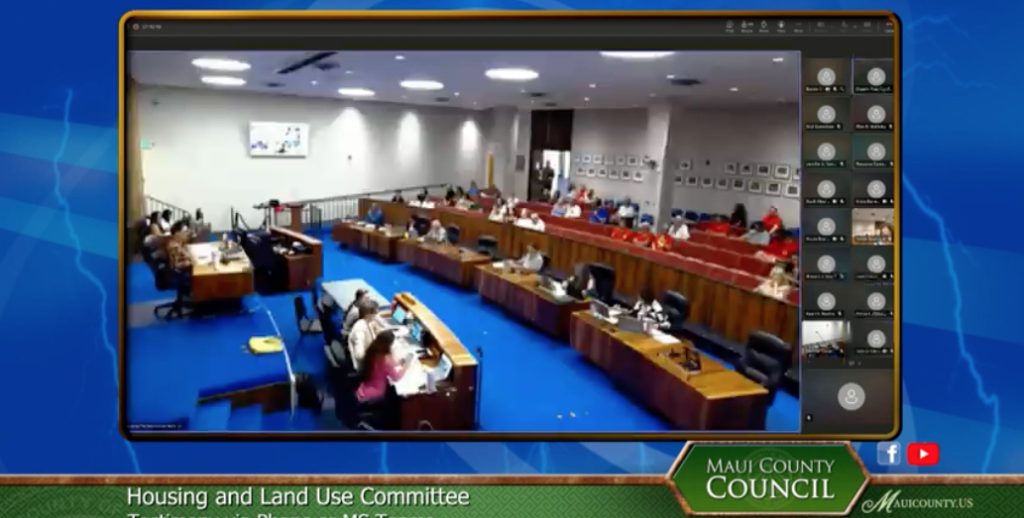
The meeting can be viewed live on Akakū – Maui Community Media, cable Channel 53 or on the Council’s YouTube channel. It’s also accessible online via Teams at http://tinyurl.com/2p9zhjr2. To testify by phone, call 1-808-977-4067 and enter meeting code 420 614 452#.
If a meeting participant wishes to testify anonymously, he or she should log in to the meeting with an appropriate anonymous name and virtually raise their hand. If a testifier connects to the meeting by phone, the committee chair will call the last four digits of the testifier’s phone number.
In person testimony will be taken in the order of signups in the eighth floor Council Chambers of the Kalana O Maui Building in Wailuku.
Written testimony will be accepted via eComment. Search for the meeting date on mauicounty.us/agendas, click on the eComment link, then select the agenda item to submit comments on. Or, written testimony will be accepted via email to BFED.committee@mauicounty.us or postal service to BFED Committee, Maui County Council, 200 S. High St., Wailuku HI 96793.
The fiscal 2027 budget will go into effect on July 1.
Sponsored Content