Maui Fraud Risk Assessment reveals inadequate policies, identifies millions of dollars in ‘direct pay’
or filing a tip online. PC: County of Maui / YouTube screen grab.
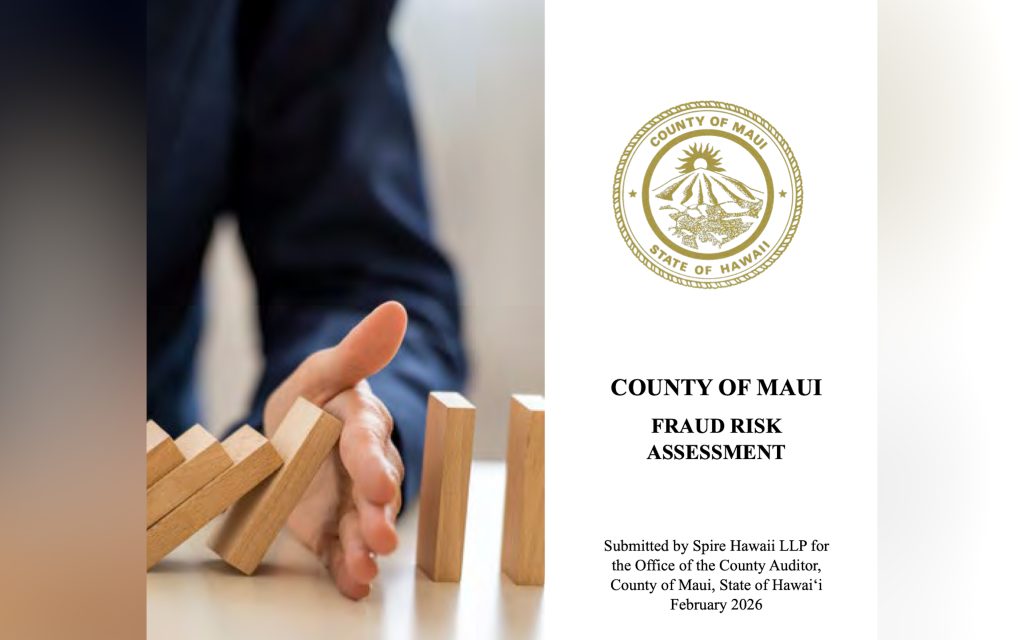
The County of Maui’s Office of the Auditor presented findings from a Fraud Risk Assessment report during a committee meeting Tuesday and outlined 2027 plans to address concerns. The report, prepared by Spire Hawai’i LLP, identified two major findings and five recommendations to strengthen fiscal protocols and foster public confidence in government.
The findings and recommendations, were released in February 2026, and were publicly presented this week before the council’s Government Relations, Ethics and Transparency (GREAT) Committee.
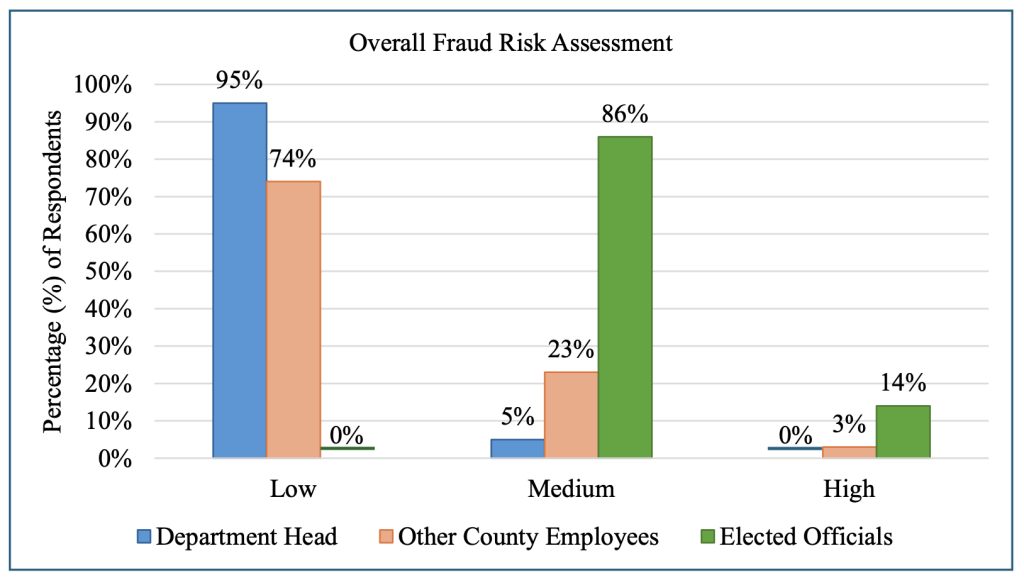
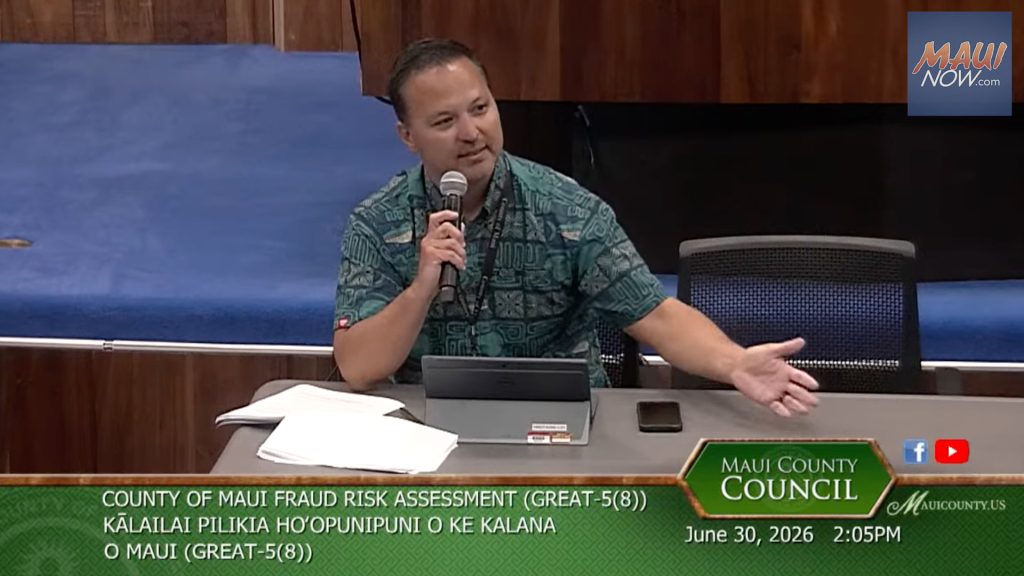
Tyler Kimura, partner with Spire Hawaiʻi, presented the findings, saying his team surveyed 382 officials and employees across 20 of 21 executive departments. (The Salary Commission was excluded, as it didn’t have any staff). He pointed out a gap in perception with 86% of elected officials rating fraud risk as “medium,” while 95% of department heads rated it as “low” within their own departments.
Kimura said a kickoff meeting was held with the mayor’s cabinet in which the scope of the risk assessment was discussed. Subsequent to that, numerous document requests and followup requests for interviews were made. Four departments either provided limited information or were unable to schedule an interview after “multiple attempts,” according to Spire.
Two findings identified
The report outlined two key findings, focused on gaps in policies and procedures concerning anti-fraud controls and handling of complaints.
The report’s first finding identified inadequate anti-fraud controls. The County’s policies and procedures do not cover significant areas of fraud exposure, according to the report.
The report found there are no controls when Procurement Law is suspended, no countywide programs to monitor vendor billing fraud, and County policies don’t prevent employees from being paid for working overtime that was not required or approved. The report also finds that Maui is one of only two Hawai’i government entities with no nepotism policy. Also, while certain departments have background/fraud screening during their hiring process, there is no countywide policy in place for this preventative measure.
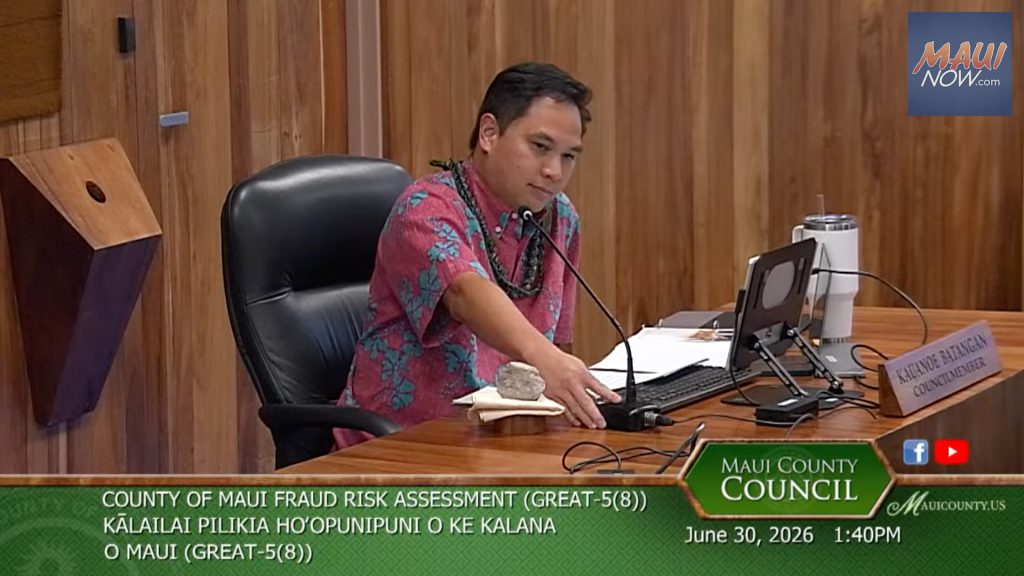
This section also identified oversight conflict between the Department of Water Supply and the Department of Finance. Committee Chair Kauanoe Batangan sought clarification on two potential instances of fraud identified in the report.
- He pointed to a portion of the report that showed 6,223 “direct pay” transactions at the Department of Water Supply, totaling approximately $21 million in goods and services procured outside of county safeguards.
- He also sought clarification on a reference in the Department of Finance involving a P-card and an “undocumented instance of management override” related to the County Financial policy. According to the report, “In this instance, an employee’s P-card was removed for inappropriate parceling but was reinstated by higher-ups in the Department of Finance.”
Committee staff from DWS provided clarification, saying more than $16 million of that figure involved utility payments, leaving approximately $5 million in other direct pay that was not attached to a purchase order or contract.
Batangan said “All of the protections for fraud are built in to purchasing orders, P-cards, [and] RFPs; and the direct pay system circumvents all of that.” He said that if the purchase of utilities is an acceptable use, it doesn’t match the explanation given by the department for how direct pay is used and when it’s appropriate.
The report’s second finding noted that there is no policy on handling fraud complaints. Multiple entities receive, investigate, and make decisions on fraud using their own processes—creating confusion and potentially inconsistent outcomes. This can result in the following consequences according to the report:
- Forum shopping: The public and employees might close to file complaints with whichever entity they think will give them the result they want.
- No policy on handling fraud complaints: The county has no written policy on where to send complaints it receives. The department must decide on their own where to report fraud.
- Departments left in limbo: The April 2025 Security Policy requires fraud reporting to the MPD and Managing Director, but does not say whether departments can retain their existing disciplinary processes.
Recommendations outlined
- Develop fraud mitigation and internal control systems: Design controls proactively, not reactively.
- Address policy and procedure gaps: Unwritten policies must be documented so gaps can be identified.
- Provide employee fraud awareness training: The report notes that organizations without training suffer two times the losses. An estimated 58% of department heads cited lack of training as a barrier.
- Convene a cross-departmental fraud reporting working group: The working group could develop a unified countywide policy for reporting, investigating, and responding to fraud. Also, seek to address jurisdictional overlaps.
- The working group could develop a communications and training plan for fraud reporting: Ensure all employees, departments, and the public understand how to report fraud and what happens next.
Administration begins taking action
The County administration disagreed with certain findings, but agreed with recommendations and noted that it will start to implement actions.
Managing Director Josiah Nishita said that the Countyʻs response was based on a draft report filed by Spire Hawaiʻi, and some of the items have since changed in the final assessment, creating some confusion.
He said that the County being a CDBG-DR recipient was “a blessing in disguise” because that required the creation of additional protocols and policies in order to obtain federal financing. He said the County has been able to benefit from external agency review and “honing” in on policies and procedures and identifying where some of those can be integrated into normal County operations.
Nishita said the assessment provides the opportunity for the County to examine the situation.
“For us it’s less about what we may or may not agree or disagree with in relation to the report—What’s more important is how do we learn from it and how do we get better. That’s really the most important piece of it,” said Nishita. “Really in anything we do, thereʻs always ways to improve and get better.”
He said progress is being made and includes the expansion of fraud awareness training, development of a nepotism policy in collaboration with the Board of Ethics, screening applicants for fraud risk by working with consultant Guidehouse.
The Finance Department requested $125,000 in FY2027 to strengthen internal controls. An RFP has been drafted, and it should be solicited in the first few weeks of July, according to department officials.
2027 Audit Plan to include review of private jet travel
In addition to charter mandated projects, items added to the FY2027 Audit Plan include the following Self Initiated Projects:
- Review of “Direct Pay” Transactions of the Department of Water Supply
- Review of the County’s Travel Policy regarding private jet travel.
- Evaluation of the County’s Vacant Positions.
- Audit of Improvement Agreements related to three lots or less subdivisions, also known as deferral agreements (Postponed).
Details of travel incidents were not covered during the meeting, but County Auditor Lance Taguchi provided further context saying:
“Specifically private jet travel provided to county employees by entities with businesses in front of the County… This just came to my attention a few months ago, but I believe it warrants us taking a look to find out if this was widespread and whether or not the county travel policy allows such things.”
Charter-mandated projects to be reviewed as part of the Audit Plan include: oversight of the ongoing independent financial audit of the County of Maui for FY2026 financial statements including an audit of DWS and single audit reports of federal financial assistance programs; and a financial impact analysis of proposed amendments to the Maui County Charter.
Fraud hotline established
As as result of the assessment, the County Auditor’s office has established a new fraud, waste, and abuse hotline that is now operational. The hotline, managed by a third party outside the state, accepts reports and tips around the clock via phone and online reports, and allows anonymous submissions. Reports can be made by county employees, vendors, and the general public.
- Fraud Hotline toll-free number: 833-908-TIPS (8477)
- Online: https://secure.ethicspoint.com/domain/media/en/gui/1002660/index.html

Background: Why assessment is needed
County Auditor Lance Taguchi said the assessment was commissioned following a “share of challenges” occurring within Maui County in recent years including:
- A bribery scheme from back in 2012 to 2018 involving former Maui director of the Department of Environmental Management, Stewart Olani Stant. Stant was sentenced in 2023 to 10 years in federal prison after pleading guilty to honest services wire fraud. He was accused of steering $19 million in contracts to H2O Processes, LLC, a company run by Hawaiʻi businessman Milton Choy.
- Prolonged use of emergency procurements and large purchases during the COVID-19 pandemic and the recovery efforts related to the Aug. 8, 2023 wildfires.
“Also, there were observations by my office of possible fraud, waste and abuse made between 2023 and 2024,” said Taguchi. “There was a departure of key county personnel including the termination of the Director of Finance in April 2024.” Scott Teruya was put on paid administrative leave Feb. 2. His removal as director at the time was described as a “personnel matter” with no further explanation.
ARTICLE CONTINUES BELOW AD“Just to be clear, some of the issues predate this administration, however that doesn’t make them immune from being targeted nor being responsible for addressing it when they are made aware of it,” said Taguchi. “We recognize that the administration, the council as well as my office must stay vigilant and focus on making many meaningful corrective actions until these risks are minimized.”
What’s next?
The GREAT Committee meets again on July 28, 2026. Members will review ethics-related legislation including Bill 55-2025 on code of ethics violations and penalties. There’s also a bill to prohibit nepotism, and legislation establishing standards for lobbyists.
Taguchi reflected on the Fraud Risk Assessment saying, “The findings are the findings.. . But I’ve always felt, more importantly, it’s the recommendations and implementation of the recommendations. Without that, then the report becomes useless.”
Sponsored Content