Maui Council committee advances bills rezoning dozens of Kīhei, West Maui apartment complexes as hotels
The Maui County Council’s Housing and Land Use Committee voted 6-2 Monday to forward two resolutions that would begin the process of moving dozens of vacation rentals from apartment-zoned districts into newly created hotel zoning. Council Members Gabe Johnson and Keani Rawlins-Fernandez voted “no,” and Council Member Tamara Paltin was excused from the final vote.
In what one testifier said might be the largest county-initiated zoning and community plan change in Maui County history, the measures would allow dozens of West and South Maui transient vacation rental properties to continue operating as hotels, as many have done for decades.
The crux of the debate is whether apartment units, long zoned for residential use, should be used as direly needed local housing or continue operating as visitor accommodations with the economic benefits of jobs, property tax revenue and income for vacation rental investors.
Bill 88, now Ordinance 6008, created two new hotel zoning categories—H-3 and H-4—intended to match the existing use of roughly 4,500 grandfathered vacation rentals at 104 properties on the so-called Minatoya List. The passage of Bill 88 kicked off what’s happening now—the first attempts to rezone properties from apartment to new hotel zoning as the County phases out vacation rentals in apartment districts under Bill 9.
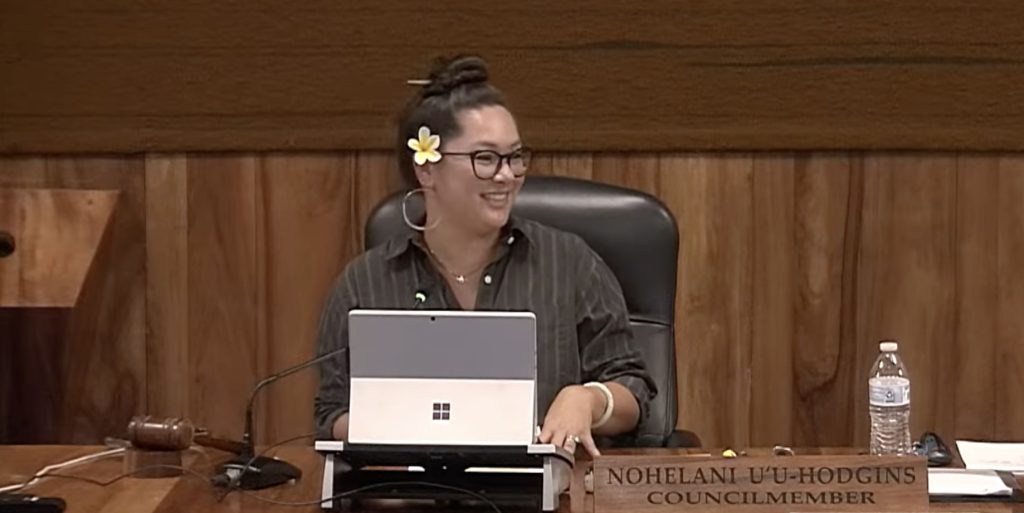
The Housing and Land Use Committee, chaired by Council Member Nohelani Uʻu-Hodgins, spent parts of two days — July 1 and July 6 — working through Resolutions 26-110 and 26-111. It heard hours of testimony on the first day and adopted a series of amendments before sending the measures forward on Monday.
If the full Council adopts them, the resolutions would refer companion bills to the Maui Planning Commission. These bills would amend the Kīhei-Mākena and West Maui community plans and change the zoning for select apartment-district properties to the H-3 or H-4 Hotel District, which was created under Bill 88 when it took effect on June 22. Uʻu-Hodgins told the committee the new districts mirror the A-1 and A-2 Apartment District standards but permit continued transient vacation rental use.
Resolution 26-110 covers properties with timeshare, leasehold or other characteristics, including Hono Kai and Milowai-Māʻalaea in Māʻalaea, Maui Sunset and Maui Hill in Kīhei, and Kahana Outrigger, Hale Mahina Beach Resort and Kāʻanapali Royal in West Maui. Resolution 26-111 covers seven properties the county says already operate like hotels, including Wailea Ekahi I, II and III, Wailea Ekolu, the Palms at Wailea, Papakea and Maui Eldorado. Both bills would shift the affected properties’ community plan designation from multifamily or light industrial to hotel.
Planning Department recommendations
Following two transmittals from the Department of Planning dated June 30 and July 1, the committee adopted corrections Planning Director Jacky Takakura’s office had flagged. Administrative Planning Officer Greg Pfost told the committee that three properties — 1444, 1440 and 1470 Halama St. — were listed with an incorrect “multifamily” designation when their actual designation is single-family, and the bill was corrected accordingly.
The Planning Department recommended adding a tax map key to Kahana Outrigger’s listing that had been omitted, and called for rezoning the entire Milowai-Māʻalaea’s apartment-zoned property to hotel district. Hono Kai, which is split-zoned A-1 and A-2, will be rezoned to a matching split of H-3 and H-4 instead of H-3 alone. The department also recommended retaining language—rather than removing it—that allows A-1 and A-2 apartment uses to continue as compatible uses under the Hotel/Resort community plan designation.
Committee adds, subtracts from property lists
Over two days, members added and subtracted properties and criteria. The committee removed Hale Ono Loa from Resolution 26-110 after testimony indicated the property no longer has timeshare units, with Uʻu-Hodgins saying she wanted the list to be “as least arbitrary as possible.”
Council Member Tamara Paltin added amendments covering additional single-ownership properties and properties allowed to operate vacation rentals under county variances. She included criteria to capture properties that are 100% timeshare and not affected by Bill 9’s vacation-rental phase-out. Committee Vice Chair Kauanoe Batangan added a friendly amendment tying that criteria to the county’s 1991 timeshare-plan cutoff date in the Maui County Code.
Members also considered, and on a 4-5 roll call rejected, a motion by Rawlins-Fernandez and Paltin to limit Resolution 26-110’s rezoning eligibility to only properties that are 100% leasehold — a change that would have shrunk the list to seven properties, including Milowai-Māʻalaea and the three Kahana Outrigger parcels. Council Chair Alice Lee had proposed amending that threshold to 75% “to be fair to those in the minority who really don’t have a voice here today,” but withdrew it before the vote.
Leasehold properties
Much of the committee’s caution about leasehold properties stemmed from an assumption that these units are difficult to mortgage, making them poor prospects for long-term local housing.
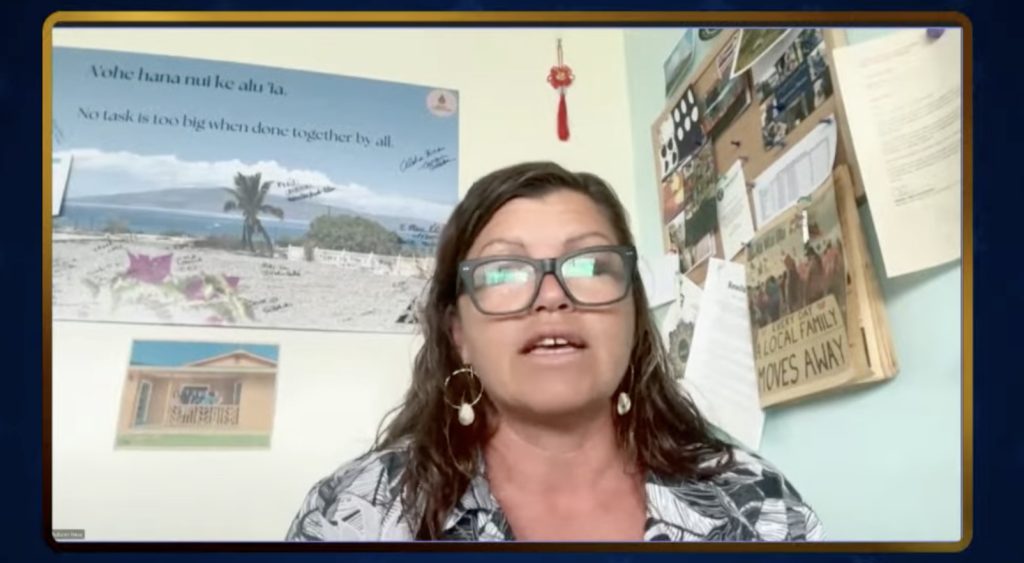
Autumn Ness, executive director of the Lahaina Community Land Trust, challenged that premise, telling the committee lenders “love leaseholds” as long as the lease term outlasts the mortgage by five years or more. Ness named four lenders—American Savings Bank, Central Pacific Bank, Security National Mortgage, and Land Home Financial—that she said routinely finance leasehold properties, while noting Bank of Hawaiʻi, often cited in committee discussions, is a stricter outlier. She urged the committee to seek a bank opinion on specific properties, such as Kahana Outrigger, before assuming those properties can’t support local homeownership.
Resident housing versus tourism revenue
Much of the two-day discussion focused on whether formalizing hotel zoning for these properties would deplete Maui’s housing stock.
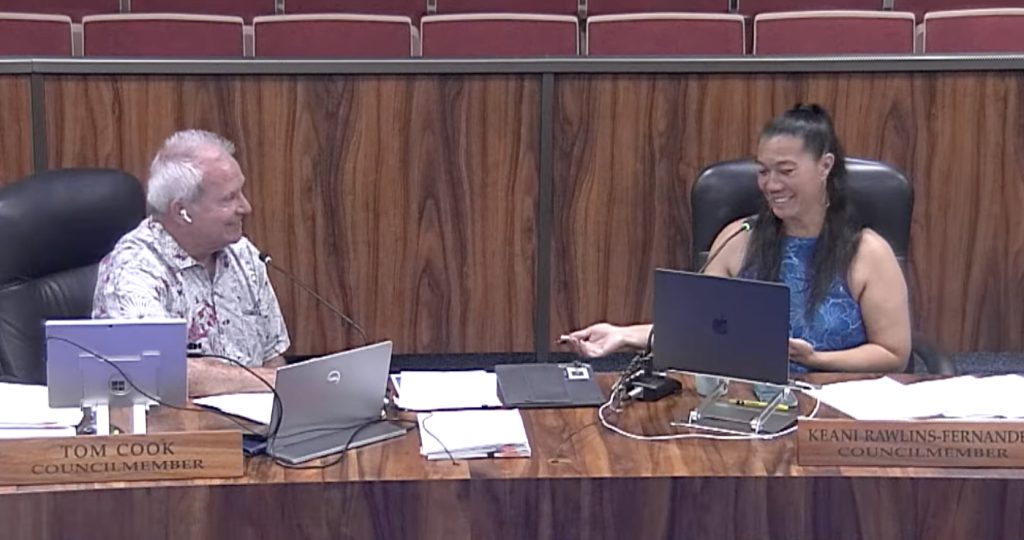
Council Member Tom Cook presented Multiple Listing Service data showing 298 sales of Minatoya List properties between Dec. 2 and June 1, with 183 cash sales and about 90% of buyers from off-island.
“Some of these properties won’t end up being local resident housing,” Cook said, adding that the County could generate income through real property taxation to fund affordable housing.
“It’s not all about the money, but the cash generated potentially to basically be able to subsidize and build, whether it be buying property and building homes for local residents,” he said.
Johnson and Rawlins-Fernandez, who cast the two dissenting votes on referring the bills to the Maui Planning Commission, argued the County should buy units for workforce or affordable housing rather than rezone them for continued vacation rental use.
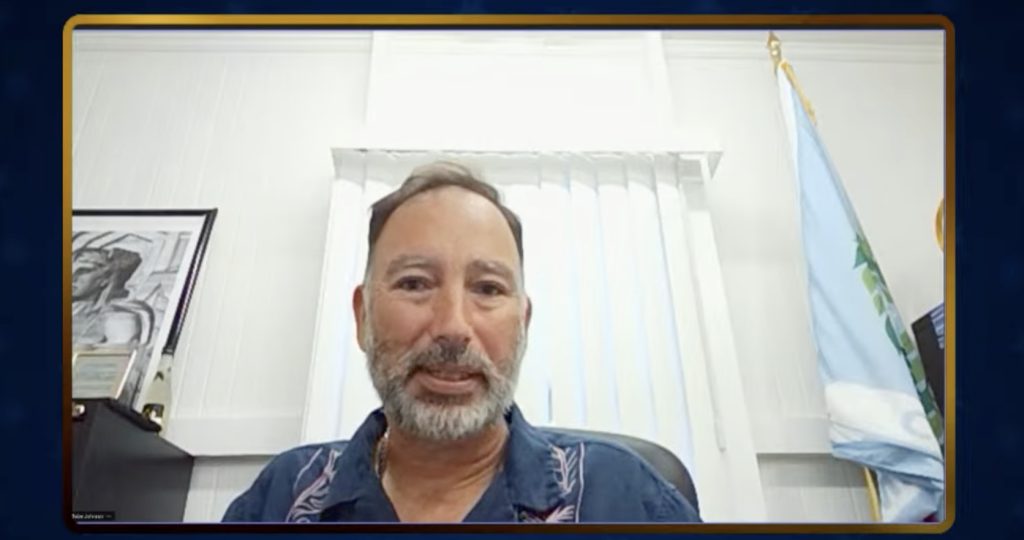
“Where’s our Department of Housing? They should be out buying some of these units,” Johnson said.
Current market pressure calls for more resident housing, not more short-term rentals, he said, noting roughly 80% of pre-fire Lahaina residents were renters. “They would have loved some of those two-bedroom units.”
Rawlins-Fernandez agreed with Johnson.
“I know that certain colleagues are just like revenue hungry, and it’s just like when is enough, and it’s never enough,” she said. “It’s like selling out our people… It’s great when we get revenue if it’s actually improving the quality of life for our residents. But, no, we’re pushing them out, and they have to leave, and they have to divide up their family, and it’s heartbreaking.”
Public testimony
During public testimony, several property owners and their representatives urged the committee to move forward, arguing the buildings already function as hotels and deserve zoning that reflects this.
Brian Banks, a small business owner who manages vacation rental units at three Minatoya properties in Wailea, said all four condominium complexes in that neighborhood—Ekahi, Ekolu, Grand Champions and the Palms—have operated primarily as short-term rentals since they were built, “contributing significantly to the community through taxes and jobs.”
He asked the committee to add Grand Champions, which Resolution 26-111 currently excludes.
Rory Frampton testified representing the family-owned Makai Sunset Inn located at 1411 and 1415 Front St. in Lahaina, requesting hotel zoning for the property. Before the August 2023 wildfire, the 21-unit property operated as a transient vacation rental, he said.
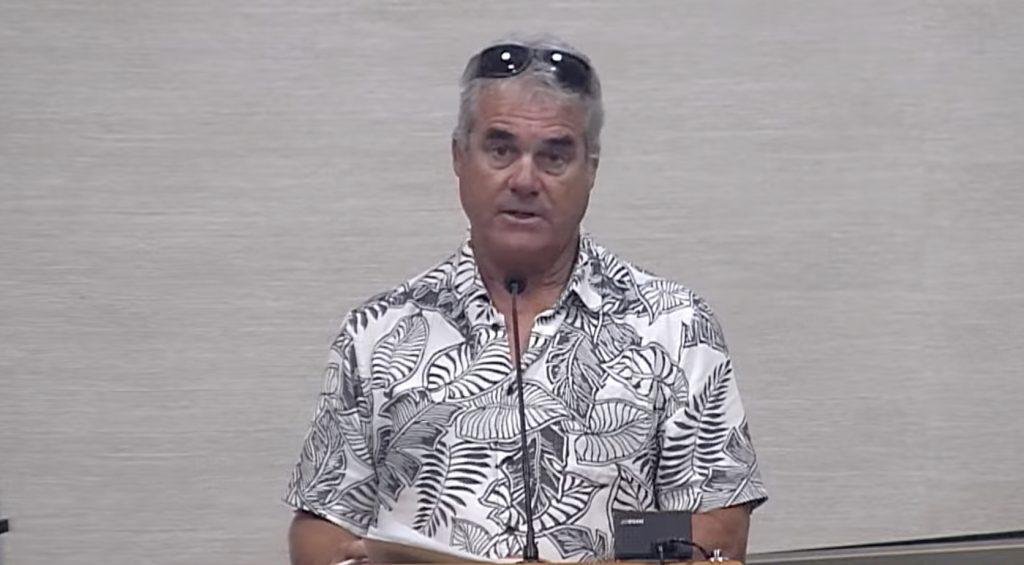
“Although they met all the criteria, for some reason, they were not identified on the Minatoya List, so they’re not on any of the lists that you see in front of you today,” Frampton said, noting the purpose of the resolution is to adopt zoning and community plan designations for properties operating as hotels.
“The Makai Sunset Inn operated as a hotel,” he said. “It had a front desk. It had a property manager that would assist with the check-ins and check-outs… It had housekeeping staff.”
Phil Mills, board president for Hale Ono Loa’s owners’ association, told the committee the 68-unit oceanfront complex “has operated as a legal short-term vacation rental property” since 1969 and “functioned in many ways like a small resort.”
Caitlin Miller, testifying for the Maui Vacation Rental Association, said the resolutions are consistent with Bill 88’s underlying purpose: “to align zoning with longstanding lawful visitor accommodation uses,” not to create new visitor-accommodations or new land-use rights.
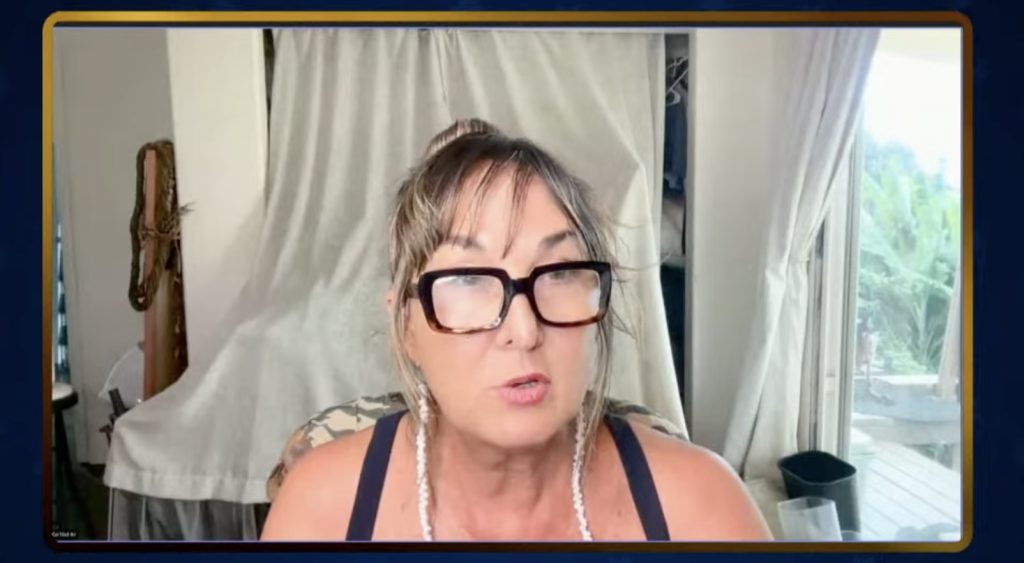
Kai Nishiki, a former chair of the West Maui Community Plan Advisory Committee, told council members the pending bills may be the largest county-initiated zoning change and community plan amendment in Maui County’s history.
She encouraged councilors to ask one question: “What do we want Maui shorelines to look like in 25, 50 and 75 years from now?”
“The answer should guide our land use decisions, our infrastructure investments and our policies,” Nishiki said. “Today, I ask that climate risk be placed at the center of that discussion.”
She noted that the Council’s Temporary Investigative Group “acknowledged that many properties within the sea-level-rise exposure area will not provide long-term housing for local residents. At the same time, the County’s own hazard mitigation plan tells us that coastal erosion will reduce property values, impact our tax base and require increasing public expenditures as shorelines migrate inland.”
The fundamental question, she said, is: “Who is ultimately left holding the bag when investors decide to exit aging shoreline properties built in the ’70s? Investors naturally seek to maximize their return when they sell, but the County and our taxpayers remain responsible for the long-term consequences; whether that’s emergency response, damaged infrastructure, beach loss, shoreline hardening, or declining tax revenues.”
Nishiki called it “fiscally reckless” to encourage additional investment in known hazard areas while expecting the Federal Emergency Management Agency and US taxpayers to “absorb the costs when the inevitable occurs.”
She argued the county should treat any value increase from upzoning as grounds to require public benefits and stewardship commitments from owners, particularly given climate exposure. She cited a Planning Department memorandum showing 43 Minatoya List properties, about 2,440 units primarily in West Maui, sit within a 3.2-foot sea-level-rise exposure zone. She asked the committee to require the same environmental and hazard review of these Council-initiated rezonings that would apply to owner-initiated ones.
“The plans, policies, and management actions we adopt today will determine whether future generations inherit healthy beaches and thriving coastal ecosystems or fields of sandbags, failing seawalls, and collapsed buildings,” Nishiki said.
What’s next?
If adopted by the full Council, the resolutions will advance the bills to the Maui Planning Commission, which is expected to take them up in September.
Sponsored Content