

Hale Noelani demolition clears way for future student housing at UH Mānoa
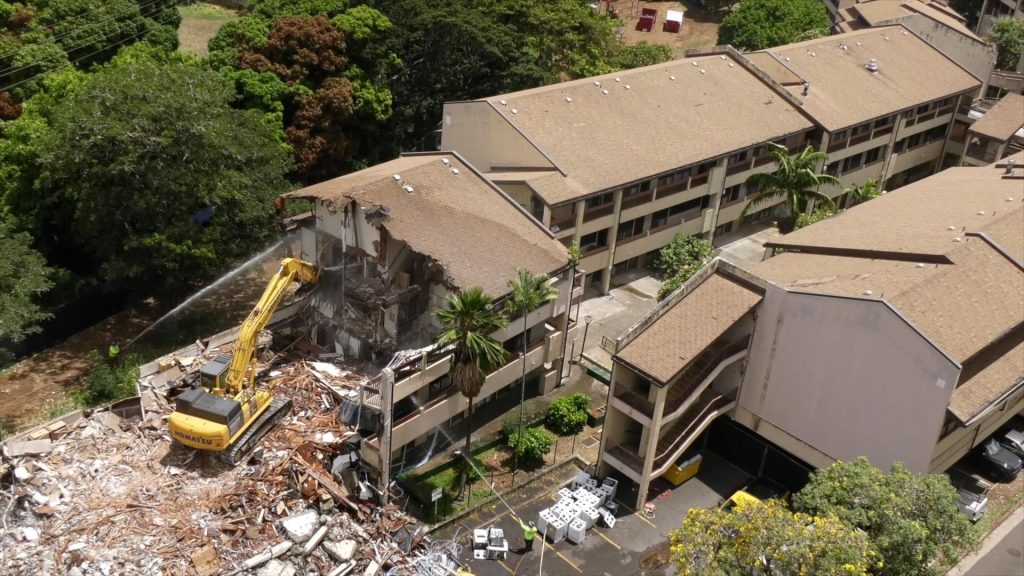
The University of Hawaiʻi at Mānoa has begun demolishing two buildings at the five-building, three-story Hale Noelani student housing complex, marking another step in the university’s long-term effort to modernize campus housing and enhance the student residential experience.
Demolition of Buildings C and D began on July 6 and is expected to be completed by mid-August, before the start of the fall 2026 semester. The project is overseen by the UH Mānoa Office of Campus Operations and Facilities (COPF) and the UH Office of Project of Delivery, and includes demolition of the structures, removal of debris and preparation of the site for future use. The university continues to evaluate options for the remaining three buildings (A, B and E), including renovation or demolition, as it works to realize the highest and best use of the Hale Noelani site in support of its long-term student housing strategy.
“Providing high-quality housing is an important part of the student experience and one of my highest priorities as chancellor,” UH Mānoa Chancellor Vassilis L. Syrmos said. “The university has made good progress over the past four years modernizing our residential communities, and this project allows us to continue building on that momentum. Clearing this site creates new opportunities to better serve our students for generations to come.”
Constructed in 1977, the Hale Noelani complex once provided approximately 530 apartment-style beds for students. Demolition of Buildings C and D permanently removes 174 of those beds. The complex has been vacant since 2017 after university officials determined that returning it to service would have required extensive infrastructure upgrades, including replacement of the aging plumbing system, at a time when student enrollment was declining.
Expanding housing
During that period, the student housing inventory has been increased by the UH Foundation through innovative public-private partnerships (P3s) that did not rely on state funding. The Walter Dods, Jr. RISE Center opened in 2023 as one of Hawaiʻi’s first successful P3 projects, adding 325 student housing beds along with innovation and entrepreneurship spaces. In 2025, Hale Haukani became the university’s second P3 housing community, adding 558 apartment-style beds, study rooms, retail space, a childcare center and community gathering areas.
Together, the two projects increased UH Mānoa’s housing inventory to more than 4,000 beds, the largest residential capacity in university history.
Investing in the future of campus housing
While expanding housing capacity, UH Mānoa has also made significant investments in the long-term planning of its existing residence halls. Beginning in 2023, the UH Office of the Vice President for Administration led a comprehensive effort to modernize and strengthen the university’s student housing program, including the development of a seven-year capital improvement plan for residence halls. The plan aims to bring 95% of residence halls into fair or better condition by fiscal year 2028 and extend the useful life of existing housing facilities by an additional 20-30 years.
The university is also contracting with a planning consultant to develop a comprehensive Student Housing Plan that aligns with the university’s mission and strategic goals.
“We’re taking a broader look at the future of student housing that will address current challenges and anticipate future student housing needs,” said David Akana, interim director of Student Housing Services. “This comprehensive Student Housing plan will help guide long-term decisions while ensuring our residence halls continue to foster community, support academic success and enhance the overall student experience for future generations of students.”
The university also partnered with an independent financial consultant to develop a long-term financial model that aligns housing rates with the costs of operating, maintaining and renewing residence halls, helping ensure the program’s long-term financial sustainability.
Improving the student experience
Student Housing Services and COPF also made significant investments to enhance students’ day-to-day living experience, from modernizing common spaces to upgrading residence hall rooms and infrastructure.
One of the most visible projects was the 2024 renovation of the lobbies and common areas in the four 13-story Hale Aloha Towers, home to 1,040 first-year students each year, about one-fourth of the approximately 4,000 students living in UH Mānoa housing.
More than 1,400 new energy-efficient MicroFridges—combination microwave and refrigerator units—were installed in student rooms and suite areas across nearly all residence halls, except Hale Wainani Apartments. Every student room has also received a new mattress, while more than 300 wireless access points have improved Wi-Fi coverage and reliability throughout the residence halls.
Behind the scenes, crews repaired or replaced more than 300 windows, bed frames, plumbing fixtures and air-conditioning units while expanding preventive maintenance and security upgrades throughout the residence halls. The university also replaced more than 1,300 smoke detectors and installed new water bottle filling stations across campus housing.
Additional improvements include new community furniture, eco-friendly dining initiatives, updated laundry equipment, improved move-in experiences, and the addition of a Starbucks at Gateway Café, creating additional spaces for students to gather, study, and build community.
Sponsored Content