Maui Council committee votes 7-1 to recommend $6 million purchase of West Maui water systems
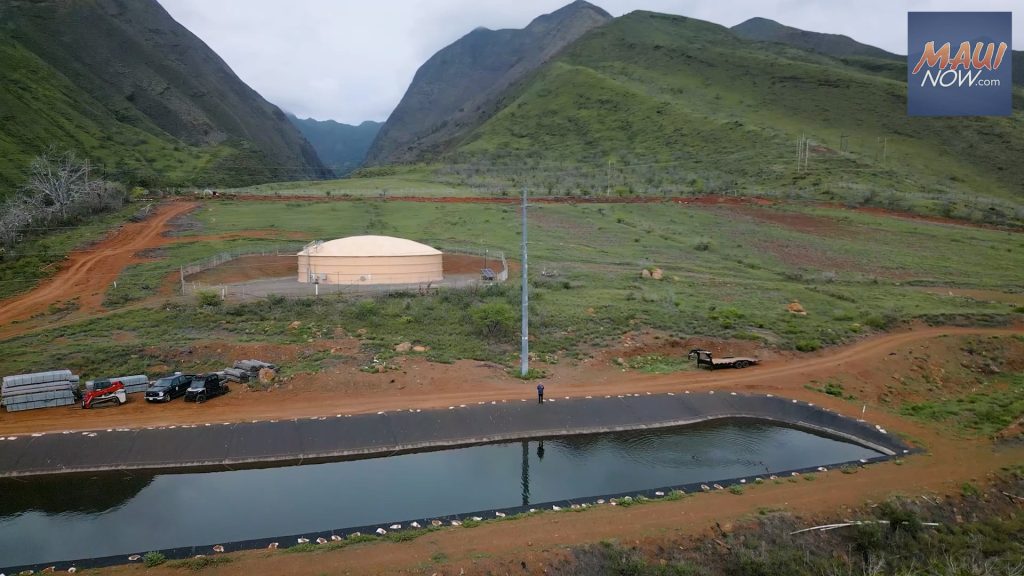
A Maui County Council committee voted 7-1 Tuesday to recommend adoption of a resolution authorizing the county to spend up to $6 million to acquire two privately owned West Maui water systems.
The Budget, Finance and Economic Development Committee advanced Resolution 26-116 to the full Council. The resolution would authorize the county’s Department of Water Supply to acquire wells, reservoirs, booster pumps, pipelines and easements from the Launiupoko and Olowalu water companies.
Council Chair Alice Lee cast the lone “no” vote. Council Member Shane Sinenci was absent and excused.
The vote sends the resolution to the full Council for consideration, following an earlier discussion-only hearing before the Water and Infrastructure Committee on July 27. If approved by the full Council, the resolution would move to the state Public Utilities Commission for review before a sale could close.
The $6 million price tag does not include closing costs. Because the proposed acquisition price exceeds $250,000, Council authorization is required under the Maui County Code, which governs County acquisitions of real property.
Support cited thoroughness of review, community demand
Council Member Tamara Paltin, who holds the West Maui residency Council seat, said she has seen packed Commission on Water Resource Management meetings with residents arguing that 28% of public control of water in West Maui is too little and 72% of private control is too much.

Paltin told committee members she was in “full support” of the proposed water acquisitions. “I don’t think it’s a smart move to delay any further,” she said.
Council Member Tom Cook, who chairs the Water and Infrastructure Committee and has worked on the acquisition for months, said the appraisal and engineering review of the systems were thorough. He said his confidence in the deal was built when he learned that Water Department staff physically inspected the systems during the due diligence process.
Council Member Keani Rawlins-Fernandez pointed to years of advocacy from West Maui residents for public control of local water resources because nearly 90% of West Maui water has been controlled by private interests.
“We’re now rectifying this by taking control on behalf of the community,” she said.
Council Member Nohelani Uʻu-Hodgins called the West Maui water acquisition a “historical” opportunity.
“Not always do we have a willing seller for water and infrastructure,” she said, adding that the $6 million cost represents a small fraction of the county’s overall budget.
Council Member Gabe Johnson said he strongly supports taking a working water system out of private hands and putting it into public ownership. “That’s right up my alley,” he said, adding that he believes the county should be more aggressive about moving private water systems and other infrastructure into public hands. “This is taking the profit out of it and putting the service into it,” he said.
Council Member Kauanoe Batangan, who had pressed county staff earlier in the process over the pricing gap between the two systems’ appraised and purchase values, said he continued being in favor of the acquisition but he might reconsider.
“I’m still supportive of this, but I might be open to a different position,” he said, if the county’s Board of Water Supply raises new concerns.
County projections show both systems would operate in the black under Department of Water Supply rates. The Launiupoko system is projected to generate about $2.56 million in annual revenue against roughly $880,000 in operating costs, while the Olowalu system is projected to bring in about $734,000 against $672,000 in costs — meaning existing customers would not require a taxpayer subsidy to keep the systems running, under current usage and income from water use.
Lee’s dissent centered on process, county finances
Lee said she had reservations about the water deal and wanted to hear input from the Board of Water Supply. She voted no, but she said she could change her mind when the matter comes before the full Council.

Lee said she wanted her decision to be grounded in facts and objectivity. “I try not to get emotional with my decision-making, and I am very concerned about the financial state of the county,” she said. “That’s where my priority lies; that we’re making a wise and prudent decision, economically, financially.”
She pointed out that the Board of Water Supply, through the findings of its Temporary Investigative Group, raised concerns about surface and groundwater permits in the Lahaina water district, which includes Launiupoko and Olowalu.
Other members countered that the Water Board had known about the proposed acquisition for months without formally weighing in, and that the board reviews the department’s acquisition funding requests as part of its regular budget oversight.
No members of the public testified at Tuesday’s meeting.
Connecting Olowalu-Launiupoko with the Lahaina water system
In response to a Maui Now question about whether the Department of Water Supply plans to connect the Olowalu-Launiupoko water system with the public Lahaina system in the future, the department affirmed that “as part of long-term planning, the department is evaluating potential connections between water systems to support future water needs and system reliability.”
The department said that while the system would support customers in the Olowalu-Launiupoko area, it is evaluating how the system could support broader community water needs.
The proposed transfer or allocation of water resources would require review and approval by the state Commission on Water Resource Management, the department said.
Background: A $6 million deal priced below combined appraised value
The resolution would authorize the county to acquire the Launiupoko system, which serves 402 active connections, for $3.5 million — well below its $8,056,000 appraised value. The Olowalu system, which includes separate potable and non-potable components, would cost the county $2.5 million, about $518,000 above its $1,978,000 appraised value.
Combined, the purchase would add about 480 potable customers and 72 non-potable customers to the county water system and transfer roughly 16 miles of potable water mains and 3 miles of non-potable mains into public ownership. County officials have said the two systems were negotiated together as a package deal worth roughly $10 million in combined investment value, or $4 million more than the $6 million negotiated purchase price.

Post-closing, the county has budgeted for improvements including reservoir fencing, relining the Olowalu system’s Snake Reservoir, new Supervisory Control and Data Acquisition system integration and expanded fire hydrant access — work officials say is aimed partly at hardening the systems after wildfire-related water contamination problems in 2023.
The purchase is the second phase of a broader county effort, following a May memorandum of understanding with Maui Land & Pineapple Co. to acquire that company’s larger, unrelated West Maui water infrastructure.
Last week, the Council’s Disaster Recovery, International Affairs and Planning Committee held an informational briefing on that non-binding MOU, signed May 18.
Mayor Richard Bissen’s administration has said the combined effort would raise public ownership of West Maui’s drinking water systems from 45% to 93%, and has tied the acquisitions to freeing up water capacity for affordable housing, agriculture, emergency preparedness and Native Hawaiian cultural practices.
Mayor Bissen first announced the $6 million Launiupoko-Olowalu proposal on July 1, and the Water and Infrastructure Committee held a discussion-only hearing on the resolution July 27, where all public testimony favored the purchase.
County officials have previously said approval from the state Commission on Water Resource Management is not required for the acquisition itself but would be needed if the county later sought to expand water use beyond the sellers’ existing pumping permits.
Separately, because Launiupoko and Olowalu are regulated utilities, the sale itself requires state Public Utilities Commission approval. If the full Council approves the resolution, the deal would move to the PUC for review before closing, a process county officials have said could take several months.
Sponsored Content