

State land board rejects 30-year East Maui water-license auction, moves ahead with contested-case
The state Board of Land and Natural Resources on Friday unanimously rejected a proposal to put a 30-year East Maui commercial water license up for public auction, while separately voting to advance a court-ordered contested-case hearing over revocable permits held by Mahi Pono and East Maui Irrigation Co.
Maui board member James “Jay” Carpio made the motion to deny the water lease for auction.
“I see the 150 years of reckoning,” he said.
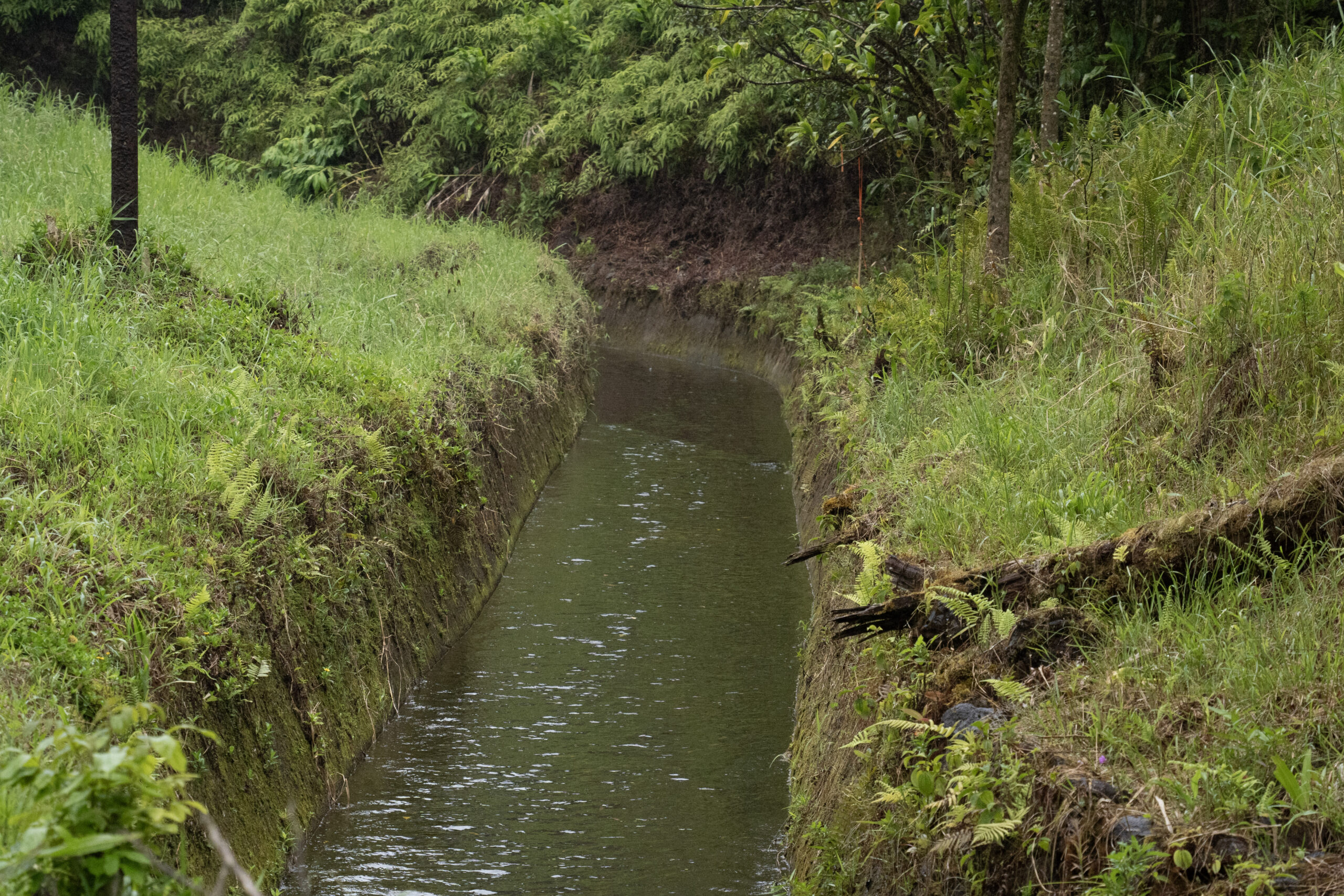
Carpio reflected on the 7,000 kānaka and pākē (Chinese) laborers who built the first 17 miles of ditches in East Maui, “and four-fifths of that was kānaka,” building without the benefit of hydraulics and other modern construction equipment.
“They busted butt back then,” he said. Later, adding that “fast-forwarding to today, I was really hoping to see somebody from (Mahi Pono owner) PSP over here today. I think that would have been huge.”
The board’s two votes followed hours of testimony, much of it from dozens of East Maui residents, kalo farmers, Native Hawaiian advocates and public officials who opposed placing long-term control of diverted East Maui water with a private commercial licensee.
Mayor Bissen: A “meaningful voice” for Maui in water stewardship
Mayor Richard Bissen asked board members to deny the proposed public auction of the water lease.

“For generations, the waters of East Maui have flowed from the mountains, through our streams, and across our islands, sustaining our families, our communities, our cultural practices, and agriculture,” he said. “But the history of East Maui water is also filled with difficult and too often wrong decisions about who controls that water, who benefits from it, and whose voices are heard when those decisions are made.”
Board members had an opportunity to “correct that history,” Bissen said. “For the people of Maui, this is more than a discussion about licenses, infrastructure, or allocation. It is about who has a voice in the stewardship of one of our most precious public trust resources. That history led to decisive action in 2022 when 64% of Maui County voters supported the creation of the East Maui Water Authority. Our people called for a meaningful voice in the stewardship of our own water resources . . . As mayor, I have an obligation to ensure that that collective voice is heard.”
Bissen said Maui County has been working toward building capacity to assume greater public stewardship not only of the East Maui water system, but all water systems countywide.
In April, Maui County formally requested a set-aside from the state for the county’s interest in the EMI system and East Maui surface water, Bissen said.
“I’m deeply disappointed that the option of a set-aside to the county has been summarily denied without the benefit of a full and fair hearing,” he said. “The recommendation before you today moves us away from that path, contradicts the will of our community, and moves us toward a structure that could determine the management and allocation of this resource for the next 30 years.”
Bissen told board members their decision was not about choosing between public stewardship and agriculture.
“Mahi Pono is a critical and vital part of Maui’s agricultural future,” he said. “We respect their investment in our community and firmly support their commitment to keeping our lands productive, strengthening food security and creating agricultural jobs. We are aligned in those goals.”
The need for reliable water service is shared by small farmers, ranchers, Upcountry residents and future generations of Maui residents, he said. “I firmly believe public stewardship can protect all of those interests.”
The counties of Hawaiʻi and Kauaʻi and the City and County of Honolulu own their water systems, Bissen said. “Why is Maui so different? Why are we not capable of pursuing our own water?”
Auction proposal rejected
The rejected proposal would have authorized a public auction for a water license involving state surface waters within the historic Nāhiku, Keʻanae, Honomanu and Huelo hydrologic areas.
It also proposed a direct water license to Maui County for domestic, municipal and agricultural uses, along with a future operations, maintenance and monitoring agreement among licensees of the East Maui Irrigation system.
The proposal contemplated licenses of up to 30 years. Opponents repeatedly cited an allocation of up to 88 million gallons per day, contending that a long-term disposition should not proceed before resolving questions about stream restoration, actual water needs, Department of Hawaiian Home Lands reservations and cultural impacts.
Meanwhile, the board unanimously approved delegating authority to Chair Ryan Kanakaʻole to select and appoint a hearing officer and issue notices and preliminary procedural orders for a contested-case hearing ordered by the 1st Circuit Environmental Court. The proceeding concerns revocable permits that allow Mahi Pono and East Maui Irrigation Co. to divert water from East Maui streams.
In a news release, Kanakaʻole said it’s the board’s responsibility to determine state water rights consistent with state law and public-trust obligations.
“In considering the future use of East Maui water, the board must carefully consider the public purposes served by water use, including water for Maui communities, agriculture and other uses, while protecting stream resources and Native Hawaiian traditional and customary rights,” he said.
Moving forward with the court-ordered contested-case hearing would help develop a “robust record of information” to inform future decisions about East Maui water, Kanakaʻole said.
Testimony opposed auction
Roughly 70 people gave oral testimony, overwhelmingly against the public auction and 30-year private commercial license, although a small number of speakers defended Mahi Pono’s community contributions and agricultural role. Board members heard testimony from people at the board’s meeting site in Honolulu and online from testifiers at the J. Walter Cameron Center in Wailuku.
Many testifiers said the proposed license would perpetuate the longstanding diversion of East Maui water away from streams, loʻi kalo, nearshore ecosystems and traditional Native Hawaiian practices. They urged the board instead to set aside the water-license areas and system for Maui County, working with the voter-created East Maui Water Authority and its community advisory body, ʻAha Wai O Maui Hikina.
Kyle Nakanelua, chair of the ʻAha Wai O Maui Hikina (East Maui Regional Community Board), testified in opposition to issuing any lease to Mahi Pono of Pomona Farming LLC, a California-based agricultural group, and the Public Sector Pension Investment Board, known as PSP Investments, one of Canada’s largest pension investment managers.
“Their interests and fiduciary duties are to the beneficiaries of the pension fund and citizens of Canada, not the citizens of Maui County and Hawaiʻi,” he said. “The Maui County mayor and his department of water are ready to take on this kuleana of stewarding these resources.”

Albert Perez, executive director of the Maui Tomorrow Foundation, urged board members to be skeptical of Mahi Pono owner PSP and the assumption that the corporation will remain on Maui for 30 years.
“When they first came to Maui, they told us they had eight years to show a profit. I truly doubt that they have; that eight years will be up this December,” Perez said, adding that the board should require PSP to open its books to see if it’s making a profit.
“We should be skeptical,” he said. “If they do get a license, the value of their land will increase exponentially.”
Office of Hawaiian Affairs Board of Trustees Chair Kaialiʻi Kahele told the board it should not commit up to 88 million gallons a day for 30 years before there is a complete evidentiary record on Mahi Pono’s actual water needs and the protection of traditional and customary rights.
“For approximately 25 years, East Maui water has operated under short-term permits,” Kahele said. “What is another year or two to allow the court-ordered contested case to run its course and give this board the evidentiary record that it deserves?”
OHA said its trustees had unanimously voted July 29 to support stream restoration and a set-aside to Maui County, rather than a long-term private commercial license. OHA said the board’s rejection preserves discussion of a publicly accountable model involving the county Department of Water Supply and the voter-created East Maui Water Authority.
“Water is not simply a commodity—it is a public trust resource and a source of life that sustains our people, our culture and our environment,” Kahele said in OHA’s release.
Support for Mahi Pono
Hawaii Farm Bureau Executive Director Brian Miyamoto supported the auction of water leases as proposed.

“Without water, there can be no agriculture; no ag, no food,” Miyamoto said. Water permits are necessary “to keep agricultural lands productive while the state works towards a long-term solution.”
“Agriculture cannot operate indefinitely on a year-to-year basis,” he said. “Farming requires long-term planning and substantial investments. Farmers make investments into the future, into crops, into irrigation, into equipment, infrastructure, their workers and into their markets.”
Sharon Hurd, director of the state Department of Agriculture & Biosecurity, testified in favor of the water lease auction because of the state’s need for food security and to double local food production.
“We have to grow more food to feed the people to sustain us,” she said. “Six hundred refrigerated containers a week come in from the ports. They’re carrying food . . . They’re bringing in potatoes, onions, citrus, berries, roots, celery, carrots. They’re bringing in food that we eat, okay?”
“Mahi Pono is committed to doing that,” she said. “It’s hard work. We welcome all farmers . . . who will increase food production for the state. COVID taught us a bad lesson. The two Kona Lows taught us a really stronger lesson in how fast it can happen.”
Hurd cited the then approach of Hurricane Lala as another reminder that severe weather can disrupt Hawaiʻi’s food production and supply. “We have to grow the food we eat,” she said.
Scott Enright, former chair of the Department of Agriculture, submitted written testimony in favor of Mahi Pono continuing its farming operations.
During his time as head of the department, Enright watched the beginning of Central Maui’s transition away from sugar and into diversified agriculture.
“That transition does not finish in a year, or five years,” he wrote. “It takes decades of investment in infrastructure, crops and workforce before land that sat fallow becomes a reliable source of local food. A one-year revocable permit is fundamentally mismatched to that timeline. It is not a sustainable way to manage the water source for an agricultural transition this significant.”
Enright wrote that Hawaiʻi’s food security depends on operations with the scale and capacity to reduce the state’s reliance on imported food.
“I saw firsthand during my time as chair how few operations in this state have that capacity, and how much state policy already depends on operations like Mahi Pono’s succeeding,” he wrote. “A long-term water license, issued within the flow standards the Commission on Water Resource Management has already established, gives that transition the water security it has always needed to succeed.”
Michael Spalding submitted written testimony in favor of granting a long-term water lease to Mahi Pono.
“Mahi Pono has made a major investment on Maui by purchasing the HC&S plantation from Alexander & Baldwin and investing millions of dollars in labor and materials to plant thousands of acres using drip irrigation,” he wrote. “This has created jobs and an alternative economic stimulus to the Maui economy. This is all possible because of the availability of surface, gravity feed water from East Maui. In order for Mahi Pono to confidently continue to invest in their farming operations, they need a long-term commitment for East Maui water.”
Spalding said that East Maui Irrigation is committed to supplying up to 12 million gallons per day to Maui County at the cost of 6 cents per thousand gallons. “Because the system has been built and maintained by EMI for 150 years, they are the logical holder of the water license,” he added.
Maui County: Ready to manage water system
Maui County Department of Water Supply Deputy Director James “Kimo” Landgraf said the county is prepared to manage the East Maui system, citing the department’s existing operation of 12 water systems—nine on Maui and three on Molokaʻi—and 239 employees.
Landgraf said the department had created 10 additional positions in preparation for additional work and could address questions posed by DLNR staff about operations, financing, water delivery and system management. He estimated a transition could take about six months, though he acknowledged a full financial analysis for a set-aside had not yet been completed.
Commission on Water Resource Management retains authority
The Commission on Water Resource Management did not take a position on the proposed East Maui water auction, but told the board that a board license would not override the commission’s responsibility under the State Water Code.
Ciara Kahahane, first deputy of the state Commission on Water Resource Management, told board members the commission retains authority over water through in-stream flow standards.
“There is no vested right to water under state law,” she said. “And so even if this board makes a disposition through a license or otherwise, that remains subject to the commission’s primary authority over setting the in-stream flow standard.”
A board license does not replace or limit the commission’s authority to establish and amend in-stream flow standards, regulate stream diversions or act on matters such as the Department of Hawaiian Home Lands’ water reservations, she said.
“As the Supreme Court has also said, the primary mechanism by which the commission is to discharge its duty to promote and protect the full range of public trust uses dependent on in-stream flows are our in-stream flow standards,” Kahahane said.
The board’s actions leave the court-ordered contested-case process to move forward, while the longer-term disposition of East Maui water and management of the irrigation system remain unresolved.
Sponsored Content