FEMA to donate Kīlohana modular units to Maui County; plans call for permanent housing
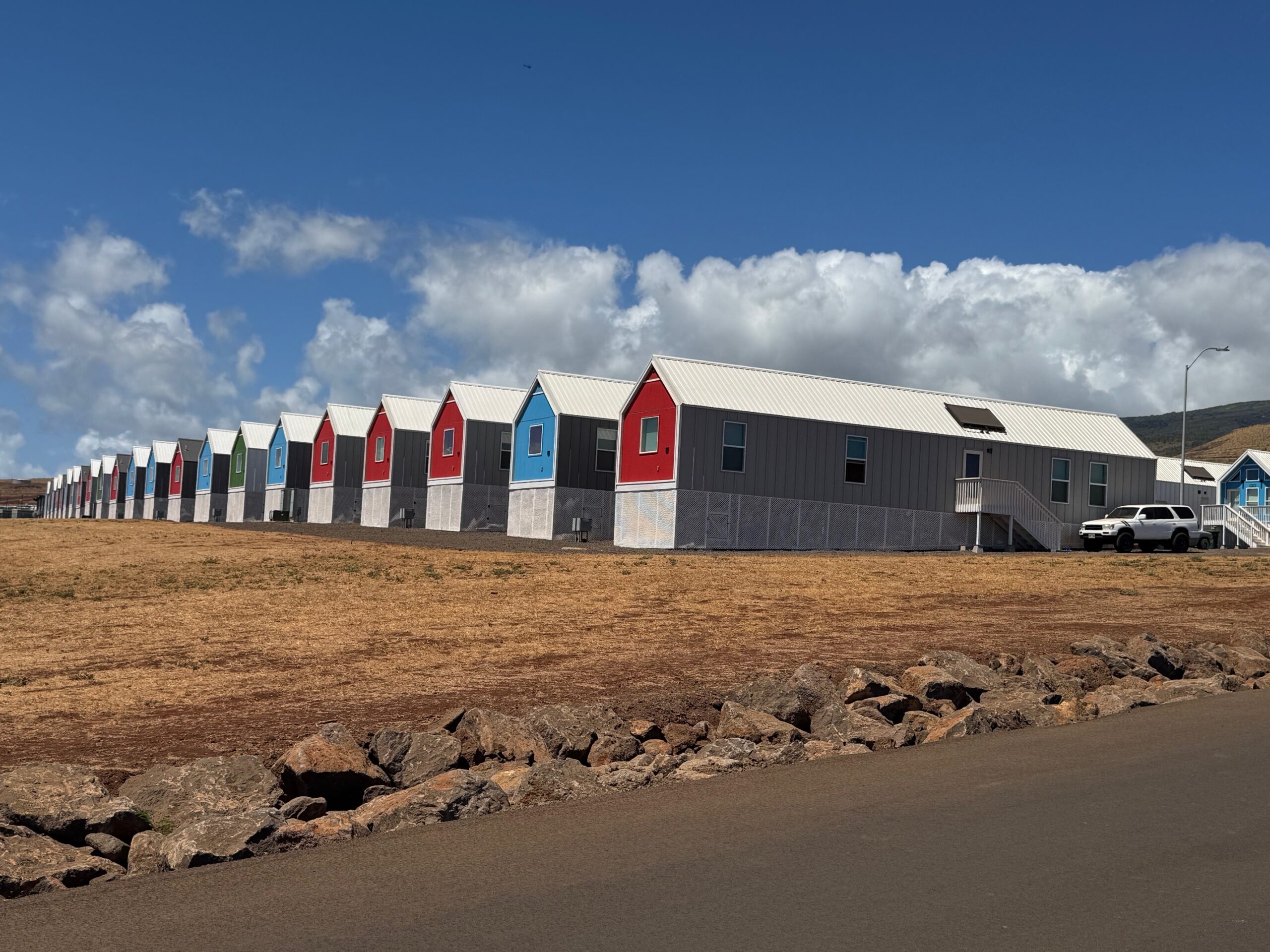
Maui County will take ownership of the 167-unit Kīlohana modular housing project, now serving Lahaina wildfire survivors, in a move that could pave the way for the temporary homes to become permanent housing, County Council members learned Wednesday.
Office of Recovery Administrator John Smith told the county’s Disaster Recovery, International Affairs and Planning Committee that the Federal Emergency Management Agency’s sales-and-donations program cleared its final approval the same day as Wednesday’s meeting, allowing the units to be transferred to the county through the state.
“The intent is to turn those into permanent housing,” Smith said. “That final end-like configuration, location, all that is not set yet. The current plan is to utilize them in the interim while we still have these bigger multi-families being built.”
The Kīlohana housing will transfer from FEMA, to the state, to Maui County at no cost.
“We won’t end up paying for them. They will donate those to us,” Smith said.
The units are of higher quality than typical FEMA temporary housing, he said.
“If you look at what happens, most other places that FEMA will get involved in temporary housing, they’re going to look a lot more like a trailer,” Smith said. However, the Kīlohana homes look like accessory dwelling units, “and they’re well built.”
Council Member Tom Cook pressed Smith on the units’ future, saying the units are “basically livable homes that are being used and can be moved and used,” possibly in “a whole bunch of different places.”
“As long as we have land use and permitting and et cetera, we can accommodate it,” he said. “It could provide housing in a variety of places.”
Cook envisioned prepping a site, putting in utilities and moving the modular units to other sites. However, he acknowledged that moving the Kīlohana units would be challenging because they would need to be partially dismantled to get through the Pali Tunnel.
“We don’t want to move those far,” Smith said. “That would be very expensive, but we do think that they are a good housing solution perhaps as a starter home.”
Housing Department, Office of Recovery split responsibilities
Smith outlined a broader division of responsibilities between two county agencies as Kīlohana and the county’s other main interim site, the 83-unit Hale ‘O Lā’ie project in Kīhei, move toward permanent status. Hale ‘O Lā’ie is the former Haggai Institute on Līpoa Street, across from Kīhei Elementary School.
At Hale ‘O Lā’ie, Smith said the property itself must first be transferred from state to county jurisdiction, a process now underway. The Department of Housing is the lead agency on that transfer and, according to Smith, it will remain the lead agency for the permanent housing work that follows once the county takes ownership. In the interim, while the jurisdictional transfer is finalized, the Office of Recovery is handling the temporary housing piece—day-to-day management of the population currently living there.
The same division applies at Kīlohana, though the ownership path differs: the site is being donated to the county through FEMA’s no-cost transfer rather than shifting between state and county jurisdiction.
Kīlohana is currently owned by the Hawai’i Housing Finance and Development Corp., which manages the land, while FEMA has run and funded the units, Smith said. Once the transfer to the county is complete, the Office of Recovery will manage the site in the interim, with the goal of eventually converting the units to a permanent housing program.
Interim housing population and the path to permanent units
Smith told the committee that Maui’s interim housing population currently stands at about 1,137 households, spread across a half dozen categories: 83 households at Hale ‘O Lā’ie; 360 at the state-run Ka La’i Ola project; 157 at Kīlohana; 304 in FEMA’s direct-lease program; 193 in the Continued Temporary Housing Assistance program; and 40 households across roughly six private micro-sites, where temporary units have been placed on private property.

The county expects that population to decline toward zero by June 2030, as permanent housing comes online, Smith said. There was some hedging, with Smith saying that, by 2030, the current household population in temporary housing “will be theoretically really close to zero.”
“That’s the plan,” he said. However, 2031 is the “drop-dead line” for the Community Development Block Grant Disaster Recovery fund itself.
According to the presentation, permanent housing projects intended to absorb that temporarily housed population include Front Street Apartments, Kaiahale ‘O Kāhiluhilu Phase 2, Lahaina Surf, a permanent version of Hale ‘O Lā’ie, a permanent version of Kīlohana, single-family reconstruction, and households transitioning off direct lease assistance into the private rental market.
Between now and 2030, Smith said the county’s strategy relies on several concurrent efforts: up to 24 months of rental assistance and other resources for households moving toward permanent housing; continued case management through the Disaster Case Management Program; ongoing property and utilities management at existing interim sites; a phased reduction of temporary sites as permanent housing becomes available; and a public communications campaign, not yet launched, to notify affected households and coordinate with landlords.
Office of Recovery staff met with EPA officials two weeks ago with the aim for Maui County to get ongoing disaster relief funding, beyond 2031, Smith said. That discussion was mostly related to infrastructure and housing.
Managing Director Josiah Nishita added that the county could also seek additional appropriations from Congress in future years, pointing to Kaua’i County’s continued operation of disaster recovery programs stemming from Hurricane ‘Iniki in 1992 as precedent. Demonstrating that Maui County is a responsible steward of its current CDBG-DR funds will be central to justifying any future funding request, he said.
FEMA “cliff” looms as February 2027 deadline approaches
In an exchange between Nishita and committee Chair Tamara Paltin, who holds the Council’s West Maui residency seat, they addressed the community’s concern about the “FEMA cliff” in February 2027, which refers to what happens to displaced wildfire survivors when FEMA stops providing assistance, whether it be monetary or programmatic, “and what happens to those households in existing programs.”

Smith said the county is preparing a public communications campaign to help households currently enrolled in FEMA’s direct lease and Continued Temporary Housing Assistance programs transition into a new county-run program once federal support ends. That campaign has not yet launched, he said, in part because the county is still pressing FEMA to extend assistance.
Storm fund tracking grows more complex with Hurricane Lala
Council Member Gabe Johnson raised concerns about how the county would separate wildfire recovery funding from damage caused by Hurricane Lala, which struck Maui earlier this month, or any future storms.

Nishita acknowledged the accounting can become difficult when disasters overlap, saying the county has had to track damage storm-by-storm in past events, including a series of back-to-back storm systems during a previous Kona Low, and that additional damage caused by a new storm before repairs are completed gets attributed to the new event rather than the earlier one.
“We do have to do our best to kind of piece those things out and identify when damage occurred or what got damaged, and then even things could be further exacerbated by a future storm before improvements can be made,” he said.
“That’s why I worry,” Johnson said. “It’s not a nimble process that we have to deal with.”
Passing the hat to billionaires
Johnson, who holds the Council’s Lānaʻi residency seat, also noted that he saw a recent news report that UNIQLO founder Tadashi Yanai donated $3 million for Hurricane Lala relief in Hawaiʻi. Gov. Josh Green told Hawaiʻi Public Radio’s “The Conversation” that Yanai had made the donation, along with $1 million each from Salesforce co-founder Marc Benioff and Michael Dell of Dell Technologies.
“Boy, I tell you, I wish there were some billionaires in our neck of the woods who would pay attention to this kind of billionaire money,” Johnson said.
Other business
The committee also heard updates on the county’s takeover of the Disaster Case Management Program from the state, which Smith said has technically already occurred; existing service providers have been retained through at least the end of September while the county finalizes a long-term procurement.
Department of Housing Director Richard Mitchell told the committee that the state Department of Human Services and Governor’s Office previously issued tenants at Hale ‘O Lā’ie a notice to vacate the premises by August. However, Mitchell said that in the last few weeks he’s had communications with the building’s management, Paramount, and learned that the state intends to issue a new notice with a move-out date closer to the end of February. That would be closer in time to the planned transition of operations at the building to Maui County, he said.
“They did note that they should have issued that much sooner,” Mitchell said.
Deputy Director of Human Services Trista Speer said later in the meeting that the update was in the final stages of state approval and would be issued soon.
Also, the committee went into executive session for roughly 90 minutes to discuss the proposed acquisition of Launiupoko Irrigation Company Inc.’s non-potable water infrastructure assets, citing state law, covering consultation with legal counsel and negotiations for the acquisition of public property.
Legislative attorney Carla Nakata said afterward that the closed-door discussion was limited to Maui’s long-term recovery operations as they relate to the acquisition of water assets. No action was taken.
Sponsored Content