


By the numbers: Maui recovery inches forward 2 years after fires
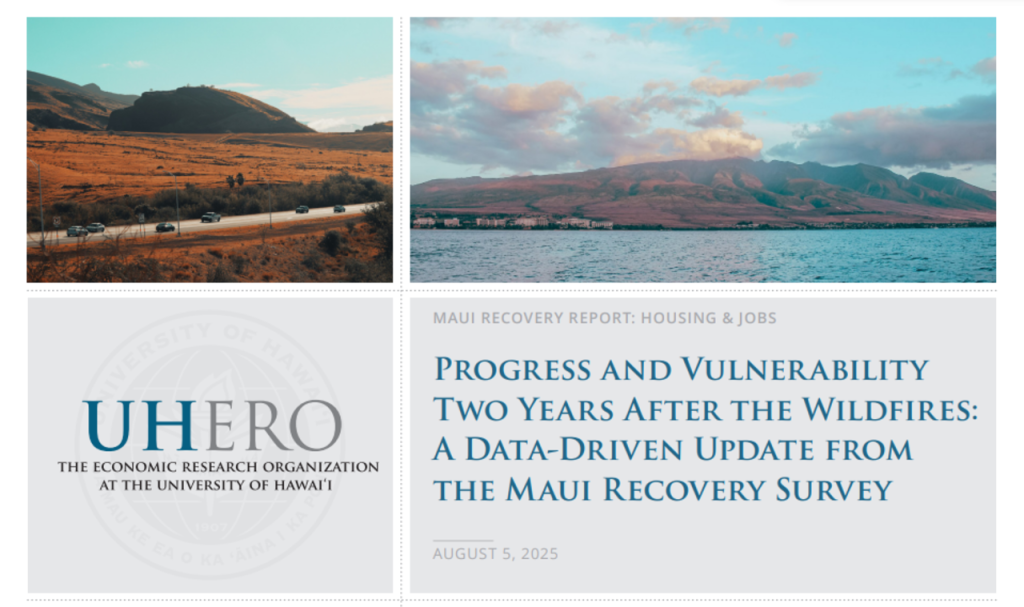
Two years after the wildfires that devastated Lahaina and parts of Kula, Maui’s recovery story is still being written—one of slow progress, uneven outcomes and resilience being tested.
A new report from the University of Hawaiʻi Economic Research Organization (UHERO), released Tuesday, offers one of the clearest pictures yet of how fire-affected residents are faring. Based on nearly a year of monthly survey data from over 950 people, the report outlines two distinct paths: some households are regaining stability, while many others remain displaced, underemployed or unable to afford basic needs.
“Our findings show two realities unfolding side by side,” said UHERO Research Economist Daniela Bond-Smith. “Some households are finding new footing—moving into stable housing, returning to work and regaining stability. But others are still living with deep uncertainty, especially those with limited support and population groups who had already been marginalized prior to the fires.”
Housing stabilizes for some, but many remain displaced From West Maui

In a recovery milestone, UHERO found more than half of fire-affected households have transitioned into permanent housing, as of August 2025.
Among those still in temporary arrangements, nearly half have lived in the same location for over a year. The share of people in precarious housing, such as couch-surfing or living unhoused, has also halved since late 2024.
However, nearly 40% of those displaced from West Maui have not returned home, as of mid-2025.
“It’s unsurprising,” Bond-Smith said of the 40%, “given the limited progress towards rebuilding Lahaina and limited availability of temporary housing in West Maui.”
According to 4Leaf, of the over 1,300 residential properties lost to the fires, only about 49 homes have been reconstructed in West Maui and Kula as of Aug. 5, 2025, with another 280 homes under construction and 184 more in the permitting process.
“Displacement also extends beyond households whose properties were destroyed by the fires,” Bond-Smith said.
Others—like those who didn’t lose homes but worked or owned businesses in Lahaina—are facing their own struggles. For example, one-third of those who lived elsewhere but worked or owned businesses in fire-affected areas were also displaced from their homes and remain displaced even at the two-year mark after the fires.
“This is likely a result of indirect economic pressures and an even tighter housing market,” Bond-Smith said of the displaced non-Lahaina residents.

Rents drop slightly—but not for everyone
Rental affordability for wildfire-affected families varies depending on whether they are receiving assistance and the size of their household.
About a third of fire-affected renters who now live in a different property than before the fires still receive full rental support, such that they pay little or no rent.
Almost three-quarters of this group pay less rent in the second quarter of 2025 than before the wildfires. But others, especially those without formal assistance, pay rents well above pre-fire market rates, which were already the highest in the state.
Rent affordability for this group could worsen when FEMA’s rental assistance expires, as it’s planned to, in 2026.
UHERO also reports signs of rental market stabilization. Rents for studios, one-bedroom and two-bedroom units have fallen over the last 12 months. Rents for larger units, on the other hand, have fetched nearly double their pre-fire rent.
“Without a sustained increase in housing supply, these pressures will only worsen,” Bond-Smith said.
The economic comeback lags
Employment recovery has been slower than housing.
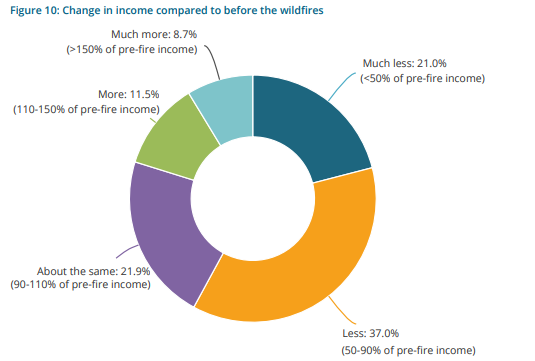
Full-time employment for wildfire affected individuals remains below pre-fire levels, and nearly 60% of fire-affected households report earning less than they did before the disaster.
About 21% of households are earning less than half their pre-fire income, while just 20% report earning more than they did before the fires.
Unemployment among this group is about 8%, more than double the island-wide rate of about 3.5%.
Financial losses following the wildfires have pushed a substantial number of households into poverty.
According to UHERO, 14% of households who were above the poverty line before the fires have fallen below it by mid-2025. An additional 10% who were already in poverty remained there. Only 4% moved out of poverty during this period.
By the second quarter of 2025, 24% of households were living below the poverty line— up significantly from 13% before the fires.
Tourism, a key driver of the local economy, hasn’t returned to pre-fire levels. The report highlights that only two-thirds of fire-affected people who worked in the visitor industry before the fires remain in the sector today.
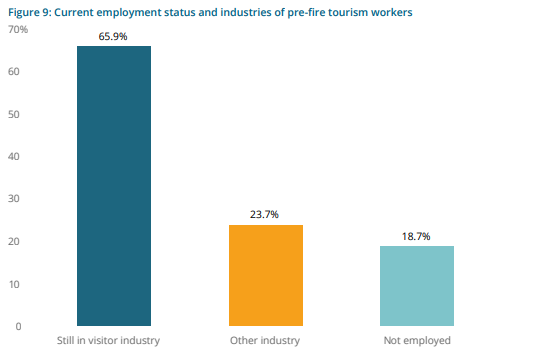
“These are very important implications for that part of the population that used to be employed in tourism,” Bond-Smith said, adding that the slowdown has ripple effects throughout Maui’s economy.
UHERO Executive Director Carl Bonham said in a Tuesday press conference that “it would have been nice” if the state “did more faster” in terms of boosting tourism.
Bonham called the state’s recent investments, like the $6 million emergency tourism marketing campaign, in Maui’s industry “a step in the right direction,” but said factors like international travel trends and inflation may be beyond local control.
A shrinking safety net
At the start of recovery, many families relied on rental assistance, food aid and other forms of support. But by mid-2025, nearly half of all fire-affected households were no longer receiving any assistance at all. Some no longer need it—others may have fallen through the cracks.
Bond-Smith said the decline in unmet needs—such as housing, food and financial support—is encouraging, but noted that “there’s a concern that this reduction in assistance may leave some of the most vulnerable behind.”
Federal programs like SNAP and Medicaid are also facing cuts in 2026, raising new concerns about how long-term needs will be met.
“The share of households living in poverty has nearly doubled at the same time as we are in a situation where support systems are shrinking,” Bond-Smith said.
Will more families leave?
A growing share of respondents who relocated to the Mainland say they expect to stay there. Last year, about one-in-four of these displaced residents thought they might return to Hawaiʻi. Now, only about 6% do.
Many people still on Maui aren’t sure they can afford to stay.
“A lot of people’s responses said things like ‘It depends on where I can make it work. I would like to be back in West Maui—or at least stay on Maui—but I have to go where I can afford my life, my family’s life,’” Bond-Smith said.
Migration estimates are difficult to track precisely, especially for those who left early. But data collected by UHERO suggests about 10% of their survey cohort has left Maui so far.
And while solid numbers on how many fire-affected families have moved to the Mainland or overseas are even harder to access, a study on early indicators from 2024 state tax filings suggests at least 430–510 Maui residents have moved out of state because of the 2023 fire.
The Federal Census also recorded a significant drop in Maui’s population of more than 1,000 from 2023 to 2024. This number is likely due to both increased out-migration and reduced in-migration.
Whether more people leave likely depends on rent and housing, job opportunities and how long support lasts.
Are we on track?
When asked whether Maui is where it “should be” two years after the fires, Bonham said comparisons to other disasters suggest this pace is probably typical.
Bonham said a sensible metric to measuring recovery success is: “If everyone who lived and worked in West Maui was back; if everybody who wants to come back is back.”
Right now, Bonham said, “we’d like to be further along, but maybe that’s not reasonable.”
Recovery in places like Paradise, Calif. is taking five years or more, he said. “Their community is only back 50-60%, so this is just something that’s going to take time.”
Both Bonham and Bond-Smith emphasized that resilience planning must address long-standing inequalities. Lahaina was already poorer than other parts of Maui before the fires, and many residents were one crisis away from poverty.
“We really need to focus more and more on the most disadvantaged and the people who have the hardest time recovering from any kind of a shock,” Bonham said. “As long-term planning continues, it’s important that decisions are guided by timely data grounded in the experiences of those most affected.”
UHERO will continue surveying fire-affected residents through at least mid-2026 and will release regular updates through its Maui Recovery Dashboard.
To view the full report, titled “Progress and Vulnerability Two Years After the Wildfires: A Data-Driven Update from the Maui Recovery Survey,” visit uhero.hawaii.edu.
Sponsored Content