

Planning panel OKs rebuild of smaller Front Street home amid precedent-setting concerns
The Maui Planning Commission approved a special management area permit Tuesday for a somewhat scaled-back reconstruction of an oceanfront home on Front Street property owned by a retired Boeing executive and his wife, Stanley and Dilara Deal.
In the end, the most hotly disputed issue: the size of the home was reduced about 10% from the Deals’ proposed rebuild of their 3,617-square-foot home. Stanley Deal agreed to the reduction, which amounts to living space not to exceed 3,255 square feet. Also, the building’s footprint will not allowed to move closer to the shoreline or Front Street.
After the commission’s 5-0 decision, Deal said: “My family and I are deeply grateful that the Maui Planning Commission will allow us to rebuild the home that we lost in the devastating Lahaina fire. We know it’s hard to balance often competing interests and concerns. Every commissioner approached that difficult job with care and respect. We look forward to welcoming our friends and neighbors home as the community begins to rebuild.”
Kai Nishiki, who opposed the project in public testimony, monitored the meeting online and said she was “deeply disappointed” by a decision that she believes “green lights rebuilding in a known coastal hazard zone that will be severely impacted by sea-level rise and erosion within a single lifetime.”
She said the next disaster might be a tsunami, hurricane or rising seas.
“Despite hundreds of testimonies and strong community opposition, the concerns of residents were ignored by the majority of commissioners,” Nishiki said. “Shame on them. We greatly appreciate the efforts of some commissioners who valiantly fought for us to the bitter end.”
The Aug. 8, 2023, Lahaina wildfire demolished the Deal’s modern-style, two-story, single-family home at 1045 Front St. in Lahaina. Maui County planning officials told them they could rebuild “like-for-like,” but the final decision on an SMA permit fell into the hands of the Maui Planning Commission.

The panel’s decision came under the glare of a public spotlight because it’s expected to set a precedent for future rebuilding requests. Of 86 similarly situated properties destroyed in the wildfire disaster, 11 had already submitted SMA applications to rebuild as of this past spring.
It’s noteworthy that the SMA application for the Deal house was processed under old shoreline rules that it qualified for because of the timing of its application submittal. Most, if not all, of the other homes fall under new rules. So, the extent of precedent in this respect at least is limited.
At meetings on April 8 and April 22, the commission heard from more than two dozen public testifiers – both for and mostly against the proposed SMA permit to rebuild a home valued at $1.85 million. On Tuesday, the commission returned to the application as “unfinished business.” They needed to render a decision because the commission faced an Aug. 20 deadline to take action. Otherwise, the permit would have been automatically approved as submitted.
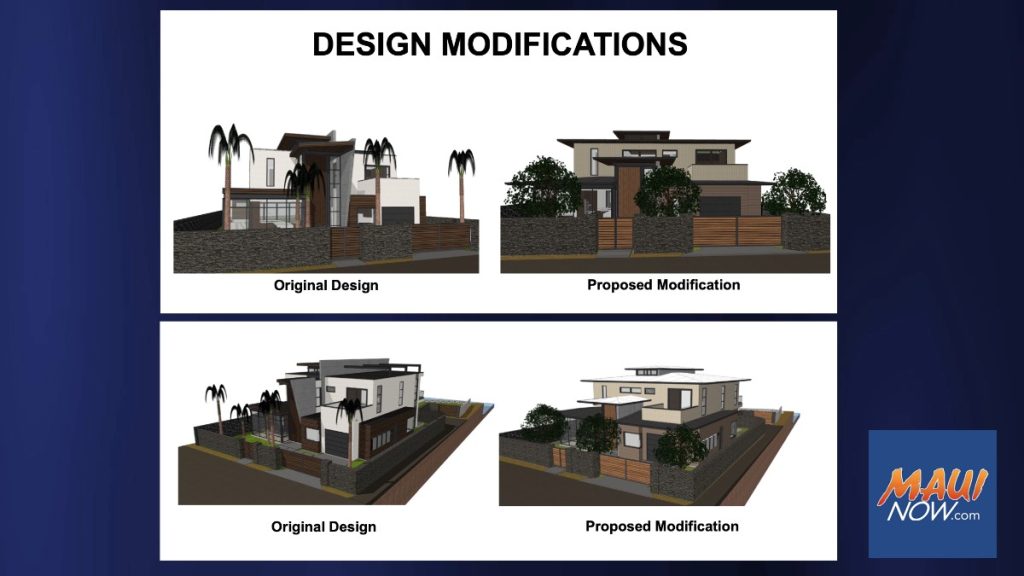
On Tuesday, project consultant Tessa Munekiyo Ng of Munekiyo Hiraga, representing the Deals, presented the application on behalf of the Deals. She emphasized that the proposed reconstruction aimed for a “like-for-like” rebuild, substantially similar to the original home constructed in 2018. The design had undergone modifications based on previous commission and community feedback, including:
- Replacement of flat roofs with hipped roofs.
- Elimination of architectural steel beams the top of the north side second floor roofline.
- Changes to the architectural concrete wall visible on the Front Street side of the home, which included removal of the angled edge of the wall and a reduction in the height of the wall to below the foyer roofline.
- Addition of more wood siding to the front facade of the home.
- Changes to building materials and landscaping to reduce water consumption and visual screening of the home.
- Imposition of water conservation best management practices for the swimming pool, including elimination of a pool waterfall feature and the use of a pool cover to minimize evaporation.
A key point of contention throughout the discussion was the sheer size and massing of the proposed home. Commissioner Andrea Kealoha questioned how a 3,617-square-foot residence was necessary for a retired couple, even with an expanding family.
Deal explained that his home’s design was intended to accommodate large family gatherings, along with extended family and friends.
Commissioners also pressed the Deals and their consultant team on why the home could not be pulled back further into the minimum buildable area, which would reduce its size by approximately 30% to around 2,500 square feet. This move, suggested by some commissioners and echoed by the Maui County Cultural Resources Commission in its July 3 recommendation, was seen as a way to address concerns about the home’s size and its appropriateness within the National Historic Landmark District.
The cultural commission had voted 6-2 to recommend that the Planning Commission require the applicant to reduce the square footage and footprint of the home, scale down the structure’s size, and revisit the overall design to ensure it was more appropriate to the landmark district.
Project architect Atom Kasprzycki of Kasprzycki Designs said that a significant reduction in footprint would require a complete redesign, abandoning the “like-for-like” approach that had guided their initial reconstruction plans. He argued that the design changes already made addressed the scale and size concerns on the Front Street side, aiming to “bring the scale down.”
The property’s existing seawall and public shoreline access were also debated.
Public testimony had frequently focused on concerns about shoreline access and potential erosion due to future sea-level rise. While lateral shoreline access exists, discussions about establishing a new perpendicular access point through adjacent parcels, partly owned by the Deals, remained in early stages.
Honolulu attorney Cal Chipchase, representing the Deals, cautioned against requiring removal of the existing seawall. He cited a structural engineer’s report on potential negative impacts to the property and adjacent parcels, as well as possible legal liabilities for the property owners.
Deputy Corporation Counsel Michael Hopper noted concerns about placing a perpetual waiver of future armoring applications as a permit condition, suggesting it might not be legally defensible.
The Maui Planning Department had recommended approval of the permit with conditions. The Cultural Resources Commission expressed concerns about the home’s proximity to the shoreline and its contemporary design, with some opponents suggesting a “plantation style” design would be more appropriate.
The commission’s approval came with provisions aimed at mitigating the project’s impact and addressing community concerns:
- Design modifications: The approval was contingent on incorporating specific design changes to the home’s exterior, including replacing flat roofs with hip roofs, eliminating architectural steel beams, reducing concrete wall heights, adding more wood siding, revising window and door placement, and reducing the height of the central foyer. These modifications were mandated to soften the home’s visual impact and better integrate it with the historical character of the Lahaina National Historic Landmark District, directly addressing the cultural commission’s recommendations to scale down the structure’s massing and revise the overall design.
- Water conservation measures: Conditions included eliminating a pool waterfall feature, installing a swimming pool cover, conducting monthly leak inspections, and installing a rain catchment system sized to fully offset the net annual pool water usage. These measures were added to reduce the home’s water usage, especially for recreational purposes, in an arid region, addressing concerns raised by the Cultural Resources Commission about protecting wai (water) as a cultural resource and public trust.
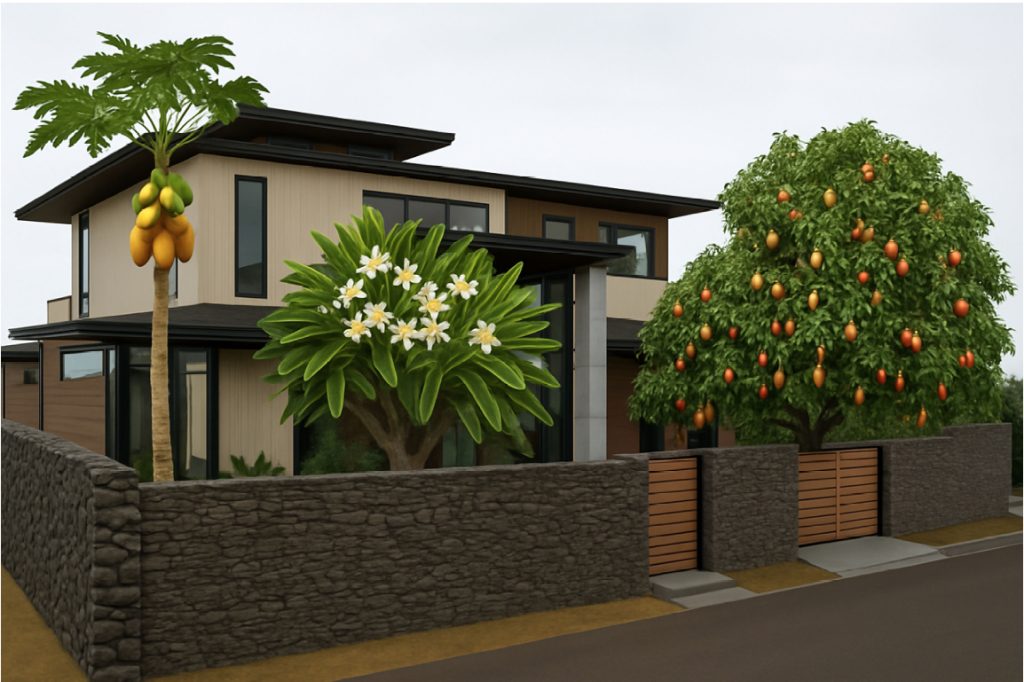
- Increased use of native and canoe plants: The project’s landscaping plan was revised to increase the use of native and canoe plants from 40% to 50% to 95%, and synthetic turf was replaced with drought-tolerant ground cover and grass lawn.
- Certified shoreline: At the behest of Commissioner Mark Deakos, the commission added a condition to require a new certified shoreline.
As the commission struggled late Tuesday afternoon to reach a five-member consensus required for a final decision, Commission Chair Kim Thayer noted that the meeting was the commission’s last opportunity to vote on the Deal application for an SMA permit.
Hopper confirmed that, saying “the time window will run out, so this would be your last opportunity to get conditions on this project.”
“Otherwise, it would be deemed automatically approved if there’s not five votes one way or the other,” he said. “That’s the timeframe and your rules.”
Editor’s note: This post has been updated to point out that the special management area application for the Deal residence rebuild was processed under old shoreline rules. Other, similarly situated homes will be administered under more recent, revised rules.
Sponsored Content