Maui Council panel pauses deliberations on TIG recommendations, focus shifts to new hotel zoning
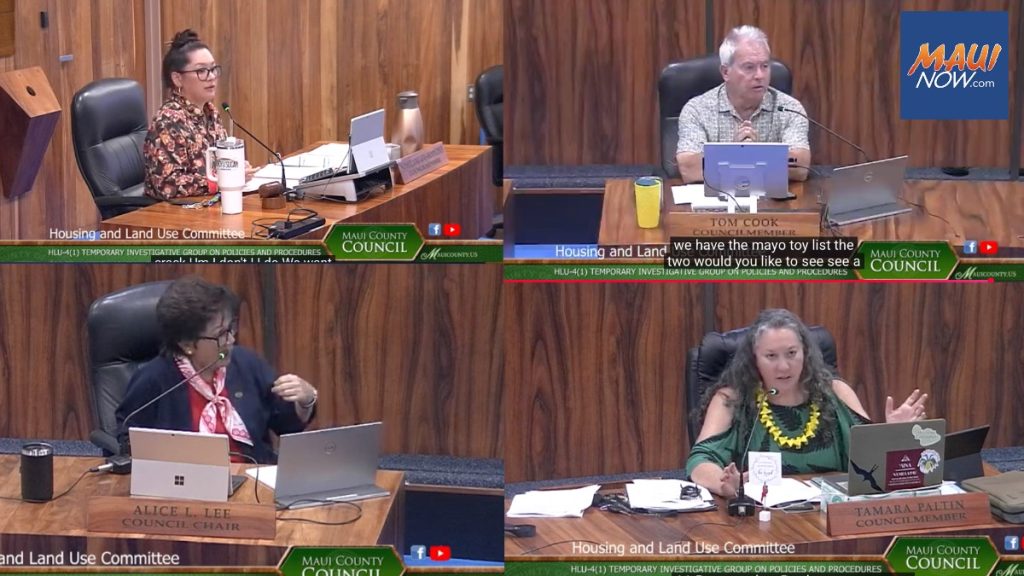
The Maui County Council’s Housing and Land Use Committee recessed a discussion Wednesday after a brief deliberation on the path forward for Bill 9, which aims to phase out thousands of short-term rentals in apartment-zoned districts to free up housing for residents.
The committee will reconvene at 11 a.m. Thursday in Council Chambers.
The committee’s 30-minute session Wednesday focused on the Temporary Investigative Group report, which proposes a dual-track legislative strategy: proceeding with Bill 9 while simultaneously creating new H-3 and H-4 hotel zoning categories. These new zoning designations are intended as a “lateral move” for a select list of properties on what’s referred to in the TIG report as Exhibit 2 — allowing them to avoid the phase-out and continue short-term rental use. The discussion also centered on the financial impact of the bill and the administration’s timeline for creating the new zoning designations.
The committee, chaired by Vice Chair Nohelani Uʻu-Hodgins, agreed to the recess to late Thursday morning to accommodate council members’ schedules.
Timeline debate creates uncertainty
A central tension emerged over the sequence of legislation. Bill 9 has already passed out of committee and is scheduled for a first reading on Nov. 12. Committee Vice Chair Nohelani Uʻu-Hodgins, who chaired the meeting in the absence of Chair Tasha Kama, outlined plans to work with the Planning Department on the new H-3 and H-4 zoning categories.
“Those zonings are going to be exactly what’s already established. It’s a lateral move,” she said. “There will be no expansion in accessory use, no expansion in hotel rooms, and no expansion in height. It’ll be exactly what is, will remain. The only caveat is they are now continuing to use in a TVR. Those are the list on Exhibit 2.”
The new hotel zonings will be introduced in two separate bills after the TIG report is officially adopted by the Council.
Greg Pfost, administrative planning officer in the Department of Planning, confirmed the department’s support for the new H-3 and H-4 designations, stating they would be “just replicating what’s in the A-1 and A-2” zoning standards.
Council Chair Alice Lee questioned the logistics of passing Bill 9 first, before establishing the new hotel zoning, asking whether it was a “huge leap of faith” to rely on H-3 and H-4 passing later, especially given potential turnover in the Council and administration.
Pfost estimated that the process to create the new H-3/H-4 ordinance, which requires review by the three Maui County planning commissions and then the Council, would take “probably four to six months.”
Lynette Pendergast of the Realtors Association of Maui submitted written testimony expressing concern about the “procedural uncertainty” of advancing Bill 9 before the County establishes the proposed H-3 and H-4 hotel district zonings.
“This sequence would effectively remove lawful TVR use in apartment districts while offering no clear, timely pathway for property owners to apply for new land-use designations or continued operation,” Pendergast said. “RAM is concerned that such uncertainty exposes the County to administrative backlogs, inconsistent enforcement and potential legal disputes from property owners seeking relief through the courts.”
Uʻu-Hodgins confirmed the TIG is now disbanded and the list of properties on Exhibit 2 is final. Any amendments to the list would happen later through Council-initiated or applicant-initiated legislation to change the zoning for those specific properties.
TIG methodology and property rights
Council Member Yuki Lei Sugimura questioned the criteria used to create Exhibit 2.
West Maui Council Member Tamara Paltin, a voting member of the TIG, provided insight into her methodology, which prioritized properties based on factors such as the presence of time-share units, shoreline access/sea level rise exposure area status, designation as a visitor-focused area, or being deemed “not suitable” for long-term residential use due to small size or parking issues.
South Maui Council Member Tom Cook, also a voting TIG member, stressed the group’s effort to strike a balance between the “need for homes” and the “need for (economic) diversification.”
“And the big, big, big thing is respecting people’s property rights,” Cook said, acknowledging the main legal argument of bill opponents—that the phase-out of short-term rental use would be an unconstitutional taking of property without just compensation.
And, Cook emphasized the economic impact, saying, “it’s part of our whole economy – all the stores, all the people, all the people that rent there, people that go there, the middle class, people that come from the Mainland that can’t afford to go to the hotels, our family and friends who are going to come for sporting events for kids; so there’s a lot to this.”
Real property tax impact
Real Property Tax Administrator Kari Stockwell presented a spreadsheet showing the potential tax impact of rezoning the properties in Exhibit 2.
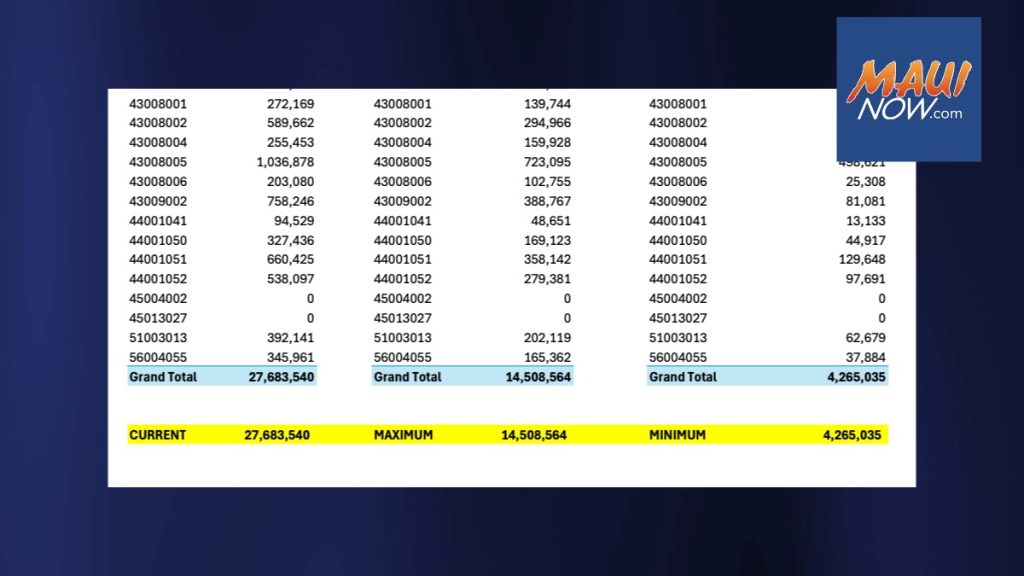
The analysis, based only on the current Exhibit 2 list, showed that current property tax collection from those specific parcels is $27.7 million. The revenue would drop to $14.5 million if all were hotel or non-owner-occupied, and it would fall to $4.2 million if all were owner-occupied. Those ranges represented the most and least revenue lost to Maui County.
After seeing the Exhibit 2 list of properties and the estimated revenue impacts, Lee said that “this is based on an incomplete list, as we’ve been hearing that other properties should have been included.” She said that an identification, recognition or designation of a certain property could have been wrong.
“Is somebody going to, like, double-check everything?” Lee asked. “So this is like a preliminary list?”
Uʻu-Hodgins said the list and real property income impact estimates are based on the properties on Exhibit 2. “Whether or not people feel it’s incomplete or not, it doesn’t change the fact that that is the list. That is what we have in front of us right now. When, if we choose to make changes, that will come at a later time,” she said.
Divided Public Testimony
Public testimony was divided, reflecting the deep conflict between advocates for immediate housing action and those concerned about economic fallout and property rights.
Opponents argued the TIG report and the bill’s sequencing were flawed. Kathy Fleming called the TIG a “fake compromise,” arguing that the proposal prioritized oceanfront properties while leaving behind owners of more modest properties.
Thom Rogers, an apartment complex general manager, asked that Bill 9 be tabled until the H-3 and H-4 hotel districts are created and safeguards are in place for the exempted properties. “Advancing this bill now without those safeguards in place would cause irreparable harm to long-standing lawful properties like ours and to the local residents whose livelihoods depend on them,” he said.
Supporters stressed the urgency of Maui’s housing crisis and the need to act decisively.
Janice Herrick urged council members to pass the bill. “It’s time to move forward so that the Maui housing can serve the people of Maui. I urge you to please have the courage to pass Bill nine as cleanly as possible,” she said.
Jordan Ruidas of Lahaina Strong emphasized the crisis facing local families. “Local families cannot find homes while buildings that were meant for long-term residents are being used for visitors,” she said. “Our community cannot wait any longer. Hawaiʻi’s biggest export is its people.”
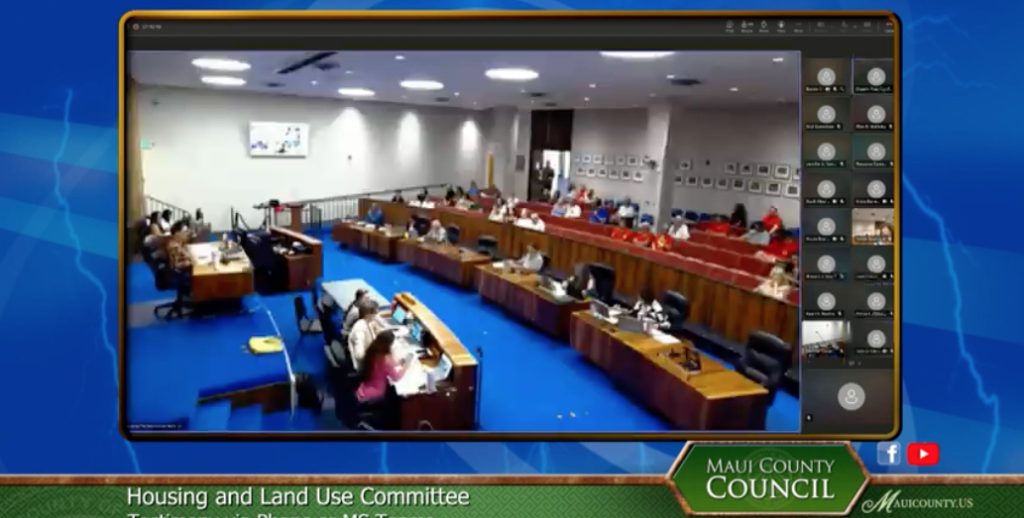
Tomorrow’s meeting can be viewed beginning at 11 a.m. on Akakū: Maui Community Media, cable Channel 53; on Microsoft Teams at http://tinyurl.com/HLU-Committee; or on the Maui County Council’s YouTube channel. Public testimony has been completed and closed.
A video recording of Wednesday’s meeting can be seen on YouTube by clicking here.
Sponsored Content