Council hears updates on kona low response, Lahaina wildfire rebuilding
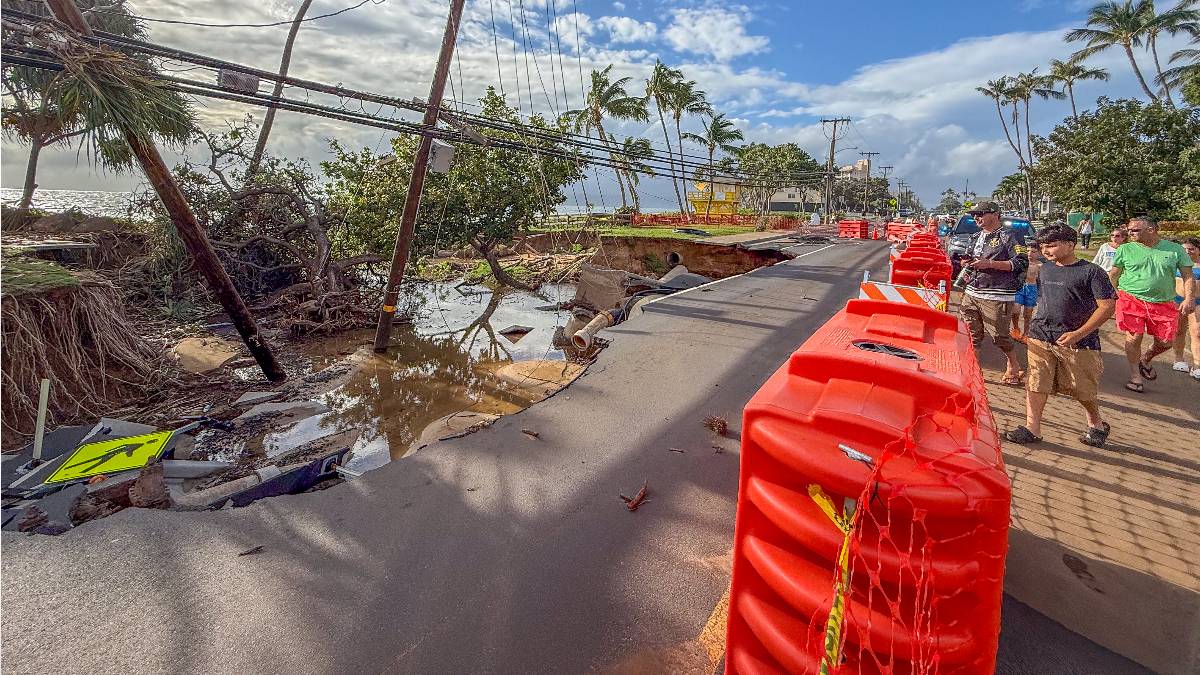
While Maui County braces for more severe weather, council members are poised to take action Friday morning on a $15 million request for emergency funding, following a Wednesday committee update on the effort to rebuild from the August 2023 Lahaina wildfire disaster.
Members of the Disaster Recovery, International Affairs and Planning Committee heard updates on both Wednesday.
To address the immediate storm impacts, an emergency Council meeting is scheduled for 8:45 a.m. Friday, preceding the Council’s regular 9 a.m. session. Council members are expected to take action on Bills 53 and 54, which would provide the $15 million requested by Mayor Richard Bissen earlier in the week for county emergency repairs and operations.
“While damage assessments are ongoing, we know the destruction caused by flooding and strong winds was extensive throughout parts of Maui County,” Council Chair Alice Lee said. “The devastation is heartbreaking, and we must move with urgency to repair and rebuild.”
At Wednesday’s committee meeting, Lee urged full attendance for Friday’s session, noting that seven votes will be required to advance the emergency funding bills.
Office of Recovery Administrator John Smith said he expected damage from the recent storm will lead to another federal disaster declaration.
South Maui has been hard hit, with flood waters undermining and collapsing the two-dozen unit Kīhei Kai Oceanfront condominium complex. At Kamaʻole Beach Park II, a sinkhole took out the soundbound lane of a portion of South Kīhei Road across the street from Fred’s Mexican Cafe.
The recent severe weather also impacted Lahaina’s post-wildfire recovery. Deputy Managing Director Erin Wade reported that while the Lahaina Restoration Foundation has finalized its master plan for rebuilding historic structures, the front facade of the historic Baldwin House was lost during the recent storm. Plans are being developed to move forward, she said, noting the county will likely request extended Federal Emergency Management Agency assistance funds.
The Office of Recovery is working with the Maui Emergency Management Agency to coordinate Maui County departments as they respond to kona low storm impacts, Smith said.
“We’ve had flooding, debris and wind events all over,” he told council members, adding that task forces have been activated, including one for storm debris. Currently, work is “gearing us up for when we get that federal (emergency) declaration and being ready to pivot for reimbursements and that sort of thing.”
Lahaina recovery update
In an update to council members on Lahaina’s post-wildfire progress, Smith reported that 552 total rebuilding permits were issued, with 159 completed. The amount of time it takes to get an expedited building permit has been reduced to an average of 44 days overall, and under 30 days for residential properties.
Wade noted that 60% of fire-destroyed single-family residential housing is either under construction or permitted, a rate she said is moving forward quite well, particularly in comparison to other similar disasters nationally.
Smith added: “We’ve been reminded over and over from other communities that a disaster of this type is a five- to 10-year process (for recovery), not just one or two years. So based on the data that we have so far, we do feel like we’re trending above what would be the speed standpoint for a disaster of that type.”
However, providing permanent housing for displaced residents remains a hurdle. Meanwhile, 849 fire survivor families remain in FEMA temporary housing, a program that has been extended for Maui until February 2027.
Wade told council members to expect future fiscal year 2027 budget requests under the Office of Recovery to fund temporary to permanent housing to address those still without long-term housing by the FEMA deadline.
Housing numbers ‘so confusing’
During the meeting, the breakdown of various housing programs and their funding sources led to some confusion later for council members.
Lee asked how the county’s initial goal of replacing close to 1,000 units aligned with current applications and program capacities. She noted later that of the 2,000 structures that burned in the Lahaina fire, 80% of the owners did not live in the residences, complicating the rebuilding and resettlement process for renters.
Smith and Jeannie Sutton, a representative of the Ho‘okumu Hou housing program, attempted to clarify the numbers, explaining that different programs cater to different needs using CDBG-DR funds.
Overall, 5,000 housing units were destroyed, the vast majority rentals.
According to Sutton, $92.5 million is allocated for a first-time homebuyer assistance program estimated to serve approximately 150 households. Another $298 million is designated for a single-family homeowner reconstruction and reimbursement program, expected to serve as many as 250 households. Finally, $420 million is allocated for multifamily home reconstruction and new construction programs, which can construct up to 1,000 multifamily housing units.
Smith noted that the first-time homebuyer program has been “extraordinarily popular,” with 501 active applications and six families already moved into homes. However, Lee expressed concern over tracking the original displaced residents versus new applicants in the various housing programs.
“Honestly, this whole thing is so confusing. Hard to nail down specifics,” Lee said. “And that’s why, if you don’t mind, I will pursue this another time with your staff.”
On the infrastructure front, the work of rebuilding Lahaina includes 22 county projects that have received awards of CDBG-DR funding. The most noteworthy is the north extension of the Lahaina Bypass, an evacuation route that proved life-saving during the August 2023 wildfires. The project, estimated to cost $220 million overall, is eligible for $100 million in federal funding, with the remainder being sought from the state of Hawaii.
Despite an allocation of $400 million for infrastructure, Smith noted there remains a $950 million unfunded need gap that the Office of Recovery is attempting to fill through other sources, including the US Environmental Protection Agency and the Federal Highways Administration.
Sponsored Content