Maui’s safety net on edge: Federal funding cuts bring financial and psychological stress to local nonprofits
Maui County’s essential health and human services are bracing for financial hits and a surge of psychological strain due to potential federal funding cuts, according to recent University of Hawaiʻi reports.
New analysis from the University of Hawaiʻi Economic Research Organization and the Hawaiʻi Community Foundation reports that 74 federal grants to 59 Hawai‘i nonprofits — amounting to an estimated $126 million — are “politically vulnerable.” Cuts to these federal funds would weigh heavily on healthcare and human services and programs impacting Native Hawaiians.
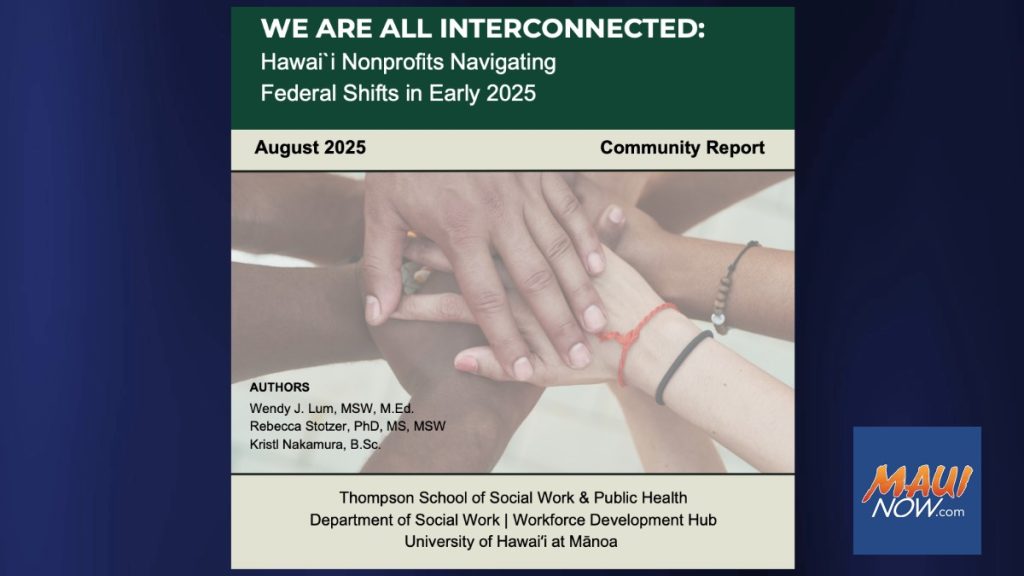
This financial threat is compounded by the mental toll, as highlighted in a separate UH Mānoa Department of Social Work study, “We Are All Interconnected: Hawaiʻi Nonprofits Navigating Federal Shifts in Early 2025.” That study documents widespread anxiety and uncertainty among staff and clients of nonprofit organizations.
Maui Economic Opportunity prepares for shocks
Debbie Cabebe, chief executive officer of Maui Economic Opportunity Inc., a nonprofit with a roughly $64 million budget for the current fiscal year (Oct. 1, 2025, to Sept. 30, 2026), said her agency did not participate in the UH study, but it has been making adjustments and preparing contingency plans.

“The stress of this uncertainty is very real, and we recognize the concern it creates for both our community and our staff,” Cabebe said in an emailed response to questions from Maui Now. “While the unknown can cause understandable anxiety, we want to reassure everyone that MEO remains strong, resourceful, and committed to our mission. We are taking proactive steps to safeguard our programs, support our employees and ensure that vital services continue for those who depend on us.”
Direct impacts and financial juggling
The looming threat of cuts hangs over the Community Services Block Grant, which MEO considers the “glue” that supports its administrative capacity and helps cover shortfalls across its numerous programs. The status of this funding remains unknown.
MEO has received increased funding from the State of Hawaiʻi and foundation-funded programs to help Maui wildfire survivors “and those experiencing episodes of need, and the County of Maui’s increase to the Head Start and Rental Assistance programs.” (Those in need can visit MEO’s website at meoinc.org for information about assistance.
However, MEO has already seen direct impacts from federal cuts:
- Job losses: MEO lost 11 senior Community Service Employment Program participant jobs and had to eliminate the program coordinator position, though the coordinator was reassigned within the agency.
- Contingency planning: MEO has developed “plan A, B, & C” depending on the status of the Community Services Block Grant funding, and the agency has reworked all budgets and increased fundraising efforts due to the uncertainty around that funding and other federal programs like the Weatherization Program and the Low-Income Energy Assistance Program.
- Local support: The organization is grateful for a one-time award from the Stupski Foundation, set aside as an emergency fund for Head Start and Kahi Kamaliʻi early childhood services. It also acknowledged the Maui County Council and administration for increasing support to Head Start and Rental Assistance programs. Fortunately, MEO’s Head Start program has been funded for the 2025-2026 school year.
“It remains challenging to plan when funding levels are uncertain from year to year,” Cabebe said, echoing the UH study’s finding that uncertainty severely impacts future planning, making it difficult to hire new staff or launch new long-term programs.
Collaborative and community response
MEO has not needed to apply for emergency state funding provided by Act 310 (Senate Bill 933), but Cabebe encourages smaller organizations with limited funding sources to do so.
On the ground, Maui nonprofits are sharing the load. “The Maui Nonprofit Directors Association brings nonprofit leaders together to support one another and collaborate and share resources,” Cabebe noted. “Together we are better equipped to address the needs of the community.”
The University of Hawaiʻi System News has released a video Hawaiʻi nonprofits bracing for federal shifts that discusses how nonprofits are navigating federal funding cuts.
Sponsored Content