Affordable housing deed extension bill revived after near-death experience
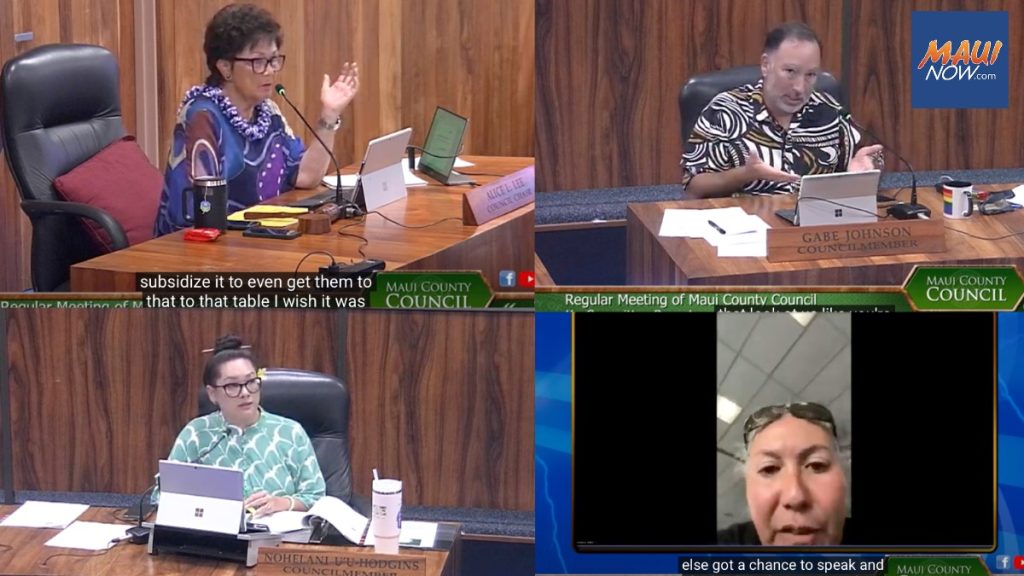
Maui County Council members killed a bill aimed at maintaining affordable workforce housing when they failed to muster a fifth vote needed for passage, even after the measure passed unanimously out of committee 8-0 last month. After a tense debate, however, they abruptly resurrected the bill by invoking a rarely used “vote for reconsideration.”
In the initial vote, the four council members voting “aye” were Tasha Kama, Tamara Paltin, Gabe Johnson and Nohelani Uʻu-Hodgins. Voting “nay” were Alice Lee, Yuki Lei Sugimura and Tom Cook. Council Members Keani Rawlins-Fernandez and Shane Sinenci were absent, leaving the nine-member Council with only seven members.
(Rawlins-Fernandez and Sinenci were attending the 2025 Native Hawaiian Convention in Tulalip, Wash., according to the Office of Council Services.)
What followed the 4-3 vote was a aftermath discussion that confronted the loss of a measure after several years of committee work.
“We just have to bring it back again another way,” someone said as the measure’s failed vote sunk in.
But Council Chair Lee said: “No, no. It’s failed. Period. It doesn’t automatically go back. It has to be revived through another bill… Are you guys counting the votes?”
Speaking to the three members who voted against the bill, Johnson said: “I’d ask you guys to reconsider… We were all in these meetings where we hammered out the details. I conceded some of my things. Council Member Kama conceded some of her things.
“Why can’t we pass this because we all kind of gave up something, and now we got nothing,” Johnson said.
Lee noted that two council members were absent Friday, and if they had been present, “this probably could have passed.”
She added: “I never was supportive of this because of my experience with housing.” (Lee is a former director of the County’s former Department of Housing and Human Concerns.) She said she was “ferociously” against a former 50% requirement of affordable housing that led to years of virtually no development of affordable housing in Maui County.
“So that’s the reason why I never supported it, and it’s not like I’m changing my vote,” she said.
Johnson said the bill’s focus was on deed restrictions, keeping housing affordable for longer periods of time, “which I though was kind of smart for us to keep our money investing.”
Lee said she has “a totally different philosophy.”
“I believe the little guy deserves a chance,” she said, referring using a home’s equity for financing. “But, that’s water under the bridge. I was perfectly well, not happy, but content to be in the minority (opposing the bill).”
“But then this went left, right, left, right,” Lee said, adding that the Council was left on Friday, essentially, back to square one, and left to “see if there’s other areas of compromise.”
In clarifying his “no” vote, Cook said her understood the need for deed restrictions, and “I support limiting speculation and enabling people to have homes and sort of trying to level the playing field… so locals have more of a leg up.”
Cook, a building contractor, said he wants to focus on the building approval process.
“We need to look at how we’re going to get it built,” he said, arguing that the County needs to review regulatory processes that have “good intentions,” but nevertheless “are preventing things from getting approved.”
Lee recalled her experience, as County housing director, with seeing hundreds of affordable homes built at the Waikapū Gardens Subdivision. “You know (developer) Jesse Spencer was like a saint because he provided a lot of affordable homes for people,” approximately 400, she said.
Of those, a good portion were affordable and came with deed restrictions of 10 years, Lee said. The moderately priced homes had less restrictive five-year deed restrictions.
“I couldn’t believe how many regular, salt-of-the-earth people refused to buy the affordable because they did not want the 10-year restriction,” she said. “This was just regular people . . . and they would borrow and beg from their families to help them pay for the step-up, moderately priced homes so they would have just five years.”
Now, even though many still live in their homes, they’re able to use them to make home renovations or pay for their children to go to college, she said.
While participating remotely from the Daniel K. Inouye International Airport in Honolulu, Paltin said council members were deciding it’s more important that people use housing as a “piggy bank” rather than as shelter.
“Ten years of affordability?” she asked rhetorically. “That’s ridiculous. No wonder why there’s no affordable housing. If it flips out of affordability in five years and people can dip into it like a piggy bank instead of shelter for their families.”
Lee argued otherwise.
“We’re not talking about speculation,” Lee said. “Will there be speculators and people who game the system? Of course. Probably 10-15 percent. But the vast majority are like people like me and you, regular people, who need that equity to pay for medical bills and grandparents living with you and all kinds of things.”
Addressing Cook’s point about streamlining regulatory processes, Johnson said that’s a separate issue from the proposed deed restrictions. “If it’s the burden of the bureaucracy, where are the bills to lessen bureaucracy?” he asked. “We can’t just say, ‘Oh, the deed restrictions are too long and then it’s this bureaucracy. Well, then let’s fix the bureaucracy and keep those deed restrictions.”
Johnson said: “We all came to a decision that it passed out of committee; why wouldn’t it pass out of the main body? And, some of the members aren’t here, and maybe that’s the thing, but I felt we had a good discussion in committee. I felt that we did kind of hammered out the details.”
Paltin said the Council has been working on deed restrictions since 2019.
“Five, eight and 10 years is the very reason why we have no affordable housing besides not building stuff,” she said.
Eventually, Sugimura agreed to change her vote from “no” to “yes.” As a member of the prevailing vote that defeated the measure, she was allowed under parliamentary procedure to ask for reconsideration. Cook also changed his vote. The final vote was 6-1, with Lee casting the sole vote in dissent.
If passed on second-and-final reading and signed by the mayor, Bill 40 would strengthen deed restrictions and resident owner-occupancy rules for workforce housing. The bill was debated extensively Sept. 24 when it came before the Housing and Land Use Committee, chaired by Kama.
Her committee recommended passage of the bill by a vote of 8-0, with Lee absent when the committee vote was taken.
A proposed amendment to Bill 40 — introduced by Kama, that would have clarified the County’s priority on an affordable housing waitlist — briefly stalled the Council’s consideration of the bill overall.
Paltin sharply criticized the last-minute amendment, calling it a “stall tactic” and “committee work on the Council floor” without consultation from the Department of Housing director. The director, Richard Mitchell, was contacted via videoconference, and he showed he was unfamiliar with Kama’s proposed amendment.

Mitchell asked for time to review the amendment and said he didn’t know about a housing waitlist and whether it would be maintained by his department or by the project developer as part of initial housing sales.
While making her way through a security checkpoint at the airport, Paltin said she wasn’t aware that the Housing Department had a housing waitlist, not yet anyway.
Kama ultimately withdrew the amendment to allow the vote on Bill 40 to proceed unamended.
Bill 40 details
Bill 40 amends the County’s residential workforce housing policy by:
- Promoting the retention of units for owner-occupancy
- Expediting the County’s acquisition of workforce housing by exempting their purchase from a requirement of Council approval
- Increasing deed-restriction periods to benefit the community
- Fostering the production and protection of the County’s workforce housing inventory
Among other things, the bill also details the deed restriction periods for different income groups that would benefit from residential workforce housing. For multifamily or two-family ownership units deed restrictions would be:
- 12 years for below-moderate income, 80 to 100% of area median income as established by the US Department of Housing and Urban Development
- 10 years for moderate income, 100 to 120% of median income
- 8 years for above-moderate income, 120 to 140% of median income
For single-family housing, the deed restrictions would be:
- 15 years for below-moderate income
- 12 years for moderate income
- 10 years for above-moderate income households
When housing is developed on county-owned land, affordable units will have deed restrictions “in perpetuity,” or forever, rather than time limits. Maui County also will get the first right to purchase units in foreclosure situations and the right to purchase any unsold units at the original sales price.
A report from the Housing and Land Use Committee details the bill’s provisions and background.
Sponsored Content