Maui Council panel eyes allowing thousands of vacation rentals to operate in new hotel zoning
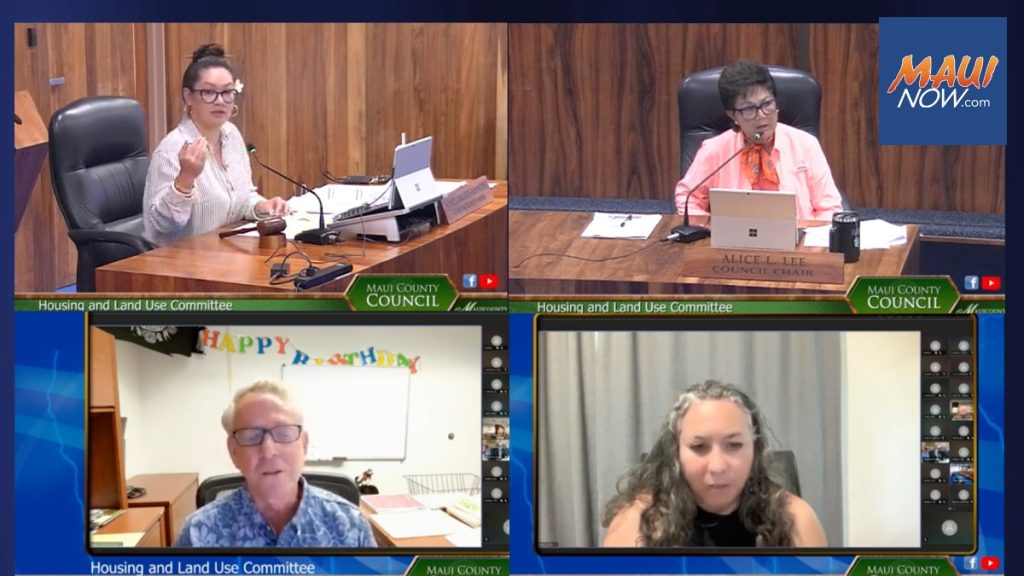
The Maui County Council’s Housing and Land Use Committee deferred action Thursday on recommendations for phasing out thousands of apartment-zoned short-term vacation rentals, shifting its focus instead to a proposal that would allow more than 4,500 current vacation rental units to continue operating legally.
The committee plans to advance legislation to establish H-3 and H-4 hotel zoning districts, effectively carving out those units — a 64% reduction from the roughly 7,000 originally targeted by Bill 9 — from the phase-out. The timeline for drafting the new hotel zoning bills and Council consideration of them remains unsettled.
In a statement to Maui Now, Mayor Richard Bissen said: “We’ve always been open to compromise and understood that through the legislative process, Bill 9 would evolve.”
“Given the seriousness of our housing crisis, any additional units that move toward long-term housing are a step in the right direction,” he said. “We support the intent and direction of the TIG’s recommendations, which strengthen the path forward for protecting homes for residents while bringing fairness and clarity to our zoning system.”
The committee reconvened its deliberations late Thursday morning after recessing discussions Wednesday. Bill 9 has already passed out of committee and is scheduled for first reading on Nov. 12.
Sequence of legislation stirs debate
Much of the discussion focused on the TIG’s recommendation to create the new H-3 and H-4 zoning designations and the logistics of a Council-initiated change in zoning for the approximately 46 properties on the TIG’s Exhibit 2 list — totaling 4,519 units.
If all those units converted to the new hotel zones, 64% of the originally envisioned 7,000 short-term rental units would remain as transient accommodations, not as long-term housing.
Committee Vice Chair Nohelani Uʻu-Hodgins, who chaired the TIG and Thursday’s committee meeting, emphasized the need for concurrent action.
“I plan to do the H-3 and H-4 new designations concurrently with the change in zonings, and I hope to do that soon.” She noted that the Planning Department would take the lead, as it is a “quicker process” for them to initiate the zoning change and send it directly to the planning commissions.
Council Chair Alice Lee, however, expressed reservations about the sequencing of the legislation.
“It doesn’t seem logical to me, as far as the sequence goes,” she said, expressing concern about carving out thousands of units for a change in zoning when the new zoning category hasn’t been created yet. She worried about “unforeseen circumstances” and delays, including legal challenges, that could extend the process beyond the current Council term.
“I think I have very justified concerns, legitimate concerns, you know, that that just shouldn’t be dismissed,” she added, requesting “specific answers” on implementation.
Lee noted that the Council is working on “substantive, significant legislation like this… with the hope and wish that something else will occur in the future, and which may actually go into some other Council’s term, where we have had absolutely no control over.”
Uʻu-Hodgins was firm about moving ahead.
“I’m not going to hope for it to get done,” she said, referring to TIG recommendations. “We are going to do it. We’ve talked about it in our TIG. The Planning Department is going to help us. They’re going to take the lead because it’s a quicker process for them to do it. If they drag their feet, which I hope they’re not, then we’re going to do it.”
Council Member Tamara Paltin, who was vice chair of the TIG, defended its approach and argued that holding up Bill 9 to complete the zoning changes first doesn’t make sense.
“If Bill 9 doesn’t pass, why bother wasting our time with creating new zoning, with doing a mass changing zoning?” she asked rhetorically. Also, she cited a sentiment heard in TIG discussions: “Take a dump or get off the pot already; because this holding pattern that we’re in is just driving everybody insane, people for and against it, including ourselves. So I don’t know why we would stall any longer on Bill 9.”
She noted that the four council members on the TIG are “for it,” so it will take only one more vote for a Council majority to take action. (The four council members on the TIG are Uʻu-Hodgins, Paltin, Tom Cook and Shane Sinenci.)
Greg Pfost, administrative planning officer in the Department of Planning, confirmed that a zoning change for so many parcels is unprecedented in his experience. But he explained that the process should be “pretty straightforward” because the new H-3 and H-4 zones are designed to “replicate the A-1 and A-2” zoning and allow the existing use to continue with the same development standards.
Planning Program Administrator Danny Dias estimated that an applicant-initiated zoning change could still take “at least a year.”
Carve-out criteria and property data
Real Property Tax Administrator Kari Stockwell provided data showing that of the roughly 7,000 potential units in the apartment-zoned district, approximately 6,000 would be affected by a change in zoning, with the remaining units either zoned as timeshare or having a successful owner-occupied or long-term rental exemption.
Lee questioned if these were “carve outs,” meaning an exemption or specific exclusion of properties. But Stockwell clarified that “no, because they’ve applied for those exemptions. Those are granted to any parcel, can apply for the owner-occupied exemption or the long-term rental exemption.”
According to the Office of Council Services, the TIG proposal would result in 4,519 units converting to H-3 and H-4 zoning, including 2,921 in South Maui and 1,579 in West Maui. This leaves 2,517 units not converting, which would remain in apartment zoning (1,377 in South Maui and 894 in West Maui) — out of a total of 7,036 units now in apartment zoning. The office noted the South and West Maui numbers do not add up to the total because some units are outside those areas.
Those numbers include all the properties with variances and don’t include the properties that no longer exist after the Lahaina wildfire, the office reported.
The criteria for placing properties on the Exhibit 2 list — the ones recommended for the new hotel zoning — include being in visitor-focused areas, located entirely in the sea-level rise exposure area, properties deemed “not suitable” for long-term residential use, or those with timeshare ownership.
Paltin noted her “ground-truthing” of properties of sea-level rise exposed zones in West Maui that she visited to “feel confident that it’s going to survive the next 10 years.”
The TIG plans to work with the Planning Department to initiate the mass zoning change for the Exhibit 2 properties. Owners of other properties not on the list could still apply for the new H-3/H-4 designation individually or “solicit a council member to do a Council-initiated change in zoning,” Uʻu-Hodgins said.
Council Member Shane Sinenci reminded the committee that the TIG’s work was, in part, a response to community testimony requesting that properties operating as hotels be rezoned accordingly, and that creating the new hotel zones “was one of the things that people actually requested.”
Committee defers action — Next steps unclear
The committee agreed to defer the item, meaning no legislative action was taken on the TIG’s recommendations at Thursday’s meeting.
“Our next step is we’re going to defer this because we don’t need to adopt the recommendations,” Uʻu-Hodgins said. Then, the Council will work on a resolution to establish the H-3 and H-4 hotel zoning, she added.
According to Office of Council Services Director David Raatz, the “next steps remain to be seen.”
“Any council member or the administration can decide whether to respond to the TIG’s recommendations. No corresponding legislation has been introduced yet,” he said.
Uʻu-Hodgins ended the meeting by reiterating her commitment to moving forward quickly, working with the departments of Planning and Corporation Counsel to establish a timeline to move forward.
A video recording of Thursday’s meeting can be seen on YouTube by clicking here.
Editor’s note: This post has been updated from its original version to add a comment from Mayor Richard Bissen.
Sponsored Content