Maui Water Department begins initial planning for West Maui desalination plant

The Maui County Department of Water Supply is taking the first steps toward developing its first publicly owned desalination facility in West Maui. The project would extend the arid region’s water resources beyond current ground and surface water limitations that currently force the department to cope with a Stage 2 water shortage.
With a desalination plant, the department would have additional water resources to meet growing demand including direly needed housing developments, such as the 500-home Pulelehua project, which is currently stalled without available water.
The lack of water availability has been a long-running issue for West Maui, but the devastating August 2023 wildfires added more stress. The blaze left widespread infrastructure damage and destroyed more than 2,200 buildings, with rebuilding homes and businesses expected to cost billions of dollars.
West Maui water availability
On Friday, the department released an analysis for the West Maui system that showed peak demand exceeds the system’s reliable supply by 41.8%. With the addition of the Kahana Well, expected to come online in early 2026, the shortfall would be reduced but demand would still exceed reliable capacity by 15.7%. The Kahana Well still requires permits from the state Commission on Water Resource Management before it can become fully operational.
The Water Department analyzed how much the West Maui water system is expected to reliably deliver to Nāpili and Lahaina service areas over the next three years. The study looked at well-pumping capacity, regulatory pumping limits and recent production data. It also accounted for uncertainties and assumptions related to mechanical failure, human error and weather events. Researchers assessed the likelihood and duration of various system disruptions, including downed well pumps and periods of low or no intake flow at treatment plants.
“Even with the Kahana Well in operation, additional supply will be needed to fully meet current demand and support future growth,” Department of Water Supply Director John Stufflebean said. “We are exploring every option for finding new water sources and expanding existing supplies, but ongoing conservation and careful management remain critical as demand continues to grow.”
What’s desalination?
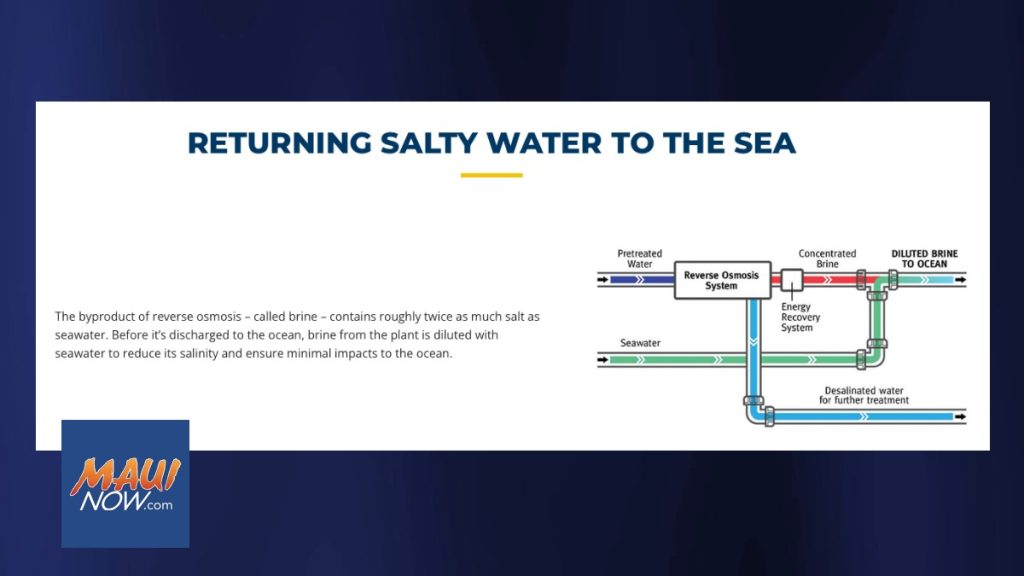
Using a desalination process called reverse osmosis, salt is pulled out of seawater or brackish water to produce drinking water. Salty water is pushed through filters so fine that salt and other impurities are left behind, producing clean, high-quality drinking water. The leftover salty water, called brine, is returned to the ocean or injected into deep brackish water wells.
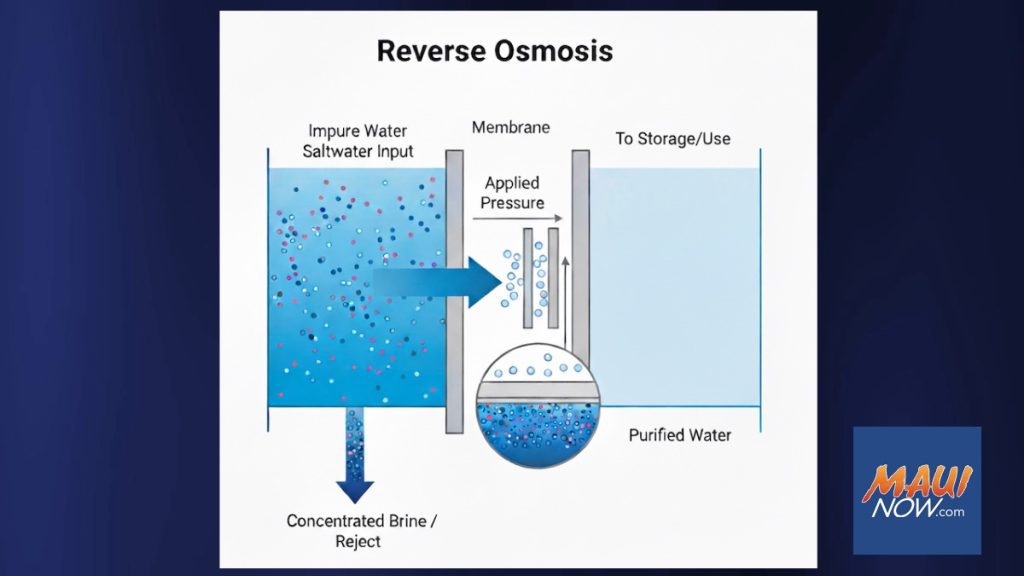
Maui County’s desalination initiative is currently in its “earliest phases,” building upon a preliminary feasibility study developed by Brown and Caldwell for the Department of Water Supply, according to Stufflebean.
The feasibility study examined options for a reverse osmosis plant, including sites in both West Maui and South Maui. However, based on the study’s established criteria, a desalination facility is not currently being considered for Central Maui. However, one is being contemplated for South Maui, Stufflebean said. If developed, the West Maui facility would be the first public desalination plant in Maui County.
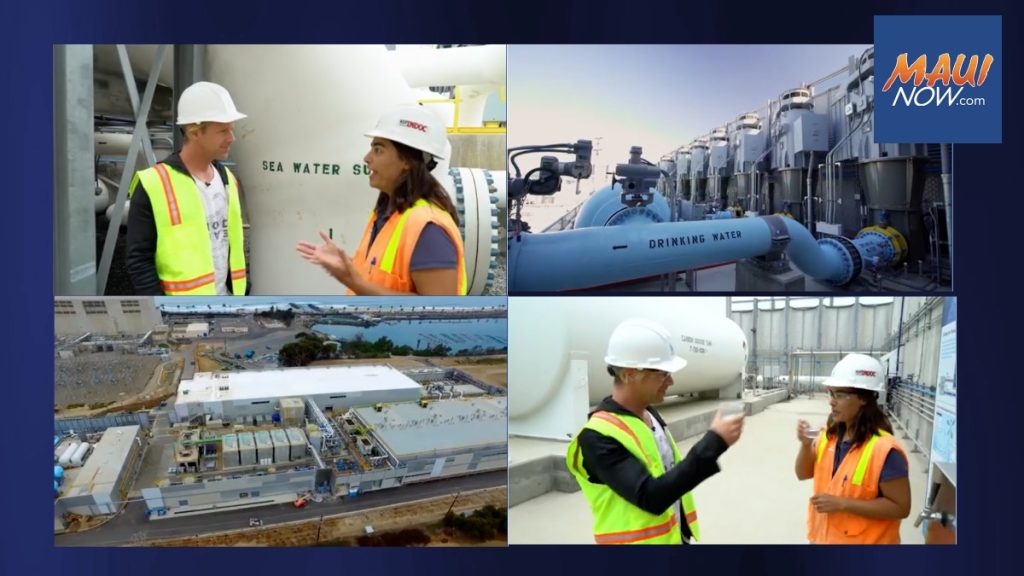
Another major desalination effort is currently underway on Oʻahu. The Kalaeloa Seawater Desalination Facility is being developed by the Honolulu Board of Water Supply and Kalaeloa Desalco LLC in Campbell Industrial Park to produce 1.7 million to 2.55 million gallons of fresh water daily. The objective of the Kalaeloa Project is to develop a drought-proof water supply, enhance water resilience to climate change, and support the Ewa Development Plans’ directed growth.
As of earlier this month, the facility is nearing completion of the design development period and is undergoing major permitting. A pilot phase was completed in May 2025 to ensure the proposed reverse osmosis membrane system meets regulatory and enhanced water quality standards.
Project status and next steps
The desalination project is one of many projects being handled by the department’s capital improvement project engineering team, in collaboration with consultants and the Office of Recovery. The department plans to pursue external funding opportunities, including federal grants, for the project.
Earlier this year, the Maui County Council appropriated $15.5 million for West Maui reliable water capacity. The desalination project is among four “future” projects that are currently sequenced behind four other projects scheduled for this fiscal year, which ends June 30, 2026.
The preliminary feasibility study is complete, and the scope for the next phase of the project is currently being developed. The department completed initial stakeholder engagement in May 2025, and additional public outreach is expected to be conducted.
The study identified general areas that would be the most suitable locations for a facility, and these potential sites would be evaluated and selected in future phases of the project. Solar power is the preferred energy alternative for the new plant.
Activities necessary for advanced planning and permitting have not yet begun. The department has not started an environmental assessment or environmental impact statement, noting this would be “initiated after the project is clearly defined.” Similarly, a hydrogeological evaluation of proposed brine disposal wells for federal Clean Water Act permitting will be performed after specific sites are chosen.
Project costs
The West Maui desalination facility’s costs are unknown since its planning is in the early stages.
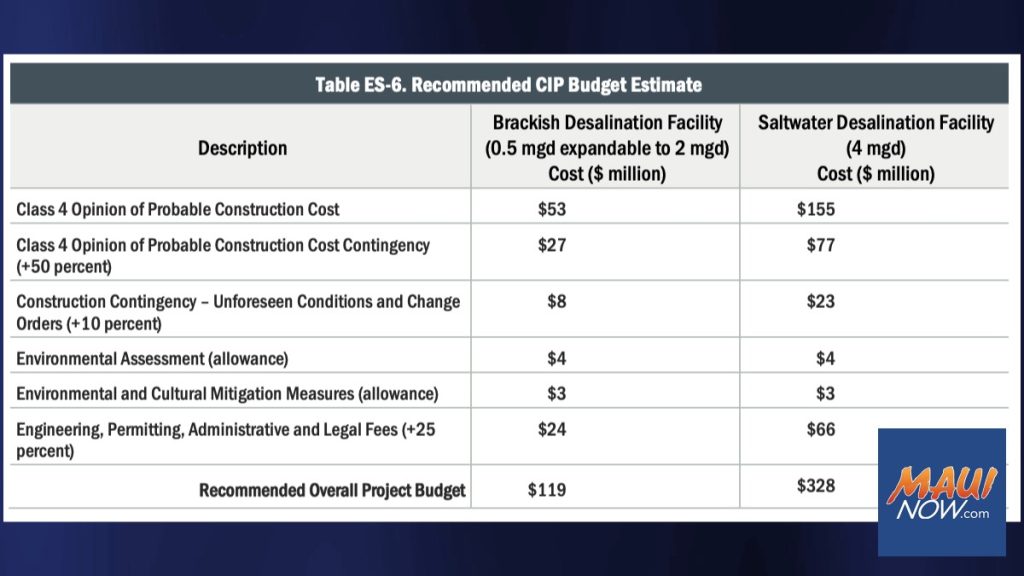
However, the Brown and Caldwell feasibility study gives a recommended range of overall capital improvement project estimates from $119 million to $328 million. The lower end ($119 million) reflects the cost of a brackish desalination facility treating up to 2 million gallons per day. The high end ($328 million) is the estimate for a saltwater desalination facility treating up to 4 million gallons per day. It’s unknown how such costs might impact fees for Maui County domestic water consumers.
In 2024 on Oʻahu, $18.9 million in federal funding was announced in 2024 for the Kalaeloa Seawater Desalination project, which has been designed for 1.7 million to 2.55 million gallons per day.
Costs vary depending on multiple factors, including the methods of drawing in saltwater (intake) and disposing it (brine ocean outfall or deep injection well); capacity sizes impact property costs, materials, equipment and labor; pretreatment costs for water sources (ocean water or brackish water); and infrastructure, the cost of building new pipelines and transmission lines to connect the desalination facility to the existing county water system.
Desalination elsewhere
There are saltwater desalination plants in places such as Carlsbad, Calif.; Antioch, Calif.; and the state of Texas. The Lone Star state has 53 municipal desalination facilities that have a capacity of producing 157 million gallons of drinking water per day. Sixteen of those facilities use brackish surface water as a source of raw water; 36 facilities use brackish groundwater; and one facility uses reclaimed water as a raw water source.
Editor’s note: This post has been updated to report that the Maui County Department of Water Supply is also considering a desalination plant for South Maui.
Sponsored Content