

State clarifies Central Maui pumping data; groundwater aquifer limits are under review
State water regulators have clarified data regarding groundwater pumping in Central Maui, acknowledging that while current withdrawals exceed official sustainable yield limits, those limits are conservative estimates that are now under re-evaluation.
The clarification comes following an Oct. 28 staff briefing before the state Commission on Water Resource Management. The main focus of the briefing was on the water supply impacts stemming from a severe, protracted drought in East Maui.
Ayron Strauch of the commission’s Stream Protection and Management Branch described the sustained arid conditions in East Maui as an “extreme drought,” following an “extremely dry” season in 2025.
Strauch reported that the drought severely impacted agricultural water users, leading to concerns about groundwater resources. Under an agreement, East Maui Irrigation (now fully owned by Mahi Pono) is prioritizing the Department of Water Supply’s needs for domestic use, resulting in Mahi Pono receiving no surface water since Aug. 28.
Instead, Mahi Pono has been irrigating crops with groundwater from the Central Maui ʻĪao aquifer system, he said. Strauch reported Mahi Pono has been “ramping up groundwater production” to sustain its operations.
At the October meeting, Jonathan Likeke Scheuer, chair of the East Maui Regional Community Board and its Hawaiian Homes Commission representative, expressed alarm about Mahi Pono’s water withdrawals from the Kahului and Pāʻia aquifers. He noted the water withdrawals were exceeding sustainable yield limits. Sustainable yield refers to the maximum amount of water that can be safely pumped out of an underground source over time.
Scheuer cited figures showing pumping of up to 13 million gallons per day from the Kahului aquifer, which has a sustainable yield of 1 mgd, and up to 25 mgd from Pāʻia, with a sustainable yield of 7 mgd.
Now, however, Andrew Laurence, communications director for the state Department of Land and Natural Resources, clarified that the 13 mgd figure for Kahului represented a peak on a single day, not a sustained average.
Laurence provided the Water Commission’s current, official 12-month-moving averages for the aquifers. The data reflects total pumping by all users in the system. The Kahului Aquifer is averaging 6.562 mgd (official sustainable yield: 1 mgd), while the Pāʻia Aquifer is averaging 13.636 mgd (sustainable yield: 7 mgd).
“CWRM relies on the 12-MAV because it accounts for seasonal variations in groundwater demand,” Laurence said. “Pumping tends to increase during drier months and decrease during wetter months. Aquifers respond slowly to changes in pumping and are resilient to short-term increases in withdrawals. The 12-MAV therefore provides a more accurate representation of long-term aquifer stress and a more scientifically appropriate basis for evaluating whether long-term withdrawals are within sustainable limits as opposed to daily totals or monthly averages.”
Mahi Pono usage and ‘Conservative’ limits
While the current pumping averages exceed the state’s official sustainable yield numbers, both Mahi Pono and state regulators agree that the official limits may not reflect the current reality of the aquifer.
Grant Nakama, Mahi Pono senior vice president of business operations, noted that the state’s 2019 Water Resource Protection Plan says that the sustainable yield numbers for Kahului (1 mgd) and Pāʻia (7 mgd) aquifers are based on “natural conditions” and do not take into account the significant recharge of the aquifers that comes from irrigation water seeping back into the ground.
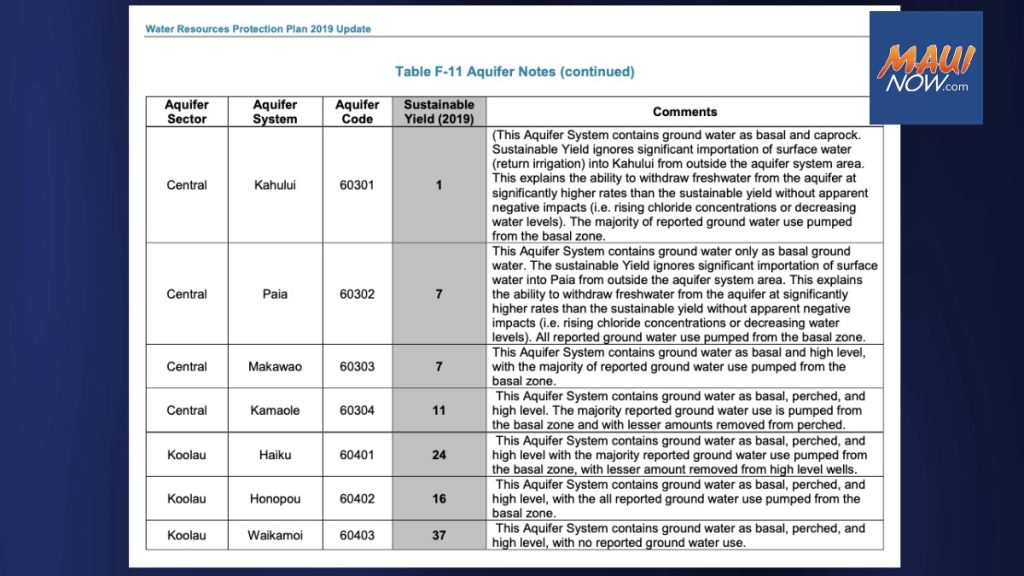
State regulators confirmed this.
“Mahi Pono correctly quoted the 2019 WRPP, which contains the State’s most current sustainable yield figures,” Laurence said. “Staff are aware that historical return irrigation was a significant source of recharge in Central Maui and that this directly influences the sustainable yield calculation; therefore, current SY figures may not fully reflect present hydrologic conditions.”
Because of this discrepancy, commission staff members are working with the US Geological Survey to develop a new groundwater model for the Central Maui aquifer sector, he said.
Regarding the company’s specific usage, Nakama reported that Mahi Pono’s groundwater use in 2025 has averaged approximately 18 mgd across its Central Maui fields. He said this figure covers the 10-month period from Jan. 1 through Oct. 31, 2025.
“We do not have that 18 mgd figure broken down by aquifer,” he said. “However, it would be safe to assume that at least half of the 18 mgd was drawn from the Pāʻia aquifer.”
Laurence, however, noted the state could not verify that number.
“Regarding Mahi Pono’s statement that its groundwater use ‘averaged approximately 18 mgd,’ commission staff do not have access to the underlying data or methodology behind that figure,” Laurence said. “It may reflect a different timeframe or a different accounting basis, which would make direct comparison inappropriate.”
Disagreement on aquifer health
While there is agreement on the pumping data, the state and Mahi Pono have differing assessments of current pumping levels.
Nakama said the company submits detailed monthly reports to the commission regarding groundwater quality.
“These reports have shown no appreciable impact on the broader aquifer,” he said.
State regulators, however, are monitoring long-term water-level trends and for saltwater intrusion — where saltwater is drawn into the aquifer due to over-pumping — as well as other data from production and observation wells, Laurence said.
“That analysis is ongoing. Providing conclusions before staff complete their technical review would not be responsible,” he said.
Because the Central Maui aquifers are not designated as groundwater management areas, the state currently lacks the statutory authority to regulate pumping.
Sponsored Content