Maui visitor spending increases in October despite fewer visitors
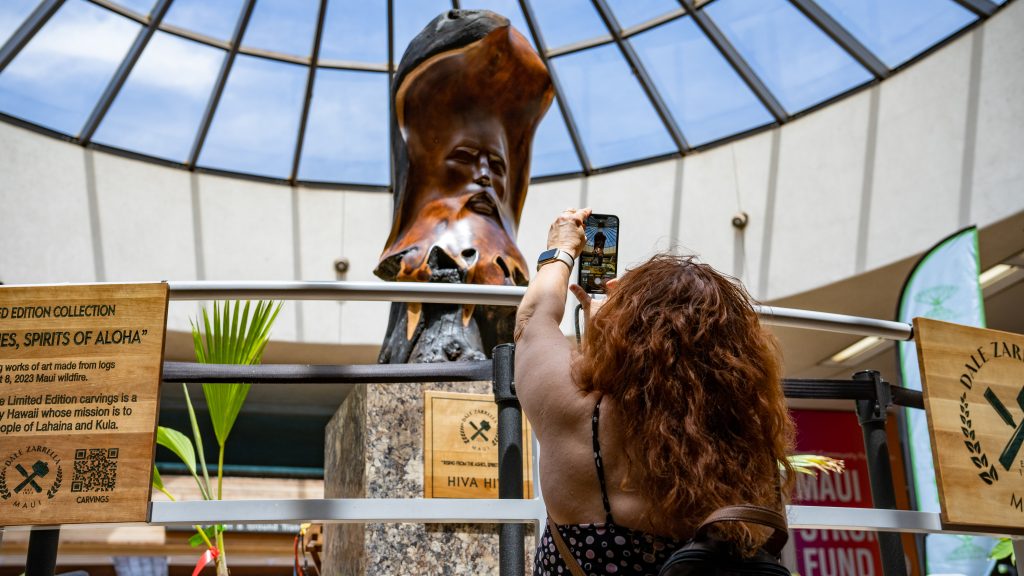
Ten months into 2025, Maui is still outpacing last year’s visitor totals — even though October delivered the island’s first year-over-year dip since midsummer.
New tourism numbers released this week show that 179,459 visitors came to Maui in October, down 1.1% from October 2024. The island’s average daily census was also down 7.5% from a year earlier.
Even so, October remained noticeably busier than September, which brought in 165,322 visitors, and it helped keep Maui on track to outpace 2024 overall.
From January through October, Maui welcomed 2,071,653 visitors, a 7.6% increase compared to the same period in 2024. Visitor spending for the first 10 months of the year hit $4.79 billion, up 12.1%.
The visitor data comes from preliminary statistics released by the state Department of Business Economic Development and Tourism each month.
How Maui compares to the rest of Hawai‘i
Statewide, Hawai‘i also saw mixed results in October.
Total visitor spending rose 6.7% to $1.70 billion, while total arrivals dipped 2.9%. Higher daily spending helped soften the decline.
Detailed breakouts show the same mixed picture:
- Maui arrivals dipped slightly in October (-1.1%), while spending climbed 11.3%.
- O‘ahu arrivals were up slightly in October by 0.5% with spending up 3.8%.
- Kaua‘i had a strong month, with arrivals up 9.8% and spending up 16.2%.
- Hawai‘i Island saw arrivals rise 9.2%, though spending was up a slimmer 4.8%.
Most visitors to Hawai‘i arrived by air from the US West, with 384,159 visitors, and US East, with 172,461 visitors. Japan travel continued to rebound with 70,991 visitors, a 16% increase from last year and a second straight month of year-over-year growth. Canada arrivals, however, were down more than 20%.
In addition to air, cruise travel saw steady activity, bringing in 21,883 visitors from out-of-state ships in October — nearly 40% more than last year.
The average length of stay statewide was 8.21 days, slightly shorter than last October. Hawai‘i’s average daily census totaled 198,322 visitors, down 4.7%.
Year-to-date statewide
Statewide year-to-date, Hawai‘i welcomed 8.03 million visitors, roughly flat compared to 2024 (+0.1%). Visitor spending statewide reached $17.87 billion, up 5%.
By county, year-to-date statistics through the first 10 months of 2025 are as follows:
- Maui:
2,071,653 visitors (+7.6%);
$4.79 billion in spending (+12.1%). - O‘ahu:
4,760,759 visitors (-1.2%);
$7.88 billion in spending (+4.9%). - Kaua‘i:
1,193,164 visitors (+2.5%);
$2.42 billion in spending (+0.5%). - Hawai‘i Island:
1,461,918 visitors (+2.0%);
$2.62 billion in spending (-0.4%).
Who spends the most?
Travelers from the US East led all markets in daily spending at $315 per person, while the US West contributed the most to the economy as a whole due to having the most visitors. Both US East and US West visitors spent over 15% more per day than they did in October 2024. Japan visitors spent about the same per person as last year, but higher arrival numbers boosted total spending by 15.5%.
Air capacity
Air seat capacity to Hawai‘i increased slightly in October, with 4,679 transpacific flights and more than 1 million seats. International air service grew modestly overall, with notable increases from Korea and the Philippines. There continues to be no direct flights from China to Hawai‘i since service ended in early February 2020.
Moloka‘i sees major event-driven boost
Moloka‘i hosted more than 3,000 out-of-state visitors in October, driven largely by the Moloka‘i Hoe World Championship on Oct. 12 — an event that drew a record 106 paddling teams, including competitors from Hawai‘i, the mainland US, Australia, New Zealand, Hong Kong and French Polynesia.
State response
DBEDT Director James Kunane Tokioka said the mix of increases and decreases shows Hawai‘i is still navigating a competitive global travel market.
“We are encouraged to see improvement from the Japan market,” he said, regarding its 15.5% jump in spending and 16% growth in arrivals. But he also pointed to continued declines from Canada and several other international markets, citing economic and political uncertainty.
“As we continue to face tough competition from other travel destinations, it is important that we continue to market to our key major market areas during this challenging time,” Tokioka said.
Sponsored Content