
Mayor Bissen signs Bill 9 into law; says it will restore housing availability for residents
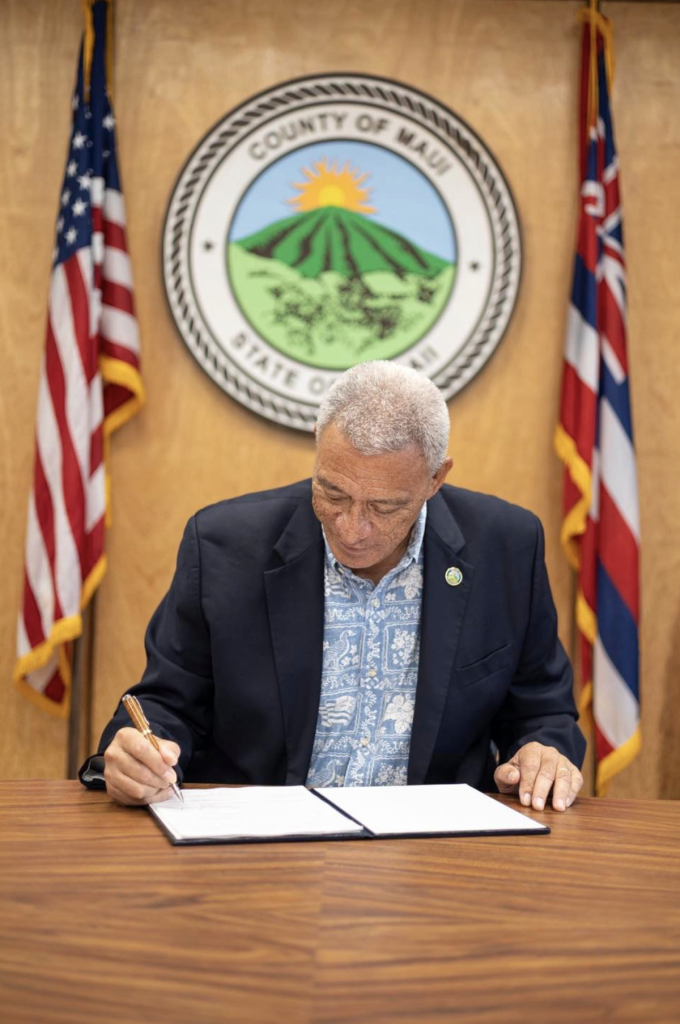
Mayor Richard Bissen today signed Bill 9 into law after Maui County Council approved the measure on second and final reading, marking what he calls “a historic step toward restoring housing availability for residents” and “realigning zoning policy with its original residential purpose.”
“Mahalo to Maui County Council members and staff for their extensive work on Bill 9 and for taking crucial and courageous steps to improve life for Maui’s most important resource – our people,” Bissen said. “Thank you especially to every community member who testified, engaged in the democratic process respectfully and showed up to change the course of history.”
Bissen emphasized that he supports the Maui County Council’s Temporary Investigative Group (TIG), which recommends that 4,519 units be reclassified under the new H-3 or H-4 Hotel zoning designation.
Bill 9 was introduced by Mayor Bissen in May 2024 in the wake of the Maui wildfires, which exacerbated Maui County’s longstanding housing crisis. Today, he emphasized that “Bill 9 is about restoring balance and prioritizing the needs of people who live in Maui County.”
“Bill 9 has consistently stood out as the most immediate way to bring thousands of units back online and expand housing inventory in Maui County,” Bissen said.
Council members voted 5-3 in favor of the bill as they weighed in on the balance between economic stability and the preservation of local housing. Voting in favor of the bill were Council Members Tamara Paltin, Gabe Johnson, Keani Rawlins-Fernandez, Shane Sinenci and Nohelani Uʻu-Hodgins. Voting against the measure were Chair Alice Lee, Vice Chair Yuki Lei Sugimura and Council Member Tom Cook. The Kahului residency seat held by the late Council Member Tasha Kama remains vacant.
“Today, transient vacation rentals make up 21% of Maui County’s overall housing stock — more than any other county in Hawaiʻi. For far too long, short-term rentals, offshore investors, and private interests have overwhelmed our housing inventory.
“We knew taking on powerful interests in the short-term rental industry was never going to be easy. We’ve seen an influx of outside messaging driven by special interests attempting to influence our community through fear. But the facts matter. Ninety-four percent of the units affected are owned by people who don’t live in Maui County, and most don’t even live in Hawaiʻi. Decisions about Maui’s housing should be guided by the needs of the people who live here—not by outside interests trying to protect profits.
“Rebalancing our housing market means we must return apartment-zoned housing to local families and residents—and that principle has guided our approach to Bill 9 from the very beginning.”
According to the mayor, “Bill 9 corrects a long-standing zoning exemption that allowed transient vacation rentals (TVRs) to operate in apartment-zoned districts — areas originally intended to provide long-term housing for local families.”
By phasing out so-called Minatoya TVRs in these districts, the legislation is expected to return more than 6,000 units to long-term residential use, expanding Maui County’s housing inventory without the need for new construction, according to a news release issued by the mayor. “Importantly, Bill 9 does not eliminate tourism or short-term rentals in Maui County. Approximately 6,500 TVR parcels, along with thousands of units in hotels, and more than 2,400 timeshares and bed-and-breakfast operations, will continue to operate,” according to the news release.
The passage of Bill 9 follows nearly two years of public engagement, policy review, amendments and deliberation. County leaders acknowledged the tension surrounding the issue, while emphasizing that the bill represents a necessary course correction in response to the evolution of the short-term rental industry, according to the release.
“When the zoning loophole that allowed short-term vacation rentals in apartment districts was created, short-term rentals were not an industry,” said Edward Codella, who testified today in support of the bill. “There were no platforms, no institutional investors, and no global capital chasing returns on Maui housing. Today, that reality has changed completely.”
County officials emphasized that Bill 9 is one part of a broader, multipronged housing strategy. In addition to correcting zoning policy, the administration has committed to working with the County Council to support the recommendations of the TIG, explore pathways to homeownership, and consider tax and policy tools that complement the intent of the legislation.
County leaders also addressed fiscal concerns, noting that while the bill may result in an estimated $60 million reduction in revenue, this represents a return to prior-year budget levels and is considered manageable, according to the mayor. “Over time, many returned units are expected to transition to long-term residential tax classifications, helping stabilize revenues while delivering housing capacity that would otherwise cost billions of dollars to build,” according to the news release.
Mayor Bissen provided the following list of additional details surrounding Bill 9:
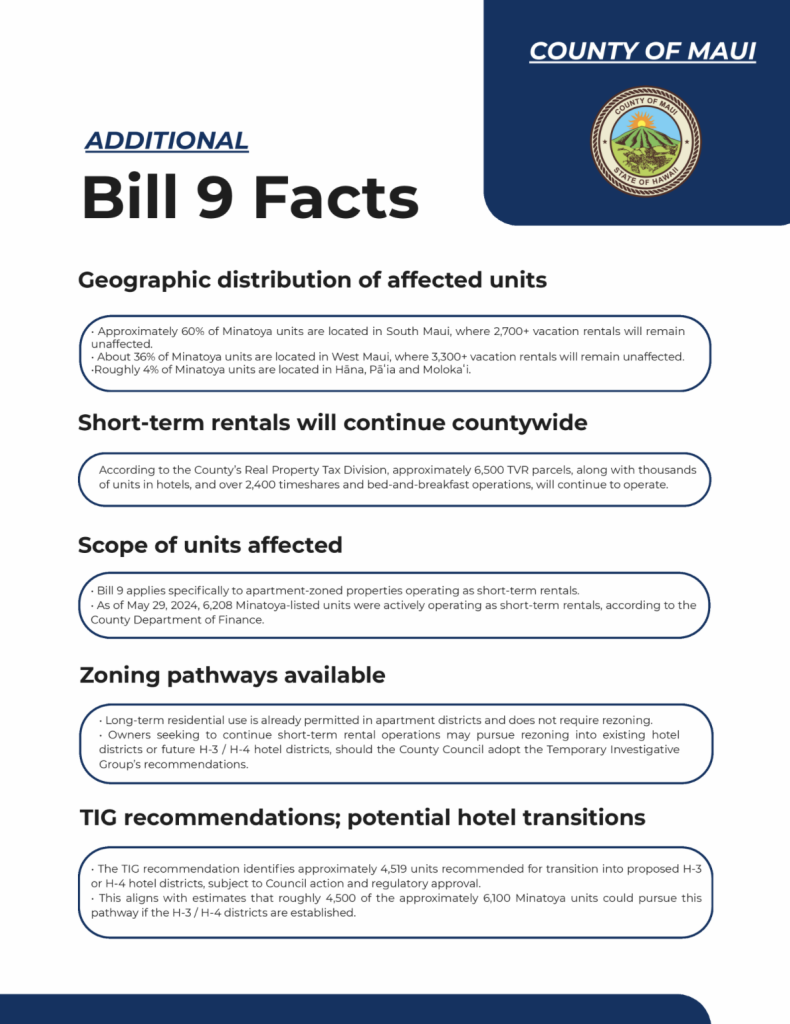
Geographic distribution of affected units
- Approximately 60% of Minatoya units are located in South Maui, where 2,700+ vacation rentals will remain unaffected.
- About 36% of Minatoya units are located in West Maui, where 3,300+ vacation rentals will remain unaffected.
- Roughly 4% of Minatoya units are located in Hāna, Pāʻia, and Molokaʻi.
Short-term rentals will continue countywide
- According to the County’s Real Property Tax Division, approximately 6,500 TVR parcels, along with thousands of units in hotels, and over 2,400 timeshares and bed-and-breakfast operations, will continue to operate.
Scope of units affected
- Bill 9 applies specifically to apartment-zoned properties operating as short-term rentals.
- As of May 29, 2024, 6,208 Minatoya-listed units were actively operating as short-term rentals, according to the Department of Finance.
Zoning pathways remain available
- Long-term residential use is already permitted in apartment districts and does not require rezoning.
- Owners seeking to continue short-term rental operations may pursue rezoning into existing hotel districts or future H-3 / H-4 hotel districts, should the County Council adopt the Temporary Investigative Group’s recommendations.
TIG recommendations and potential hotel transitions
- The TIG recommendation identifies approximately 4,519 units recommended for transition into proposed H-3 or H-4 hotel districts, subject to Council action and regulatory approval.
- This aligns with estimates that roughly 4,500 of the approximately 6,100 Minatoya units could pursue this pathway if the H-3 / H-4 districts are established.
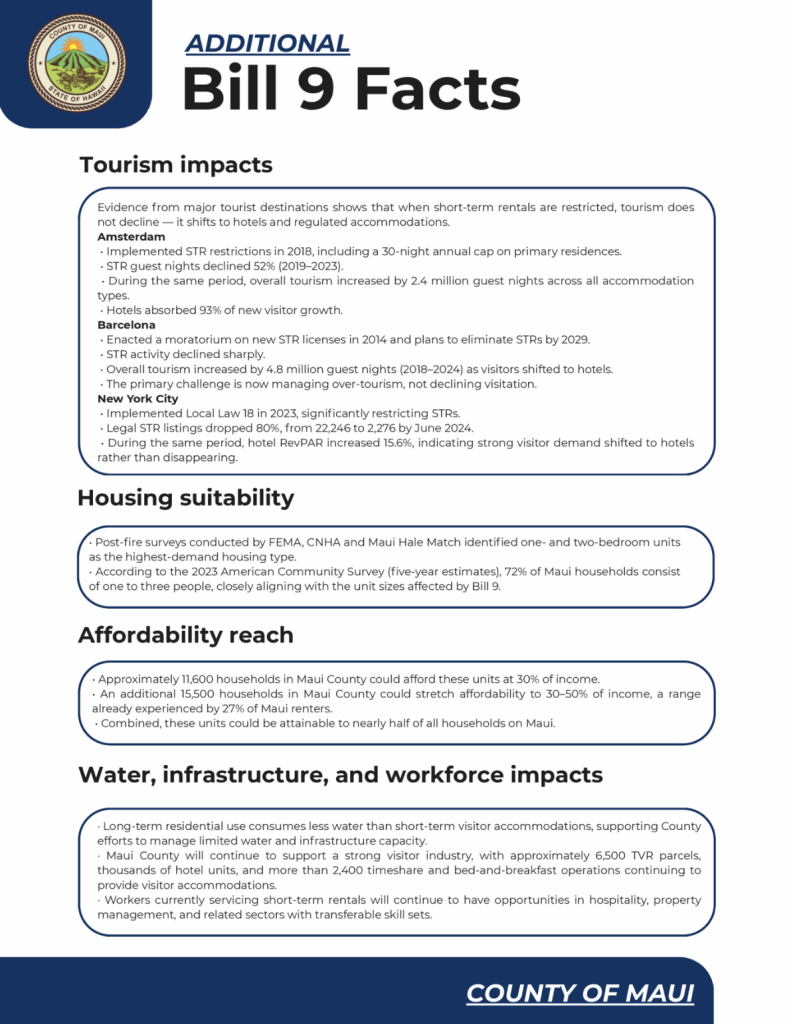
Tourism impacts
- Evidence from major tourist destinations shows that when short-term rentals are restricted, tourism does not decline — it shifts to hotels and regulated accommodations.
Amsterdam
- Implemented STR restrictions in 2018, including a 30-night annual cap on primary residences.
- STR guest nights declined 52% (2019–2023).
- During the same period, overall tourism increased by 2.4 million guest nights across all accommodation types.
- Hotels absorbed 93% of new visitor growth.
Barcelona
- Enacted a moratorium on new STR licenses in 2014 and plans to eliminate STRs by 2029.
- STR activity declined sharply.
- Overall tourism increased by 4.8 million guest nights (2018–2024) as visitors shifted to hotels.
- The primary challenge is now managing overtourism, not declining visitation.
New York City
- Implemented Local Law 18 in 2023, significantly restricting STRs.
- Legal STR listings dropped 80%, from 22,246 to 2,276 by June 2024.
- During the same period, hotel RevPAR increased 15.6%, indicating strong visitor demand shifted to hotels rather than disappearing.
Housing suitability
- Post-fire surveys conducted by FEMA, CNHA and Maui Hale Match identified one- and two-bedroom units as the highest-demand housing type.
- According to the 2023 American Community Survey (5-year estimates), 72% of Maui households consist of one to three people, closely aligning with the unit sizes affected by Bill 9.
Affordability reach
- Approximately 11,600 households in Maui County could afford these units at 30% of income.
- An additional 15,500 households in Maui County could stretch affordability to 30–50% of income, a range already experienced by 27% of Maui renters.
- Combined, these units could be attainable to nearly half of all households on Maui.
Water, infrastructure and workforce impacts
- Long-term residential use consumes less water than short-term visitor accommodations, supporting County efforts to manage limited water and infrastructure capacity.
- Maui County will continue to support a strong visitor industry, with approximately 6,500 TVR parcels, thousands of hotel units, and more than 2,400 timeshare and bed-and-breakfast operations continuing to provide visitor accommodations.
- Workers currently servicing short-term rentals will continue to have opportunities in hospitality, property management, and related sectors with transferable skill sets.
Sponsored Content



_1768613517521.webp)