

Proposal for new hotel zoning for vacation rentals deferred in Housing and Land Use Committee
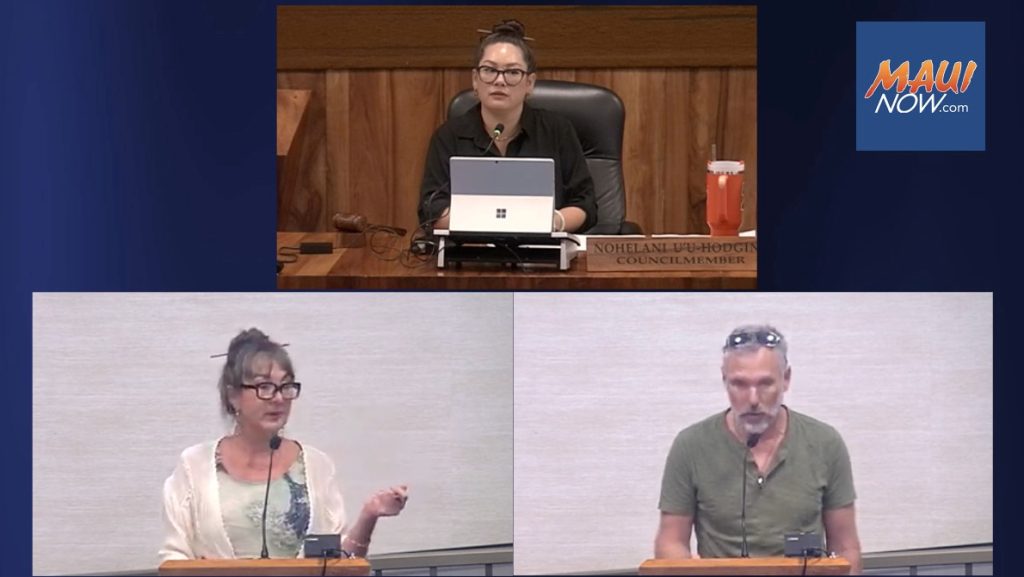
The Maui County Council’s Housing and Land Use Committee on Monday deferred action on the creation of new hotel zoning districts following an executive session that lasted over an hour.
The committee met to discuss Resolution 25-230, which proposes establishing H-3 and H-4 zoning districts. These districts are intended to allow transient vacation rentals to continue as a permitted use for certain properties currently in A-1 and A-2 apartment zones following the enactment of Bill 9. The proposal has been to “cut and paste” apartment zoning provisions into the new H-3 and H-4 zoning, except that vacation rentals would be permitted outright.
Now the resolution to refer the bill to the Maui, Molokaʻi and Lānaʻi planning commissions is on Wednesday’s full Council agenda as unfinished business. On Monday, the Housing Committee reviewed proposed amendments to the bill from Council Members Tamara Paltin and Keani Rawlins-Fernandez.
Paltin’s proposed amendments include:
- Public shoreline access: A requirement that properties within the H-3 and H-4 districts provide public shoreline access and make at least 10% of their parking spaces available for the public during daylight hours.
- Liability protections: Mandates that property owners in sea level rise exposure areas indemnify the county and state against any future costs associated with protecting or maintaining private property from coastal hazards. The County would not be held responsible for costs associated with retreat, hazard mitigation and cleanup to maintain the health of the nearshore marine environment from debris coming from eroded structures.
- Sea level rise definition: Defines the sea level rise exposure area based on the state Climate Commission’s planning threshold of 3.2 feet of sea level rise, although that might change based on best scientific information.
Rawlins-Fernandez’s proposed amendments call for the proactive removal of structures to protect coastlines. These include:
- Shoreline armoring ban: A prohibition on new construction, maintenance or expansion of shoreline armoring (such as seawalls) for properties in the new districts.
- Coastal transition and phased removal: A requirement that the planning director execute agreements with property owners for the eventual removal of non-natural, human-made objects affixed to the land — such as buildings, foundations, retaining walls, decks, swimming pools and parking lots — as coastal erosion progresses.
- Accessory use clarity: Detailing allowable accessory uses within hotel districts.
- Environmental policy alignment: Additional language to the bill’s purpose section acknowledging the need to protect shoreline and ocean ecosystems as recognized in Maui County’s Maui Island Plan, community plans and Climate Action and Resiliency Plan.
Committee Chair Nohelani Uʻu-Hodgins, who took over the chairmanship Monday following a Council committee reorganization, deferred the matter without further comment after the committee spent more than an hour in executive session. The closed meeting was called to consult with legal counsel on the powers, duties, and liabilities of the county concerning proposed amendments to new hotel districts.
In written and public testimony, West Maui community advocate and former chair of the West Maui Community Plan Advisory Committee Kai Nishiki said the Council’s Temporary Investigative Group has already noted that properties located within the sea level rise exposure area would not produce long-term housing for residents.
“That statement alone should give us pause,” she said. “If the Council’s goal is to protect the County’s long-term revenue stream, which is fundamentally tied to a healthy coastal ecosystem, then we must evaluate H3 H4 zoning holistically, with climate risk front and center — because we all understand here on Maui, our environment is our economy.”
Legislation needs safeguards to prevent “increasing property values, mostly for offshore owned, without addressing the very real and escalating risk of aging structures on eroding shorelines,” Nishiki said.
The fundamental fiscal question is: “Who is left holding the bag when investors bail out on risky end-of-life shoreline properties built in the 1970s? Investors always look to maximize profits when they exit and sell,” she said.
Citing a May 22, 2025, memorandum from the Maui County Department of Planning, Nishiki said 43 properties on the so-called Minatoya List of grandfathered vacation rental properties — with a total of 2,440 units — appear to be affected by the 3.2-foot sea level rise exposure area.
Maui County has an estimated $1.2 billion in replacement cost value of buildings in the coastal erosion hazard area, Nishiki said, and West Maui leads with 162 out of 366 buildings by community plan area. West Maui also has the highest number of residential and commercial buildings in this hazard zone, she said.
“Sea level rise is not a distant forecast, it is happening now,” Nishiki said. “Within the lifespan of this zoning, many of these properties will face loss of beach access, repeated emergency repairs, insurance challenges, and pressure for shoreline hardening.”
“The plans, policies and management actions we take today will decide whether we have a healthy coastal ecosystem and beaches for our keiki or our shorelines become fields of sandbags, broken seawalls and collapsed buildings,” she said.
Ryan Logtenberg, an owner at the Maui Sands oceanfront condominium, asked that the shoreline property in Honokōwai be included in the County-initiated rezoning to H-3 or H-4 hotel districts to align with legacy visitor properties under Bill 9.
Logtenberg said the Maui Sands is a fully leasehold property with high monthly lease rents, association fees and maintenance costs, making it economically unviable for conversion to long-term rental housing.
He noted that an owner-initiated rezoning would be difficult, time-consuming and uncertain because it would require written consent from multiple underlying landowner families.
“This creates a real risk of prolonged delay at a time when clarity and stability are urgently needed,” Logtenberg said. “Continued uncertainty regarding zoning status would be detrimental to Maui Sands, its owners, and the many local workers and businesses that depend on its operation.”
The property was built in 1965 and has operated as a small-scale visitor destination for nearly 60 years, meaning its use as a short-term rental has not displaced local residents, he said.
The next Housing and Land Use Committee meeting has not been scheduled.
The implementation of Bill 9 has been challenged in 2nd Circuit Court.
Sponsored Content