Governor hosts WGA Policy Forum on disaster management; visits Ka Laʻi Ola in Lahaina, Maui

Gov. Josh Green is hosting colleagues at a Western Governor’ Association Policy Forum on disaster management and recovery, taking place on Maui this week.
The two-day forum is being held in Lahaina, which continues to recover following the devastating 2023 Maui wildfires. The idea behind the gathering was to bring people with expertise to share their experience and take best practices away, or identify areas to improve.
“We welcome people to Maui, in this case deliberately because, just under three years ago, we had the disaster of disasters,” said Gov. Green. “On Aug. 8, 2023, we suffered that tragedy. A fire swept down the mountain… [and] it was fierce.”

On that fateful day, Hawaiʻi had just dodged any direct impacts from a passing hurricane, but the winds left in its wake were unforgiving, creating hazardous conditions and adding fuel to a fast moving fire that grew to unbearable strength.
“The embers then ultimately sped up into the air… and they went fast into an old community, and we lost 102 of our loved ones,” said Green.
“I’ll never ever forget the deep sadness, the images in my mind of a day later, the smells and the feeling. And seeing people that were already houseless who had been singed—who had, inhaled, a great deal of smoke… still huddled there, waiting for us to have the recovery.”
—Gov. Josh Green
Maui lost more than 2,200 structures, many of them homes; and just under 8,000 people ended up having to live in hotels because there were no other options, according to the governor.
“I think you’re going to hear a tale that hopefully is helpful for the rest of the world—How we settled the cases within a year; How we built a whole village; How we made sure that we brought in philanthropic support to match in many ways some of the gaps that can exist when government support just doesn’t necessarily or appropriately fit what a crisis might be,” said Green.
In addition, Hawaiʻi passed what the governor called “landmark legislation,” to establish a climate impact fee, or “Green Fee,” as a dedicated source of funding for climate change mitigation and disaster resilience.
Lessons from the Lahaina Wildfire

The first panel of regional experts and policymakers focused on lessons learned from the Lahaina wildfire, and findings of post-fire analyses.
“Wildfire risk, created by environmental conditions like extreme fire weather and dry fuels, was amplified by human factors, including communications, incident command systems, and more,” according to the WGA. “To ensure that this tragic event does not repeat itself, analysis, accountability, and policy reform are imperative.”
Among the panelists was Anne Lopez, Attorney General for the State of Hawaiʻi. She pointed to reports prepared by the Fire Safety Research Institute saying progress made was “truly astonishing.”
The FSRI released three reports over 18 months, containing 850 GB of publicly accessible data including: a Phase One fact-finding report and timeline; a Phase Two report which found “no single cause”; and a final Phase 3 report that shared key findings and recommendations.
An official report indicated that sparks from a broken overhead power line ignited unmaintained vegetation off of Lahainaluna Road, and that led to a chain of events that leveled Lahaina town. The fire’s cause was officially determined to be “accidental.”
“This process is not just to learn about fire, it’s to learn about all the different ways the actives that we do impact the land, and can be used as a firebreak and keep us all safe,” said Lopez, describing the process and the progress made as, “transformative.”
“”These things happen over time… We didn’t wake up one morning and suddenly see the grass growing… It happens over the course of many decades where you have this transition of these non-native species of grass that are highly fire adaptive—meaning they don’t mind if they catch fire.”
—Derek Alkonis, Senior Research Program Manager, Fire Safety Research Institute
There was also a transition that occurred from the Plantation Era, leaving fallow lands that began to encroach on other spaces. “The policies and the infrastructure to deal with it was not keeping pace,” said Alkonis.
One report from the FSRI noted that the conflagration was the result of “a complex set of factors” including weather and its impacts, risk and preparedness, decades-old infrastructure, as well as organizational structure and incident management and coordination.
“We have to co-exist with fire… We also have to co-exist with our vegetation. It takes human will. It takes action to clear your property, to keep it clean. That’s first,” said Alkonis. “We will always have winds. We will always have fuels. Clearing the property is very important… The other thing is that we need to make our houses more defensible against embers and radiant heat. We do that by maintaining our houses, [and] also venting.”
The FSRI reports laid out 84 findings and 104 recommendations following the Lahaina wildfire, including the hire of a State Fire Marshall, responsible for leading the charge on executing priorities. Dori Booth, stepped into that role in June of 2025.
“We don’t want to build back to the same. We want to make sure it’s resilient,” said Booth, acknowledging economic obstacles to achieve that ideal, and identifying ways to help absorb the cost through incentivizing safety.
Booth encouraged policy makers and advisors to listen to subject matter experts. “It takes all of us to move forward and continue to drive change,” she said.
Elizabeth Pickett, Co-Executive Director with the Hawaiʻi Wildfire Management Organization has been working to educate communities and create a knowledge building network for fire prevention.
It was a slow start before the Lahaina wildfire, taking 12 years to get 16 communities on board, but now there are close to 60 engaged and active groups, according to Pickett.
“I cannot speak loudly enough the value of eye contact and relationship, and connection and community. When Lahaina burned, there was understandable focus on the humanitarian need… but a lot of other communities around the state looked around and they saw themselves positioned in exactly the same way—with heavy fuel loads, unsafe built environments, inadequate evacuation routes, and risk all around,” said Pickett.
“Our organization caught those who were afraid and scared and looking to start to take action, and that was massive,” said Pickett, noting the importance of peer-to-peer sharing and learning.
Attendees also considered the use of Artificial Intelligence, acknowledging the increase in weather stations, more available data, and a better understanding of how to best mitigate fires.
ARTICLE CONTINUES BELOW AD“Fires spread fast. The fuel loads are well over what our fire prevention models ever dreamed of,” said Michelle Lujan Grisham Governor of New Mexico, encouraging the embrace of technology. “We’re going to need every tool,” she said.
Lujan Grisham will engage in a discussion with Hawaiʻi Gov. Josh Green during a scheduled conversation today as part of the WGA event.
Rebuilding After Disasters
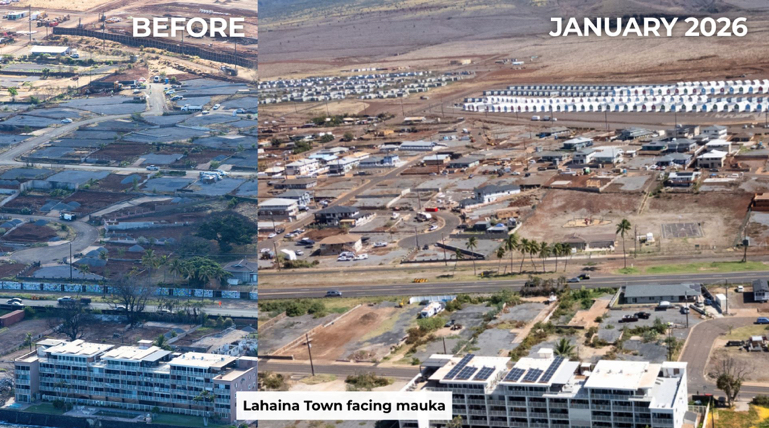
During a second session, participants examined how federal, state, and local governments responded to urgent temporary housing needs in the immediate aftermath of the fires, as well as efforts to rebuild the Lahaina community and provide more permanent housing solutions.
It came before a site visit to the state’s Ka Laʻi Ola temporary modular housing complex for Lahaina fire survivors.
 Site visit to Ka Laʻi Ola during the Western Governors’ Association Policy Forum on disaster management and recovery. PC: WGA (4.20.26)
- Site visit to Ka Laʻi Ola during the Western Governors’ Association Policy Forum on disaster management and recovery. PC: WGA (4.20.26)
- Site visit to Ka Laʻi Ola during the Western Governors’ Association Policy Forum on disaster management and recovery. PC: WGA (4.20.26)


Panelists included: Joseph Campos, Deputy Director, Hawaiʻi Department of Human Services; Roseann Freitas, Chief Executive Officer, Building Industry Association of Hawaiʻi; Josiah Nishita, Managing Director, County of Maui; and Natalie Grant, Director, Office of Human Services Emergency Preparedness and Response, Administration for Children and Families, US Department of Health and Human Services.
Monday’s discussion also examined trauma-informed approaches to disaster recovery, with a focus on lessons and ongoing needs following the 2023 Maui wildfires. Speakers discussed how recovery programs, public services, and community engagement efforts can be structured to account for the behavioral, social, and cultural effects of large-scale disasters.
On Tuesday, the forum will explore the Future of Disaster Management and Recovery, and the unique challenges of Disaster Recovery in Rural Communities.
- Gov. Josh Green hosts the Western Governors’ Association Policy Forum on disaster management and recovery. PC: WGA (4.20.26)
- Gov. Josh Green hosts the Western Governors’ Association Policy Forum on disaster management and recovery. PC: WGA (4.20.26)


Sponsored Content