


Council panel recommends Temporary Investigative Group on vacation rentals

In a move to address lingering concerns about a proposed law to phase out transient vacation rentals, the Maui County Council’s Housing and Land Use Committee voted 8-0 on Wednesday to form a Temporary Investigative Group. The TIG, a “permitted interaction group” under Hawaiʻi’s Sunshine Law, would investigate policies and procedures for vacation rentals in apartment-zoned districts.
The decision comes as the Council considers Bill 9, a measure that passed out of the Housing and Land Use Committee on July 24 by a 6-3 vote. The bill, which has not yet been scheduled for first and second readings before the full Council, seeks to phase out more than 7,000 vacation rentals on the so-called “Minatoya List” over the next three to five years to increase long-term housing for residents.
TIG’s purpose and scope
Council Member Nohelani Uʻu-Hodgins, who introduced the proposal and chairs the new TIG, said the investigative group “would provide the council some time to do our due diligence in order to really take a deeper dive into Bill 9, which we really didn’t have the opportunity to do.” she said
Council Member Tom Cook has previously expressed frustration with the lack of “actionable” procedures in the bill for rezoning or obtaining conditional use permits, saying the bill “didn’t end up with enough tools” to provide a clear path toward rezoning. The TIG is intended to address such gaps.
The TIG’s membership includes Council Members Cook, Tamara Paltin and Shane Sinenci. If the group is approved by the full Council, they will interview County officials and consult with various stakeholders, including property owners, land-use planners, housing advocates, and economists. Its findings and recommendations are to be submitted to the Housing and Land Use Committee by Dec. 31.
Overlay zoning suggested
During Wednesday’s meeting, testifier Tom Croly, a bed-and-breakfast owner in Maui Meadows, proposed a zoning overlay for vacation rentals in apartment-zoned districts as an alternative to outright rezoning. He noted that while some have suggested that vacation rental owners rezone their properties as hotels, this is a difficult process and may not be good public policy.
Croly’s idea would be to create a new land-use category to allow for continued vacation rental use while maintaining the properties’ apartment-zoned status. This concept drew some support from Council Chair Alice Lee, who voted in favor of Bill 9 “with reservations.”
Lee said Croly’s idea was “a very good one worth exploring.”
She noted that, several years ago, the County Council created an R-Zero zoning for residential areas, and “not every zoning ordinance fits every situation, so we created an overlay district on the R-Zero zone.”
With an overlay district, there would be an administrative way to grant zoning if applicants meet specified criteria agreed upon in advance by the administration and Council, she said.
Other public testimony
Caitlin Miller, executive director of Maui Vacation Rental Association, testified that the purpose of the TIG should be “thoughtful, well-informed policy.”
“Many of you have noted in prior discussions that the administration has not provided sufficient due diligence on this issue,” she said. “We believe this TIG presents an opportunity to ensure that the critical research and analysis is completed before any bill is passed.”
She added: “It’s important that the TIG not simply serve as a way to advance legislation quickly with the idea of fixing problems later. These decisions affect thousands of residents, jobs, and small businesses, and they deserve careful, transparent deliberation from the start.”
The vacation rental association “is happy to serve as a resource for the TIG by providing data, industry expertise and real-world perspectives,” Miller said.
A testifier identified as “Kathy” said that, even with the potential passage of Bill 9, property values for condominiums have dropped 30%, “and nobody wants to buy these condos . . . There’s a 15-month supply of them, and the people that own them are desperate.”
She said there’s been statements about the conversion of even one short-term rental to long-term housing would make Bill 9’s passage a “success,” but “I think that’s a really low bar to set for the destruction of Maui’s economy.”
“So, about this TIG, I understand that the council members are trying to make a bad idea into an acceptable idea,” she said. “If a bad idea is a bad idea, it’s probably just going to stay a bad idea.”
Bill 9 proponent Stacey Alapai testified she doesn’t support or oppose the formation of the TIG, but she had concerns about potential “unintended or intended consequences” to streamlining the Maui County Code’s processes for rezoning, community plan amendments and other land-use entitlements. “I feel like this is kind of too broad of a scope for the TIG,” she said.
She added that she wanted to avoid “anything that would further delay the passage of Bill 9.”
Council members weigh in
During Wednesday’s meeting, Council Member Gabe Johnson said that “change can be hard.”
“But, moving forward, I think this TIG could bring us together, bring the community together, and I think it’s sorely needed at a time like this,” he said. “For myself, I think commodification of our housing stock has gotten us in this mess. And I hope we can put ourselves in the shoes of our co-workers, of our classmates, of our residents, of the people who this will benefit. And I think that should be the focus.”
Paltin said she wanted to focus on the scope of the temporary group’s discussion. She asked: “We’re not rehashing Bill 9, right?” to which committee Chair Tasha Kama replied, “You’re correct, (but) I would love for that to happen.”
This exchange hints at a potential disagreement among council members: to what extent is the group a fact-finding panel for how Bill 9 would be implemented; or a venue to propose amendments to the measure when it comes up for first and second reading.
Before she needed to leave the meeting early, Paltin said the TIG should not start until Bill 9 passes. “If Bill 9 doesn’t pass, it’s almost a moot point,” she said.
Paltin also said she would like the TIG to identify vacation rental properties that would be ideal for long-term, affordable rental housing.
Uʻu-Hodgins said she’s “open to a date shift, but at the same time, I would like to begin sooner than later because right now it’s just right on the top of my brain as we have discussed everything related to Bill 9 for the last, well, it’s (been) a long time.”
The investigation’s purpose is to make findings and recommendations on:
- Identifying apartment district properties where continuing transient vacation rental uses may be appropriate, even if the Council enacts an ordinance phasing them out in apartment-zoned districts. (“Properties” includes individual units or entire buildings.)
- Summarizing forecasted economic and social impacts of the phase-out of vacation rentals.
- Suggesting Council-initiated bills to approve a change in zoning, community plan amendment or conditional permit for the identified properties.
- Proposing improvements to the Maui County Code for a more efficient and timely application process for changes in zoning, community plan amendments or other land-use entitlements.
Uʻu-Hodgins said those four items were intensely discussed during committee deliberations on Bill 9 “as we were trying to figure out, again, how to make this most sense.”
She noted that there’s no special process to “call out any one property to another, specifically as it goes from apartment to hotel.”
Uʻu-Hodgins said she would like the investigative panel to look at condominiums to ensure there’s adequate parking for future long-term residents; and to what extent building improvements are needed that would require special assessments for future residents, which would complicate lending.
And, she said she would like to have investigative group members walk the impacted properties “so we can take a look for ourselves what these places look like.” She noted that the Lahaina Strong group did that on the Council’s behalf, “which was very helpful.”
“And so I’m hoping the four of us can do the same,” she said. “And when we report back to this committee, . . . we will have the ability to speak on what we saw, and not just what we heard,” she said.
When Lee was asked about when Bill 9 would come before the full Council for first reading, she said she previously considered Sept. 23, but now “it’s really hard to say.”
Council Member Keani Rawlins-Fernandez expressed dismay that it would take two months for Bill 9 to come before the full Council after passing out of committee.
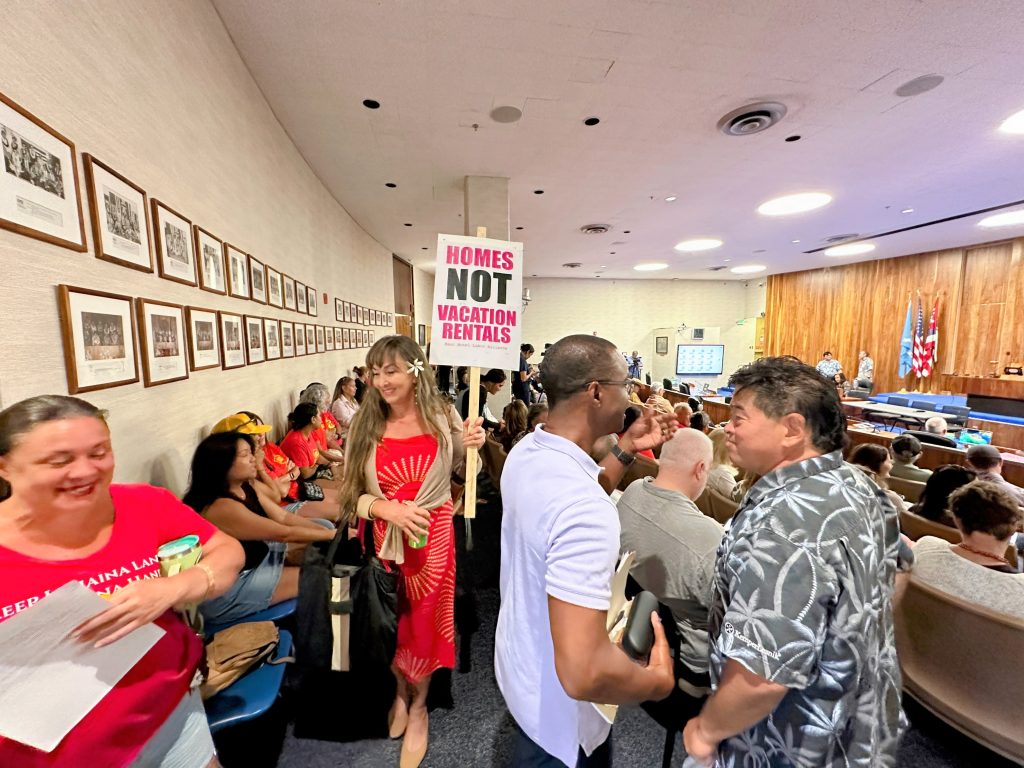
Lee said the big picture for scheduling Council proceedings includes other matters, like taking a long time to consider the contentious Honua’ula/Wailea 670 project district zoning amendments and to accommodate Rawlins-Fernandez’s request for a meeting in the South Maui community.
The challenges with an in-person hearing include site availability and online connectivity, she said.
Such matters take time to sort out, Lee said.
“Facilities are not always available,” she said. “So then what’s going to happen is we might find a facility in the district, but then we can’t receive online testimony, and people are going to complain about that too. Or, we have it back in the chamber and not in the district, and then people are going to complain about that too. So, you know, it’s really not an easy fix, and we’re trying.”
She noted that Bill 9 also affects multiple districts, whereas the Wailea 670 issue only impacted South Maui.
TIGs and Hawaiʻi’s Sunshine Law
The creation of the Temporary Investigative Group is allowed under Hawaiʻi’s Open Meetings or Sunshine Law, specifically Section 92-2.5. The law generally requires all government board meetings to be open to the public, with advance notice of agendas and an opportunity for public testimony.
However, recognizing the need for government bodies to conduct investigations, the law provides an exception for TIGs. These groups can have two or more members, but always less than a quorum of the full board (four or fewer members for the nine-member Maui County Council). TIG members are allowed to meet privately to “investigate a matter relating to the official business of their board,” as long as the full board publicly defines the group’s purpose and scope beforehand.
All findings and recommendations of a TIG must be presented to the full board at a public meeting. Also, any deliberation and decision-making on the matter must occur at a subsequent public meeting, held at least six business days after the TIG’s report is presented. This multi-step process ensures that while the investigation itself is private, the public remains informed and may provide input before any official action is taken by the full board, the County Council.
The proposal to establish the TIG moves on to the full Council for further action.
Sponsored Content