


Acoustic tracking of tiger sharks at Olowalu finds they mate during Maui’s whale season
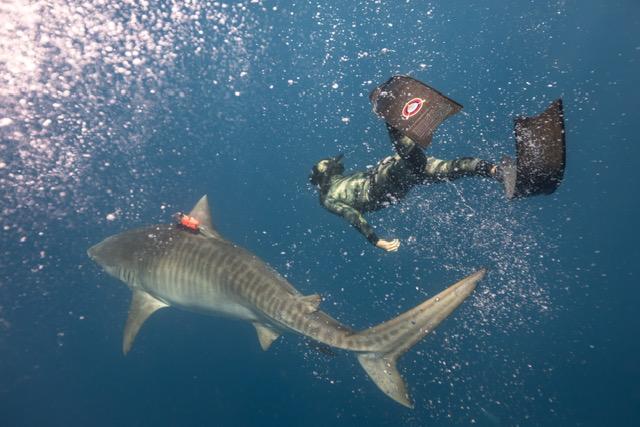
A team of shark researchers from the University of Hawaiʻi at Mānoa has solved a long-standing mystery, identifying the first-ever documented mating hub for tiger sharks. The new study, led by the Hawaiʻi Institute of Marine Biology Shark Lab, utilized six years of acoustic tracking data to pinpoint Olowalu, Maui and the nature of tiger shark mating.
This challenges the conventional understanding of tiger sharks as purely solitary animals, revealing a predictable seasonal convergence of mature males and females that coincides with the humpback whale calving season in Hawaiʻi.

Solving the mating mystery
For years, it was unclear how tiger sharks, which are typically solitary wanderers, came together to reproduce, or if mating was simply a result of random encounters.
“Tiger sharks typically roam widely in what can seem like random patterns, so finding such a strong and consistent seasonal trend in their movements around Maui was unexpected,” said Paige Wernli, lead author of the study and a graduate student in the HIMB Shark Lab.
The long-term tracking data revealed a strong, predictable seasonal presence and high overlap of both mature male and female sharks at Olowalu, with both sexes exhibiting physical signs of mating activity.
“To our knowledge, no group mating site for tiger sharks has ever been identified. This paper adds an important piece to the puzzle of tiger shark reproduction,” said Carl Meyer, co-author of the paper and principal investigator of the HIMB Shark Lab.

Dual motivations
The timing of the sharks’ convergence also aligns with the arrival of humpback whale mothers and newborn calves in the area. This unique ecological overlap indicates that the sharks may be positioning themselves to take advantage of foraging opportunities, such as vulnerable calves or placental falls.
“Mating and foraging on humpback whales may not be mutually exclusive,” said Wernli, “and both could influence tiger shark movement patterns in Hawaiʻi.”
The researchers noted that these gatherings are not dense but rather diffuse, spanning multiple months and several kilometers.
“This study expands our knowledge of tiger shark mating and challenges our conventional understanding of the term ‘gathering,’” said Meyer. “Together, the results suggest that both reproduction and food availability play key roles in shaping tiger shark movements in Hawaiʻi.”
Years of tracking
The six-year study required the team to safely catch and implant acoustic transmitters in large sharks, then maintain a vast network of underwater listening stations across the main Hawaiian Islands.
Moving forward, the team plans to equip tiger sharks with camera accelerometer tag packages to directly document mating behavior and shark-whale interactions, providing a real “shark’s eye view” into their daily lives.
This work was funded by the Hawaiʻi Department of Land and Natural Resources and the Pacific Islands Ocean Observing System.
Sponsored Content