Economist warns council of vulnerable economy ahead of budget deliberations

University of Hawaiʻi economist Carl Bonham warned Maui County Council members Wednesday that a stagnant job market and a precarious reliance on wealthy tourists leave the county vulnerable as it begins annual budget deliberations.
Bonham delivered a presentation on his economic forecast to members of the Budget, Finance and Economic Development Committee shortly after Mayor Richard Bissen released a proposed $1.616 billion spending plan for fiscal 2027, which begins July 1.
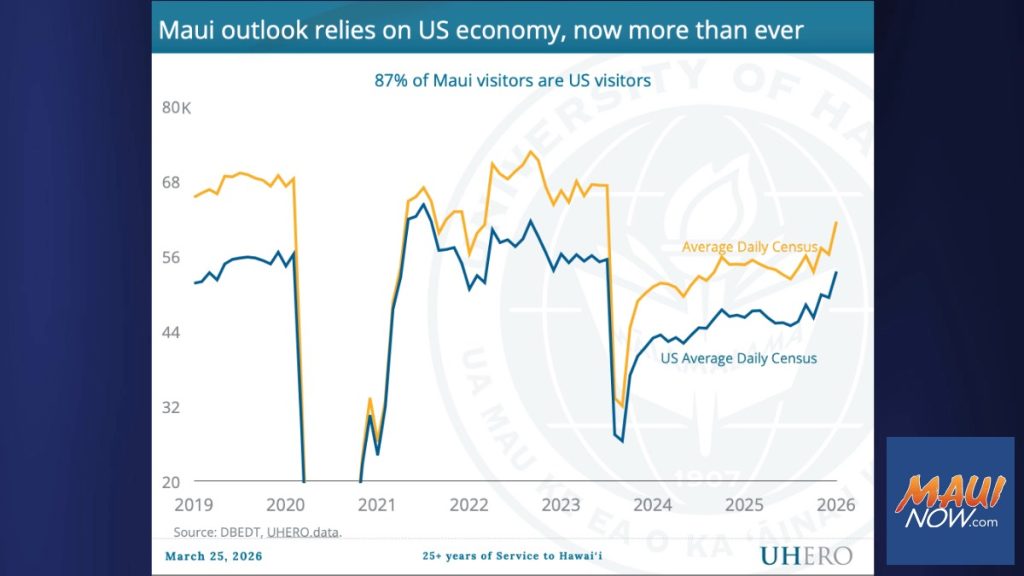
The University of Hawaiʻi Economic Research Organization executive director said that, according to the most recent data, US visitors make up 87% of all arrivals to Maui.

“The point of this is that, if the US economy weakens considerably and that turns into fewer visitors, it has an oversized effect on our economy compared to the way it would have been in the past decades,” he said.
A narrowing visitor base
The visitor market has narrowed significantly to affluent travelers, Bonham pointed out.
“High-income visitors are doing the bulk of the spending,” he said.
When analysts look at hotel room occupancy and room rates, “what you see is that only the very high end properties are experiencing rising occupancy rates and rising room rates,” he said. “On Maui, actually, the occupancy rates remain weak and room rates have come down in part to try to fill those rooms. But still, the revenue is primarily showing up, or the improvements are showing up in the high-end market.”
Bonham attributed the spending power of these visitors to artificial intelligence investment and stock market gains.
“By some estimates, the top 20% of households by income are doing more than 50% of the spending in the US economy,” Bonham said. “Essentially, that’s another story of vulnerability because we essentially have all of our eggs in this basket of high-spending visitors who are benefiting from the stock market wealth. At the same time, the rest of the economy and everybody else is sort of dealing with rising prices and are quite pessimistic about how things stand.”
Geopolitical risks and energy costs
External pressures are further complicating the local outlook.
Oil prices rose sharply worldwide in the wake of the Iran war and closure of the Strait of Hormuz, and they continue to fluctuate based on Middle East instability. The Strait of Hormuz is the gateway for 20% of the world’s oil supply.
“Basically every news pronouncement about whether or not, you know, there’s going to be a ceasefire; whether there’s going to be some kind of agreement; an offer to escort ships through the Strait of Hormuz… all of those things are causing these (oil prices) to bounce all over the place,” Bonham said. “The fundamental issue now is: How long is this going to last? And, how much damage is being done to energy infrastructure in the Gulf Region?” Hawaiʻi’s inflation rate is likely to rise higher than the US continent because the islands have a greater reliance on oil, Bonham told the committee.
Staggered rental phase-out
Bonham also updated the committee on the projected economic impact of phasing out short-term vacation rentals in apartment-zoned districts.
While previous assessments assumed all 6,000 units would close in 2026, Bonham said a new model staggers the phase-out through 2029 for West Maui and later for the rest of the island.
The county will still lose 1,800 jobs and an estimated $900 million in visitor spending by 2031, he said, but the gradual implementation “essentially dampens the blow to the economy.”
“Some people will begin to transition their units to long-term rentals,” he said. “They’ll transition them to owner-occupied or to for sale or vacant. And that will spread out over time, rather than all happening in 2026.”
However, the impact on the property tax base is already appearing. Bonham reported median condo prices dropped 23% in the second half of 2025. He noted that the reduction in value will affect real property tax collections sooner than previously expected.
The price of paradise and out-migration
Council members questioned how the county can sustain its workforce amid the high cost of living.
Council Member Tamara Paltin noted that essential workers cannot afford local housing.
“These are the jobs that we need to make society run,” Paltin said.
Bonham estimated 1,000 people left Maui in 2025, contributing to a shrinking pool of available workers for private and public employment.
He noted that while inflation isn’t necessarily higher in Hawaiʻi than on the continent, local incomes have failed to keep pace.
“The price of paradise has grown dramatically,” Bonham said. “This is not because prices in Hawaiʻi rise faster than they do on the continent because they don’t… Our prices do not grow, are not growing faster. They’ve always been higher, but they’re not growing faster.”
“The problem is our incomes are going up more slowly because we haven’t diversified our economy… (and) the tourism industry has largely stagnated since the ‘90s in terms of real visitor spending.”
Future federal spending will be a key indicator for the local economy, particularly regarding the federal civilian workforce, nonprofits and research funding.
“Where the US economy goes, that’s kind of where Hawaiʻi’s economy is going over the next year, two years,” Bonham said. “So unfortunately, this is all happening at a time when the US economy is being tested, and probably sort of the poster child for how things have deteriorated in the US economy… Of course, with the Iran war now, there’s more uncertainty and more risk.”
Sponsored Content

_(1)_1787857947612.webp)